Tag: Design

  • Systems thinking for DesignOps

    If DesignOps is about designing processes and defining transformative strategies, it is important to apply a Systems Thinking approach to ensure the strategy delivers on the expectations and does not move inefficiencies across the organisation.

    Systems Thinking is a holistic critical thinking approach that focuses on the analysis of the relationships between the system’s parts to fully assess the context (more here). By understanding how every part of the system is interconnected to the others and by evaluating how a change to one part affects the dynamics and relationships of the whole system, System Thinking becomes a powerful approach to decision making and change management to maximise impact and minimise risks.

    System Thinking sees the organisation as an integrated, complex composition of many interconnected systems, both human and non-human: all these components need to work together and cooperate effectively to empower the whole (the system) to function efficiently.

    If the organisation is a system made by smaller units, then a system can be broken down into discrete sub-units. These sub-systems need to interact together and cooperate effectively on an ongoing basis to empower the system to accomplish its purpose. 
    Form an organisational point of view the major sub-systems are:
    – People
    – Processes
    – Technology and tools
    – Resources

    And each of these sub-systems can be broken down into more sub-systems: by exploring and expanding the systems, the overlaps and the interconnectedness among the parts become visible, showing how every part is deeply interwoven to the other units of the system:

    The organisation as a System is made by a number of subsystems that compose a complex system of relationships and interdependencies.
    The organisation as a System and an example of sub-systems.

    The division in sub-systems shows a complex web of relationships among all parts and when the system’s analysis is done to a granular level, it becomes clear how a change to any part drives potential alterations to other parts. Moreover, in the model some sub-systems are closer and embedded with multiple sub-systems: i.e., although HR is a process focused function, HR touches deeply sub-systems such as People and Resources too.

    It is important to highlight that in a systemic approach there is no single way of categorising and organising the systems: each system is unique and each variable or prioritisation criteria adopted, if appropriately exploited to identify the relationships among the parts, will provide an in depth view of the context and the relationships.

    Why does Systems Thinking matter for DesignOps?

    If DesignOps is a transformative function that drives transformational initiatives to maximise value creation to multiple stakeholders by optimising and improving processes, ways of working, and engagement models, then the impact of every transformational act transcends Design and touches a number of relationships across the system.

    The same change management approach that enables DesignOps to carry out value driven transformational initiatives needs to be coupled with a systemic approach to fully understand the benefits and extended impacts of any DesignOps’ initiative. 
    The systemic approach becomes critical because DesignOps delivers business impact on multiple levels — speed to delivery, quality of output, time to market, spending efficiencies, increased ROI… — to multiple stakeholders, from the designers to the cross-functional partners, making DesignOps a systemic discipline. Moreover, Design’s positioning as a cross-functional and collaborative discipline that relies on ongoing relationships with other non-design partners reinforces the systemic nature of DesignOps and the needs to include Systems Thinking among the success criteria of any transformational initiative.

    If DesignOps’ focus is to improve operational and spending efficiencies and to maximise value creation, DesignOps needs to understand the inter-relations and the deep connections among the parts of the system to exploit those relationships to enable benefits to propagate within the sub-systems and the organisation.

    Where does DesignOps stands in a systemic view?

    DesignOps operates at the heart of the Design sub-system and DesignOps itself is simultaneously both a system and a sub-system, because it is both influenced and it influences a number of relationships on multiple levels.
    For this reason, DesignOps operates simultaneously both inside-out(from the design teams to the organisation) and outside-in (from the broader organisational level to design).

    The model below shows how and where DesignOps operates at a systemic level, providing a simplified view of the different levels and diverse relationships that are touched by DesignOps.

    From a Systemic view, the organisation is divided in subsystems: the business units, the teams of each Business Unit, the focus of each teams, the areas of intervention of each team. Every action taken in any area impacts the system.
    A simplified systemic view of DesignOps’ placement in an organisational systemic view.

    The image shows different levels of sub-systems, from the macro-level of the organisation and the Business Units, to the micr — level, the specific teams’ engagement model or resource.
    It becomes then clear that an action at a lower and more granular level, like introducing a new design tool can have a broader impact beyond the design teams and it can influence engagement models, processes, and collaboration both with designers and with the cross-functional partners, ultimately impacting the organisation as a whole.

    How does System Thinking work for DesignOps?

    The focus of DesignOps is to create operational and spending efficiencies for the Design teams by re-designing and optimising the existing operational frameworks on multiple levels to create value to both design leaders, designers, and the organisation.

    If the organisation is the system, then by creating value to the organisation, DesignOps potentially touches all other sub-system pertaining to the main system that have both a direct and indirect relationship with Design.

    Every single sub-system can be touched by changes happening within the Design teams: If DesignOps changes one aspect of the E2E design process, such as adding a new prioritisation process, this new process can impact cross functional engagement models, changing how teams and team members interact. And this change can also drive new needs for tools or resources that will move from Design to other parts of the organisation, such as finance or other leaders.

    By transforming the teams operational models to improve efficiencies, those same efficiency-driven initiatives can impact and propagate across different teams and sub-systems within the organisation. Therefore being able to apply a Systems Thinking approach to assess both the immediate, medium and long term potential consequences of change becomes a critical skills that enabled DesignOps to maximise impact on multiple sub-systems.

    It’s the intrinsic collaborative nature of Design that calls for a systemic approach and this approach can unveil any potential silos or unexplored relationships within the system (the organisation).

    The best tool to assess the impact of changes are Scenarios: scenarios are a path through the system to explore one or multiple flows and to analyse the impacts of possible future events on the system performance by considering diverse alternative outcomes.

    Scenario Analysis are used in Systems Thinking to probe how any change influences the systems and sub-systems. Scenarios explore potential use cases of all possible implications looking at the impact on relationships and exploring consequences on people, processes, and business. 
    Scenarios lead the definition and assessment of any potential outcome that may emerge from a change in one part of the system through a set of probing questions to evaluate the systemic impact. Some obvious questions that can drive the definition of the scenario may be: 
    – How would this change propagate through the system?
    – Which are the sub-systems affected? 
    – How and when would the sub-systems experience the impact of the change?
    – How would people outside design / the current sub-system react to the change? (assuming a participative change management has been applied to define the solution)
    – Which of the existing frameworks and ways of working may be directly and indirectly affected by this change?
    – What are the consequences on the ways of working and collaboration?

    To effectively exploit the power of scenarios it can be important to have clear metrics from the experiments and from the DesignOps’ approach as described here: measurements and a baseline help defining the potential impact on various dimensions (Time, Quality, Resources) and by probing how the system would respond to a propagation of new initiatives, a scenario would provide an outlook of future possible downsides or opportunities. By quantifying potential positive and negative impact through scenarios DesignOps can therefore assess impact and the value of the transformation across all teams and sub-systems.

    A practical Example

    When assessing the importance to introduce a research recruiter service to help the design teams to work faster and smarter, the initial efficiencies were focused on Design teams. It was clear that there were major inefficiencies stemming from the Design teams, whose economic impact was over $500,000 / year with a significant burden on teams’ life/work balance.

    So the solution had to focus on Design teams’ operational capacity to impact financial perfomance but it also could influence the organisation as a whole to maximise ROI and to open additional opportunities to non-design teams.

    So if the explored solution was to introduce a new role, a Research recruiter that would handle all participant sourcing needs, what would that mean for the system and sub-systems?

    Assessing the potential impact of an action means creating hypothesis and attributing credible and achievable success metrics that provide an assessment of the potential impact across the organisation by looking first at the direct impact on Design teams, such as:

    • Reduce lead time to recruit (-20%)
    • Reduce costs (-25%)
    • Increase number and variety of research participants (+35%)
    • Increase quantity of test, making testing easy (+30%)
    • Save designers’ time! (-25%)

    Some of these metrics, such as saving Designers’ time would also impact other subsystems, such as life/work balance, which would impact churn…

    After the definition of possible quantifiable metrics for the Design teams, it is important to assess the consequences for the non-design teams:

    • Increase number of user engagement and research sessions for all Business Units and teams (+50%)
    • Improving spending efficiency for the organisation (-35%)
    • Increase ROI of engagements with users by multiplying engagement per session
    • Creating opportunities to join research sessions through cross-functional visibility of research initiatives
    • Increase organisation’s empathy and understanding of the user

    Knowing how change propagates through the systems at all the levels is essential to plan and execute the change beyond Design.
     
    Scenarios were used to define the business case and to stress test the systemic impact on the organisation. Scenarios were also key to set the expectations and define what were the expected and the extended benefits be for the system of the suggested solution.

    DesignOps needs a System Thinking approach as by improving the engagement models, the tools, the processes, and the operation of one team, DesignOps implicitly touches also other teams because ways of working are all collaborative and strongly intertwined and the very nature of DesignOps is systemic and transformational.

    The UX Collective donates US$1 for each article published on our platform. This story contributed to Bay Area Black Designers: a professional development community for Black people who are digital designers and researchers in the San Francisco Bay Area. By joining together in community, members share inspiration, connection, peer mentorship, professional development, resources, feedback, support, and resilience. Silence against systemic racism is not an option. Build the design community you believe in.
  • Adding change management to your DesignOps’ strategy

    DesignOps is a transformative function that focuses on the very heart of the teams’ operative system. For this reason, a participative approach to change management is key to ensure success and impact. Yet, the importance of change management as a core skill is still often overlooked.

    A successful DesignOps initiative is a transformational act that delivers value to the teams, the leaders, and the organisation by optimising and improving processes, ways of working, engagement models, and tools ecosystems. 
    As a process and inward-looking discipline (see here) DesignOps works on the core operational structures that enable relationships, workflows, optimisations, and efficiencies. And to achieve the expected results, DesignOps needs to effectively orchestrate actions across all cross functional and design teams and this is why DesignOps’ success heavily depends on how well the change and the transformation are managed.

    Design Thinking as DesignOps’ foundational approach

    DesignOps is a discipline that builds and benefits from a solid Design Thinking process to enable operational changes.
    DesignOps’ Design Thinking approach is not only a strong and necessary legacy, but it is the most powerful method to fully understand the problem and the users, to explore and experiment with solutions to ensure that there are tangible and measurable improvements and the changes introduced are durable and consistent with the context and processes.

    This is the classic double diamond approach that is equally effective both for Design and for DesignOps initiatives:

    Double Diamond Design approach

    But when the users are your own teams, Design Thinking’s dynamics and the expected impact change, as the final solution should be a durable change in the existing process and in the current designers’ experience.
    Design Thinking is a process for creative problem solving (IDEO), its focus is the final output (the solution), but DesignOps needs to ensure that the solution transforms processes to maximise benefits on the long term.

    DesignOps focus is not on the output — the actions needed to deliver results os the final deliverables— but on the the outcome and the impact, the tangible and intangible benefits resulting from the project activities.

    This is why while Design Thinking is essential to explore the problem and opportunity space to test and define the most effective option, however DesignThinking by itself cannot deliver durable changes that scale benefits and deliver the business goals and efficiencies on the long term.

    Understanding Change management: Lewin’s Model

    Organisational change refers to all initiatives that affect any of the organisation’s core operational structures, such as tools, culture, processes, ways of working. Managing this change — change management — is the approach required to ensure that new processes, new ways of working, and new engagement models are actually adopted by the people who are affected to ensure they deliver benefits on the long term (more here and here).

    DesignOps operates at the very heart of the design teams’ operative system to deliver value and to bring tangible and quantifiable improvements to both design teams and the organisation.

    This is why DesignOps needs to combine a Design Thinking approach with a well defined change management strategy to ensure full buy-in and engagement from all who are affected by the forthcoming transformations.

    Although there are many change management models, the original archetype that has given birth to the formalisation of change management as a discipline, is Lewin’s model. This approach was developed in the late ’40s and this 3 steps model is shows the key phases of every change process (more on the model here).

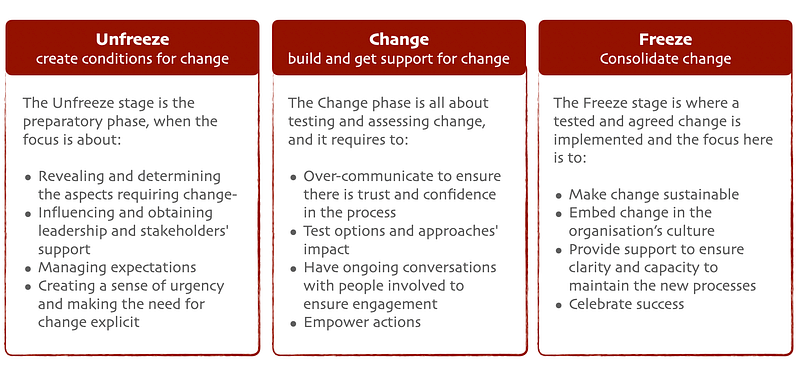
    Lewin’s model describes change as a three stage process, made by the following steps:

    Lewin’s three steps model on Change Management

    Lewin’s model shows the three critical steps and actions required to manage transformative projects and to ensure change is embedded in the organisation and the culture and delivers benefits on the long term.

    DesignOps meets Change Management

    If DesignOps delivers transformational projects to improve the ways teams engage, operate, spend, and work, then DesignOps does need a strong change management approach. 
    This why combining Design Thinking with a change management approach is introduces some minor, yet key, modifications to the classic double diamond model:

    The combination of Lewis’ change model and the double diamond shows 2 key differences: an additional stage to ensure adoption is collectively agreed, and an iteration that is related to teams’ acceptance and not on measurable results.

    The graphic above shows the double diamond framework with a tweak at the end and it combines Design Thinking with Lewin’s 3 stages of change. 
    Lewin’s 3 phases can be aligned with the double diamond model, but being Design Thinking for DesignOps, there are some changes that need to happen to ensure Design Thinking meets change management in a participative way.

    In fact the Unfreeze phase corresponds to Design Thinking’s initial problem setting and empathy driven approach to define the user problem and identify opportunities. This is when issues are revealed and by making problems explicit the process creates awareness and enables the need for change.

    The Hypothesis and Experimentation phase, when the focus is on the solution and the actions is when Change happens and needs to be driven through influencing and engagement strategies to test and experiment changes. This phase is where action happens and where the planning and design of the transformation happens — a transformation that requires engagement, over-communication, and team empowerment.

    The final step, the Freeze stage is where impact is measured and decisions are made. This is where the classic double diamond has a tweak and shows an extra half diamond to ensure the decision is made collectively and change is made sustainable and attainable through trainings and support.

    In a participative approach to change management, compared to the classic Design Thinking model, there are 2 opportunities for iteration based on results and feedback, the second of which is strictly connected with the decision to Freeze.
    If the experiment does not provide objective satisfactory results, the experiment needs to be redesigned and the process needs to look again at the solution ideation phase. This is the Design Thinking loop, where experiments provide measurable results to decide if the solution is worth progressing.

    In a participative approach though, even if the objective results achieved and even if the experiments deliver satisfactory results, if the leaders, teams, stakeholders do not accept to adopt the change in the Decide/Adoption stage, the change is not implemented (frozen) and another iteration of the experiment is required until all those involved in the change agree to adopt the transformation.

    For change to be implemented, transformational initiatives need to achieve both positive objective impact and teams’ acceptance. Without acceptance, no change can succeed on the long term.

    Bringing participation at the heard of DesignOps’ transformations

    For the reason stated above about acceptance, the biggest addition to the classic double diamond is in the highlighted focus on participative elements, formalised in the LISTEN and SHARE activities: ongoing two-ways conversations with design leaders, designers, and cross-functional partners are necessary to ensure DesignOps operates in a transparent and participative manner and all feedbacks and concerns are taken into account in a timely and open way.

    The combination of Design Thinking and change management makes DesignOps a participative user centred transformational approach. By putting the users, the designers and stakeholders, at the centre of the process and by ensuring that all involved are engaged and part of the decisions is key to deliver long lasting benefits and value.

    A case study

    Change requires and takes time, so while the graphic looks straightforward, transformational processes require time and patience. The following example described high-level actions and the rationale of an ongoing experiment.

    Step 1: Unfreeze and understand the problem
    A survey and interviews were run with the teams to understand their biggest pains and what could improve their experience as designers. 
    It emerged that one of the top asks was to learn more: more trainings, more opportunities to be inspired from experts outside the organisaton.

    Step 2: Share and create the need for change
    Learnings form the surveys and interviews were shared with both teams and leaders. Sharing with leaders meant sharing the findings, the analysis, and also providing full transparency and access to the raw data. To establish trust and build the future engagement it is important to act with a full open and transparent policy and provide access to any working material. The ask for raw data generally helps leaders to better understand their teams and it is a way to maximise the impact of any data collection effort.

    Sharing with teams is key to ensure they trust the process and they see the impact and value of their feedback. Designers need to acknowledge that they influence and determine their own ways of working: sharing with the teams is a way to empower and engage everyone.

    Participative and ongoing sharing is a win-win strategy: nothing creates the urge and need for change more than realising that an individual pain is actually a collective shared one.

    Step 3: Change! Making hypotheses and designing experiments.
    After learnings have been shared and discussed, DesignOps needs to do its magic and turn a problem into an opportunity by defining what success looks like and creating hypothesis and experiments.

    How may we foster a learning culture and bring more training opportunities to scale up designers’ skills?

    Again, every solution, idea, option was shared openly: stakeholders needed to commit and agree on the solution, teams had to understand what was happening, and most importantly, why and how they started this transformative initiative with their feedbacks.

    Step 4: Share and learn from comments!
    The planning approach to define what would become a 6 months’ Academy looked at all aspects: trainers and speakers, times that would work for all, time zones coordination, calendar synchronisation… The participative approach consolidated the first experiment: every week, for 6 months, designers would be invited to 60/90 minutes sessions with external subject matter experts.

    Step 5: Testing and measuring
    To be able to test impact, it was necessary to clearly identify which behaviours and parameters the experiment needed to affect. What would success look like for an educational experiment? Designers were invited to complete another survey to assess confidence in key areas the Academy would address. These data created the baseline to assess impact and change in an objective way.

    Step 6: Shall we Freeze? Evaluate and Decide. 
    After 6 months, it was time to collect structured feedback. Teams and leaders were shared comments on an ongoing informal base and it became clear after 3/4 months that there was need to improve some aspects of the experiment. But which aspects were relevant to leaders and which were key for designers?

    Another survey measured the impact on designers’ skills and explored the overall experience to decide if the experiment was the right change and if it was ready to be consolidated or if we had to go back (more on this experiment, here).

    Although the objective impact and the lift in confidence was satisfactory, the feedback from the teams and leaders were against accepting this as a permanent change. This has meant exploiting the elements that have delivered the lift in the objective impact and improving the experiential aspects that made the majority of those involved refuse to adopt the change.

    Everything has been constantly up for reviews and conversations making this a fully Bottom-up transformational initiative, where the initial input was originated by teams and the final validation came from them again.

    Lesson Learnt

    DesignOps is not a top-down approach: delivering transformation requires an approach that is participative in nature, user centred, and inclusive, where everyone’s voice is heard and addressed to ensure transformation is owned by all who are involved.

    Success in DesignOps is never immediate as transformational initiatives may require objective results to be fully aligned with user acceptance and adoption.

    Operational transformations need to be designed and driven with a clear view and an approach that combines seamlessly both the power of Design Thinking and the transformative impact of participative change management.

    The UX Collective donates US$1 for each article published on our platform. This story contributed to Bay Area Black Designers: a professional development community for Black people who are digital designers and researchers in the San Francisco Bay Area. By joining together in community, members share inspiration, connection, peer mentorship, professional development, resources, feedback, support, and resilience. Silence against systemic racism is not an option. Build the design community you believe in.
  • Why we need design leaders, designops leaders, DPMs, and design managers

    What is the relationship between DesignOps and Design? Is a DesignOps Manager the same as a Design Programme Manager (DPM)? Understanding the roles and responsibilities of each of these roles is key to ensure Design teams thrive.

    While Design teams have been growing and scaling fast in the past few years, the growth of the design teams has also seen an increase in the number of design-related roles and growth in the number of operational models applied to run the Design function (NN/g 2021).

    In this complex and fragmented scenario, it can be confusing to implement the right structures and processes: the speed at which design teams are growing requires clarity over the needs, the priorities, and the skillsets. Developing a design infrastructure and functioning ecosystem that integrates people, processes, and tools to deliver strategic and tactical value while supporting both the design teams and the business is one of the new key challenges in Design.

    It is important that the teams evolve by design, through a clear vision supported by skills and executive capacity to ensure that Design teams scale and grow without compromising quality, culture, and production.

    Evolving design teams

    Design has been going through a specialisation from its early days, when a webmaster was ruling the web, to today, where design has achieved a high level of specialisation and a project requires a number of complementary skills to be executed. This fragmentation and specialisation has hugely increased the quality of the output, but it has also increased the complexity of a design project and it has brought to surface the need to orchestrate design initiatives on different levels.

    The growth in demand and expectations from the customers has driven an exponential increase in the complexity required to pull together a successful design project and today’s organisations require a growing number of skillsets to be able to deliver quality at speed and to serve equally the business and the customers.

    And this increasing complexity has led in recent years to a growing number of key roles that support — orchestrate — design teams to execute the work: the Design Lead, the DesignOps Lead, the Design Manager, and the Design Programme Manager (DPM). They may sound all similar titles and they are often mistaken and confused, but that confusion can be a costly error as the consequences for design teams and initiatives may be significant.

    These 4 roles operate at different altitudes and with a specific focus that needs to be fully acknowledged to ensure design teams are run and led effectively and efficiently and that each of these 4 roles is set up to succeed and to amplify teams’ capacity to generate value.

    There are two dimensions that help understanding and defining the design roles: the altitude (strategic vs tactical) and the focus (the product vs the process). By combining these four dimensions it is possible to clearly articulate and understand the role that the Design Lead, the DesignOps Lead, the Design Manager, and the DPM play within growing design teams.

    Plotting Design and DesignOps leaders on 2 dimensions to define the remit and responsibilities of Design Leaders, DesignOps leads, Design Managers, and Design Programme Managers. © P. Bertini 2021
    DesignOps and Design roles and remits. © P. Bertini 2021

    Asking the right questions

    One way to understand the difference between these roles is their focus: what are the priority and the biggest expectation for the role? 
    Is the function focused on delivering products/services for the end-user (external-facing) or is it about delivering inner-facing transformations to improve design processes and operational and spending efficiencies?

    Is this leader focusing on the processes (the How) or on delivering the product strategy (the What)? Is this leader expected to drive internal transformational initiatives or to deliver services and processes to the market?

    And what does success look like? What are the metrics that define success and how are achievements measured and evaluated?

    All the above are valid for the managers too, but a key additional question on their role includes the expectation to manage teams or just processes? Which are the focus of managers’ execution efforts?

    Understanding the roles by focus: the product vs the process focus

    The figure above shows how DesignOps is an inward-looking strategic function focused on delivering broader cross-functional initiatives and strategies to increment spending and operational efficiencies and to increase teams’ efficiency and efficacy.

    This is a transformational function as DesignOps delivers initiatives that change how the design teams and the business operate to maximise return of investment and to support the growth and impact of design.
    For this reason, solid expertise in change management is essential to drive a successful DesignOps practice.

    DesignOps’ success is measured and quantified with clear KPIs that assess both Operational Efficiency, the ability to optimise resources utilisation and increase ROI, and Operational Efficacy (the ability to drive behaviours that deliver increased value(see more here).

    Operational Efficiency looks at how resources (money, time, people, tools, processes) are being employed to generate value to the organisation and the team includes metrics such as:
    – Tools’ engagement and utilisation 
    – Rapid testing lead time
    – Team productivity
    – Delivery time
    – ROI

    Operational Efficacy measures inner qualities of the teams and it assesses behaviours that have a direct impact on Operational Efficiencies such as:
    – User/ customer engagement
    – Experimentation cycle times
    – Teams’ skills and skills’ distribution
    – Employee satisfaction and retention

    On the other hand, the Design Lead is a product/service-focused function that is expected to deliver for the end-user and who is responsible to clearly define the segments, strategies, and vision to deliver compelling experiences. This is a strategic role that owns the vision of the product: the Design Lead needs to craft a roadmap and engage with the partners to ensure it gets executed to ensure all market and user needs and expectations are met. This is why for a design leader it is essential to have influencing skills to ensure the product vision is fully supported by all stakeholders and it is delivered according to the expectations.

    As an externally and product/service-focused function, for a Design Lead success is measured through a set of metrics that is related to the product experience and which is defined mostly by market and end users’ responses and feedback. Typical KPIs influenced and determined by the Design Lead include:
    – NPS
    – PRS
    – Engagement with a function
    – Completion task (Rate)
    – Retention
    – Conversion rate

    Tactical vs Strategic focus

    Similarly, at a manager role, DPMs and Design Managers operate with the same goals as their leaders but with a focus on the execution of single initiatives.

    The Design Manager is to the Design Leader as the Design Programme Manager us to the DesignOps Leader.

    DPMs and Design Managers are tactical roles that support the leads and ensure the execution of the vision and the strategy is done in the most effective and seamless way.
    Design leaders needs to be able to rely and work with their managers to ensure that while the leaders get the buy in from the business and keep constantly under review that the strategy is valid to ensure maximum impact and return, managers can focus on the seamless delivery of the initiatives they have been tasked with.

    Project and program management roles have been a growing necessity in the design industry in the past few years (Invision 2018), and while a Design Manager needs a solid background and hands on experience designing and executing design projects, a DPM may not need to have the same in-depth familiarity with the design execution. 
    Nevertheless, DPMs need to be fully accustomed with all aspects of the design process, including cross-functional engagement models, and governance.

    Both the DPM and Design Manager must understand and be familiar with the E2E design process, but while the DPM focuses on improving targeted aspects of the design process to empower designers, the Design Manager will ensure designers deliver the experience and execute the work.
    And while DPMs may be detached from the product and service to be delivered by Design teams, Design Manager needs to have an in depth expertise of the experience to be executed by the teams to be able to effectively drive the implementation.

    This is why while a Design Manager includes team and people management, the same is not always true for DPMs.

    Design Managers and DPMs are custodian of the success of the vision and their responsibilities in ensuring a successful implementation relies on their ability to plan and assess risks, and in their ability to define contingency plans to ensure projects deliver the expected business results.

    The Managers’ metrics are execution-related indicators and the measure of Managers’ success depends on the successful execution of the plan and projects they are driving. Their metrics are very similar and are related to project execution, including:
    – Milestone completed
    – Schedule Variance
    – On-time completion rate
    – Planned hours/actual time ratio

    Ultimately, DPMs and Design Managers are not admin roles and their main focus is not resourcing or booking meetings, but they are critical functions that enable efficiencies, visions, and roadmaps to come to live and deliver value to the customers, the users, the designers, and the business.

    Final Remarks

    When an organisation decides to scale their Design organisation and support the growth and development of their design infrastructure, it is essential that decision-makers acknowledge these differences in scope, altitude, and remits to identify the skills that can better support the teams to scale and grow.

    The UX Collective donates US$1 for each article published on our platform. This story contributed to Bay Area Black Designers: a professional development community for Black people who are digital designers and researchers in the San Francisco Bay Area. By joining together in community, members share inspiration, connection, peer mentorship, professional development, resources, feedback, support, and resilience. Silence against systemic racism is not an option. Build the design community you believe in.
  • From T-shaped to π-shaped designer

    The role of designers is changing and new approaches are needed to foster a mindset that can support them to become more impact-focused and a key strategic partner. How can DesignOps help driving Designers’ transformation to maximise results and influence?

    A T-Shaped designer had great skills and a focus on execution and delivery. But a π-shaped designer i data driven and focused on impact and collaborative conversations that can drive maximum results.

    Design has gone a long way in the past 10 years thanks to the rise and impact of Design Thinking and to the impact design has had on businesses. There are a number of studies reporting how companies with Design teams have higher profits, such as McKinsey 2018, John Maeda’s Design in Tech Reports, The Forrester Report 2020.

    Yet, many design leaders still complain about the role and positioning of Design within their organisation, claiming that their team is unable to influence conversations and that Design is still expected to execute briefs and deliver pixel-perfect prototypes or designs. But that is only one side of the story, because it is also important to learn what is the experience that engineers, product managers, and marketing teams are having with the design teams to answer the question Are design teams really misunderstood or are they missing an opportunity?

    To answer this question, both the shape of the design teams and designers’ skills matter and influence the positioning of Design.

    We have seen a growth in the so-called T-shaped designers: technically impeccable designers capable of perfectly execute any brief and delivering on time. These are greatly talented and highly skilled professionals, but to fully empower Design to reach the strategic positioning it deserves, they need to learn to collaborate on new grounds and with enhanced approaches with their cross-functional partners to ensure designers are not executing briefs but influencing decisions.

    It is DesignOps’ role to own this issue and to define the strategic approach to understand the root causes of this situation. And this required a deep understanding of what was the current experience that design partners were having with designers. A survey and 1:1 interviews revealed that there were a certain number of recurrent issues that cross-functional partners were experiencing with the design teams, but two were the key issues that were having the biggest impact: designers’ limited decision-making capacity and the design team’s overall reactive attitude.

    Why that? Why these aspects were important and where were these issues coming from?

    From Design Thinking to Data thinking

    Design Thinking has made empathy and user obsession one of the signatures of how design teams operate. Yet Design Thinking’s overall qualitative approach that investigates unmet needs has not been fully expanded towards a stronger formalised data-driven quantitative approach to measure users behaviours and impact.

    In the era of the quantified self, it’s also time to start thinking and embracing the era of the quantified user, and to do so designers need to evolve their approach to new dimensions.

    If Design is about nudging users to adopt better ways to achieve their goals, if it is about creating delight and meaningful experiences, measuring behaviours and quantifying the impact of the experiences that are being delivered is the single most important element to ensure design thinking has the impact it promises in its empathy-led approach. This becomes important because if cross-functional partners are using metrics and KPIs to assess performance and impact, it is hard for designers to compete on the same level when they focus mostly on stories and empathy with no solid data-driven approaches.

    Empathy and narratives are essential to influence, but decisions today are made with data.

    T-shaped designers in our teams were not fully relying on analytics: when in an internal survey and follow up interviews designers were asked about the tools and data points they were using to make decisions, the vast majority admitted not only that they felt they did not know much about analytics, but they were not sure about the tools and resources that were available to them. 
    And although the organisation had 3+ analytics tools available to all in an effort to democratise data, yet many designers felt that analytics was “the analytics guys’ stuff”.

    But having to rely on the analytics’ guys to get behavioural data, also meant that when a designer wanted to check on the performance of an in product feature, these queries had very low priority for the analytics teams, meaning that the data may take days or even weeks to arrive. And of course, these low added value asks from the design teams were not helping the relationship between Design and Analytics.

    This demonstrates the need to rethink designers’ mindset and move from a T-shaped to a π-shaped approach to Design. π-shaped designers combine Design Thinking with a solid data driven approach: they use data to make informed decision and to quantify changes in users’ behaviours. π-shaped designers drive conversations and visions with their cross-functional partners thanks to the shared focus on impact and the ability to use analytics as a common language: in this new approach, data complements and strengthens designers’ deep understanding of the users’ pain-points and supports their capacity to be part of the decisions and to be proactive in identifying impactful opportunities.

    What if we nurture a data-informed mindset?

    These considerations led to an experiment: can we foster, and measure designers’ mindset?

    This type of overarching strategic initiatives fall within DesignOps’ strategic remit. Fostering a data driven mentality, requires an ongoing commitment, time, and support from the leadership and the teams and it needs a combination of both the technical training on existing platforms and ongoing exposure to best practices and case studies.

    DesignOps partnered with the analytics platform suppliers by sharing the concerns, analysing the expertise gaps, discussing the opportunities, and defining a learning plan to increase teams’ understanding of the platforms.
    On the other side, a number of Subject Matter Experts have been invited to share case studies, best practices, examples on how analytics and data can be used in Design and innovation.

    This soon become a 6 months’ initiative: both the technical training on tools and mindset shaping initiatives were needed to ensure designers started asking the right questions and touse tools to answer those questions. 
    Data driven is a mindset that is supported by tools and platforms. The agreed commitment with design leaders and teams was to attend 90 minutes’ sessions 3 times a month. Basically a total of 4.5 hours a month with a weekly commitment.

    The results after 6 months

    Assessing the impact of how training initiative impact teams’ development of a more data informed mindset requires… data!

    For this reason, ahead of the sessions, all designers were asked to fill a skill matrix assessment to understand teams’ strengths and opportunities and to assess the level of confidence in data and in analytics platforms and tools. We also collected analytics data to understand the current engagement and utilisation of the existing data platforms to answer a key question: how much and how often were designers engaging with analytics tools?

    It was important to both understand self-perception and to triangulate that with behaviours to get a full picture of the initial situation and to quantify actions and attitudes.

    All these data point, the behavioural analytics and the skill matrix, were the baseline. 6 months and 30 hours trainings later, designers were asked to fill the same matrix and new data were collected from the platforms to understand if there were any changes in designers’ behaviours.

    Yes, the needle was moving and it was moving in the right direction!

    Designers were asked to rate their confidence in the domains touched by the trainings, and while confidence in data and analytics increased up to 12% with an average increase of 8%, the confidence in using analytics tools and platforms increased by up to 29%!

    Behavioural data from platforms’ analytics confirmed these self-assessments, with an increased engagement that overcome all initial hypothesis: in 6 months there was a 70% uplift in the number of data and analytics projects launched by designers, an 1,800% increase in designers’ queries to the platforms, and a +170% increase in overall engagement with all analytics tools.

    Can we foster and nurture a data-driven mindset?

    Yes, we can. But it takes time: these results are just a starting point: maintaining momentum, ensuring new acquired behaviours become habits, strengthening confidence, and establishing the habit to think and to make decision with data is a mindset that needs to be exercised constantly, like a muscle.

    These initial results can be quickly nullified by the wrong initiatives and it is now key to rethink and to learn from these 6 months to identify opportunities to consolidate the learnings and nurture the mindset.

    Because one positive result is not a victory, it is the beginning of more targeted and efficient actions to increase designers’ engagement and excitement for data and to ensure we foster the π-shaped mentality that can allow Design to move into the strategic and influencing space it deserves.

    The UX Collective donates US$1 for each article published on our platform. This story contributed to Bay Area Black Designers: a professional development community for Black people who are digital designers and researchers in the San Francisco Bay Area. By joining together in community, members share inspiration, connection, peer mentorship, professional development, resources, feedback, support, and resilience. Silence against systemic racism is not an option. Build the design community you believe in.
  • DesignOps’ impact on innovation

    Organisations have always faced a challenge in balancing productivity and creativity due to organisations’ constraints and priorities. But the right DesignOps strategy can deliver innovation at scale and achieve a true Organisational Ambidexterity.

    Hands and a clock. Because DesignOps enabled organisational ambidexterity by streamlining processes and improving time utilisation.
    Credits: https://www.pexels.com/@diimejii

    DesignOps’ goal is to maximise value generation for both the business, the design teams, and the design leaders through the creation of efficiencies and the optimisation of end-to-end design processes. If its goals were important in the pre-pandemic world, the pandemic has hugely increased organisations’ need for flexibility and agility to effectively cope with the new WFH (Woking From Home) situation.

    The sudden disruption in teams’ operations and ways of working have been a major challenge for most organisations, with the exception of those companies which implemented a successful DesignOps function before the pandemic hit: organisations with mature and ready DesignOps teams have been able to adapt faster and better to the new ways of working, minimising disruption and ensuring continuity even through the pandemic.

    Yet the value of DesignOps is way more significant than supporting organisations’ productivity during exceptional times: DesignOps is a transformational discipline that can and has a major impact on organisations’ capacity to deliver innovation.

    DesignOps and the balance between productivity and creativity

    If properly implemented, with a solid performance driven approach, DesignOps can have a strong transformative impact, even more so in times of uncertainty and change. In the past decades there has been a growing attention on organisations’ behaviours that enable or hinder business’ capacity to overcome competition and exceed in innovation and customer satisfaction.

    Organisations have shown a dual and ambiguous attitude when it comes to define a strategy that balances the investment in innovation with execution of ordinary business as usual- type of tasks. A large amount of companies struggle to fully combine the tension between productivity at scale and innovation: many companies are still looking for the best operational model that enables them to effectively combine innovation focused efforts, also known as explorative aspirations, with their exploitation needs, focused at utilising the existing competitive advantages and ensure the business keeps running.

    An ideal state would see organisations being able to perfectly combine productivity with speed and creativity: ensure innovation and execution of the ordinary tasks is balanced to maximise business revenues and profits.

    DesignOps plays a key role when it comes to balancing and taking advantage of both exploitative and explorative approaches and this area has not been fully investigated.

    Explorative and Exploitative efforts: balancing the business as usual with innovation

    Exploitation can be defined as the organisational practice focusing on taking advantage of existing concepts, services, and products to impact operational productivity and to maximise returns. Exploitation is considered a safer strategy as it reduces investments in innovation while allowing the organisation to exploit existing ideas, scale, and maximise productivity. But the competitive advantage is eroded over time, and this is why an exploitative approach is not sustainable on the long term and it requires to be counterbalanced by explorative engagement to generate new concepts and new competitive advantages.

    Exploration is a riskier approach that emerges from experiments and it is focused on delivering ground-breaking and disruptive innovation. These two organisational attitudes are equally necessary for organisations to thrive, yet many businesses failed to fully implement efficient end to end processes that could empower this balance, also called Organisational Ambidexterity.

    Ambidexterity has been defined by Tushman and O’Reilly (the original researchers that came up with the concept) as the The ability to simultaneously pursue both incremental and discontinuous innovation to generate value through both explorative and revolutionary, and exploitative / evolutionary innovations and change.

    The tension between operational excellence (exploitation) and innovation (exploration) is one of Design’s key dichotomies, yet exploitation and exploration should be both part of the same design process and solving for one will necessarily impact the other.

    By reducing the time designers spend performing routine tasks through better E2E processes and ways of working, DesignOps enables design teams to invest in innovative initiatives and use their time for higher added value explorations.

    By streamlining the exploitative processes with templates, an integrated tools’ ecosystem, unified processes that empower designers to execute ordinary tasks without delays, DesignOps generates the conditions to invest more resources in the explorative phase.

    By streamlining productivity and scaling the capacity to deliver business as usual and repetitive tasks, DesignOps enables and opens up new opportunities to develop creativity and foster innovation.

    How DesignOps’ generated efficiencies can impact and push Innovation

    A properly laid out explorative process, with unified steps and generative methods will allow the organisation to gather better insights and to be able to identify new user problems that can lead to the definition of new competitive advantage.

    DesignOps empowers ambidexterity by simultaneously streamlining both the explorative and exploitative processes so that designers can work at speed in a rapid iterative environment where exploitation serves exploration and vice versa.

    This is where DesignOps becomes the key function in an organisation driving a new competitive advantage through the ability to optimise Design’s E2E processes to enable explorative and innovation-focused practices by taking into account operational and business needs (AD Little, 2018).
    DesignOps main remit is therefore to create the optimal conditions for ambidexterity and to support the organisation to manage ambiguity and uncertain times by balancing competing factors such internal tensions, business goals, and operational performances.

    By enabling ambidexterity DesignOps has a direct impact on business performances and key metrics, affecting revenue and growth through a more efficient utilisation of resources enabled by the combined analysis of design processes and business targets.

    That altitude is a new altitude that businesses have not fully implemented: yet if a single DesignOps initiative can save the equivalent of 4 full time employees (see here), it means that DesignOps can generate the condition to invest in innovation with no (or limited) cost for the organisation by simply eliminating endemic inefficiencies in the design operations.

    Because by streamlining processes and reducing inefficiencies in the ordinary, lower added value and most frequently performed tasks, DesignOps multiplies the ability to maximise time and resources to be invested in initiative that can have a higher return of investment, like product and service innovation.

    This is how DesignOps can become the most impactful enabler for organisational ambidexterity and it can drive innovation at scale.

    The UX Collective donates US$1 for each article published on our platform. This story contributed to Bay Area Black Designers: a professional development community for Black people who are digital designers and researchers in the San Francisco Bay Area. By joining together in community, members share inspiration, connection, peer mentorship, professional development, resources, feedback, support, and resilience. Silence against systemic racism is not an option. Build the design community you believe in.
  • Designing efficient teams

    Positioning and introducing DesignOps in your teams’ lives.

    Less is more. This is what DesignOps does.
    Credits: https://www.pexels.com/@kaboompics

    Yes, DesignOps is a thing. And it is growing fast, establishing itself as an emerging function that actively supports teams and organisations to scale through the design of efficient Design teams.

    DesignOps’ focus is to increase operational and spending efficiencies by understanding, analysing, and optimising the E2E design processes to deliver value to the design teams, the design leaders, and the business.

    Value of course is different for each of these stakeholders and this is where strategic thinking and the ability to assess impact and weighting opportunities becomes essential.

    It’s known that knowledge workers may spend up to 60% of their time doing nondesign tasks just to fill the inefficiencies. This has a significant impact on both productivity and morale: a designer wants to do great design and having to execute mundane tasks that are needed to enable them to do their design is not a good way to maximise their impact and ensure quality.

    So if the value for a designer is efficiency, streamlined E2E processes, availability of tools that can support their work, adequate communication, an open and creative working environment, and a great culture, value is different for the design leaders. For them, the real value is the ability to deliver quality at speed, execute roadmaps and strategies efficiently, grow the team members, reduce churn, ensure teams are running smoothly, and increase the impact of design within the organisation to be able to scale up.

    On the other hand, the biggest value for the business is a combination of spending efficiency and increased quality of work with a clear impact on customer and business metrics: design has a huge role when it comes to NPS, CSAT, PRS, CES.

    DesignOps is constantly weighting and balancing the needs of design teams, design leads, and the business to define the top priorities in 7 main areas:
    ⁃ Teams
    ⁃ Tools
    ⁃ Budget
    ⁃ Workflows
    ⁃ Communication and culture
    ⁃ Data governance and research
    ⁃ E2E processes, including cross functional and cross geo engagement models.

    At a first sight, this list with DesignOps’ areas of responsibilities looks similar to those of design leads, and this is where tension and confusion arise regarding who are and why DesignOps are needed in an organisation.

    So, where does designOps stand?

    DesignOps’ unit of work are not individuals, but teams: while the design lead is in charge of the team members, DesignOps looks at the team as a whole to assess and understand how the team is performing as a unit.

    DesignOps focuses on team assessment to understand the strengths and opportunities of each team and to identify ways to support the growth of the teams and ensure all core skills are present.

    The team aspect is probably a critical one: it is not unusual that when a DesignOps is introduced in the organisation, design leaders get confused and tend to push DesignOps into a more programme manager’s role due to the limited clarity over the sphere of influence of each function.

    Although Design Programme Managers (DPMs) are essential, they are the executor and contributor of the strategy (see here).

    While DesignOps is a strategic role that defines mid and long term roadmaps and priorities with clear business KPIs to increase operational, performance, and spending efficiencies, DMPs are the executors that ensure that targets are met and strategies and actions are successfully rolled out.

    Getting started with DesignOps

    DesignOps’ focus is on creating efficiencies and efficiencies can only be created if there is a deep understanding of the overall E2E design processes and a clear identification of existing inefficiencies.

    For this reason, the very first step to implement designOps in the organisation is doing a thorough 360 degrees assessment of the state of the art that looks at: 
    What is happening in the teams?
    How are teams spending their time?
    How is the budget being spent?
    How are design teams interacting with the business? 
    How is the business interacting with Design and designers?
    Do teams have all they need to do their job in a positive and inspiring environment?

    A map the E2E process, informed by data collected through a mix of surveys and conversations is the single most important step to kick off any DesignOps programmes.

    These data, combined with a spending review, an analysis of the workflows and the tools’ analytics, provide invaluable insights to identify the biggest pain points and support the definition of a 12 months’ strategy to deliver the biggest impact for the business, the design leaders, and the teams.

    This assessment is a major and crucial effort when it comes to DesignOps: the annual evaluation dictates the actions and priorities that need to be taken to increase the quality of the work, the impact of design within the organisation, the teams’ performance and morale, and the spending efficiency.

    This assessment is critical and it is a key effort, requiring months of data collection and analysis, but it is this knowledge shared with the design leads that will create the synergies and the clarity to establish the relationships with key stakeholders and the positioning of DesignOps within the organisation. The assessment is essential to have meaningful conversations and establish solid collaboration with the stakeholders, who often lack the data and the insights that these assessments will provide.

    DesignOps is the function that supports organisations to have highly performing teams: because efficient design teams do not happen, they are designed, and this is the role of DesignOps.

    And this does not overlap with design leaders’ role, it complements it so that design directors can focus on the craft aspect, the individuals’ growth, the positioning of Design within the organisation, knowing that more operational aspects are being taken care of. This is where the partnership between DesignOps and design leaders becomes the opportunity to scale up teams and to elevate design to more strategic functions.

    And this is where the collaboration and constant alignment between DesignOps and design leads is crucial: all DesignOps roadmaps and initiatives need to be coordinated and managed with the team leaders to maximise impact and results and to join efforts to focus on the priorities that will deliver the biggest value to all.

    Because happy designers create awesome design which will make happy customers. And happy customers will ultimately make happy shareholders and business stakeholders.

    Generating this virtual cycle is DesignOps.

    The UX Collective donates US$1 for each article published on our platform. This story contributed to Bay Area Black Designers: a professional development community for Black people who are digital designers and researchers in the San Francisco Bay Area. By joining together in community, members share inspiration, connection, peer mentorship, professional development, resources, feedback, support, and resilience. Silence against systemic racism is not an option. Build the design community you believe in.
  • Understanding DesignOps as a strategic function — PART 2

    PART 2

    Part 2 of 2

    DesignOps relies on ongoing performance assessments to constantly evaluate what can be done better to impact positively the business metrics. Yes, DesignOps’ impact is quantifiable.

    Post-its with key words, such as finance, work, create.
    Credits: https://www.pexels.com/@nietjuh

    The application of a system thinking business mindset relies on DesignOps leaders ability to apply a solid analytical approach to quantify impact and inefficiencies and to focus on aspects that can bring more value to the organisation as a whole.

    To do so DesignOps has a very specific set of KPIs, that are unique to its domain and which complement the Chief Design Officer’s performance indicators.

    Design Leaders assesses the value of Design through metrics that take into account outward-looking variables, such as product and marketing dimensions. The metrics that the Design leader will consider typically include funnel related metrics, conversion and retention rates, CSAT, PRS, NPS, CES, and other engagement metrics.

    On the other hand, the DesignOps leader defines internal inward looking metrics focusing on the teams’ performances and behaviours. To do so, DesignOps focuses on operational dimensions to assess what impact are the design teams creating through the ways of working and the design process and execution.

    DesignOps metrics are defined by two main types of indicators: Operational Efficiency and Operational Efficacy.

    Operational Efficiency are metrics related to the ways processes are streamlined and bottlenecks have been removed, and they include KPIs such as:

    • Tools’ engagement and utilisation metrics
    • Rapid testing and prototyping lead time
    • Number and type of quality reviews
    • Team productivity
    • Delivery time
    • Cost and budget ROI

    Operational Efficiency focuses on how resources — time, money, people — are utilised and it defines the opportunities to maximise the organisations’ return of investment.

    Operational Efficacy focuses on soft metrics that assess inner qualities of the teams and the execution of a design thinking approach. These type of KPIs measures and weights behaviours that have a direct impact on operational efficiencies such as:

    • Empathy and the capacity to deliver on an ongoing user-centred engagement
    • Ideation and experimentation cycle times
    • Composition of teams’ skills and skills’ distribution
    • Perceived value of design teams by cross-functional partners
    • Employee satisfaction and retention

    Both Efficiency and Efficacy metrics deliver and impact spending and operational targets and these indicators are key to drive C-level conversation between DesignOps, Design, and cross functional partners to identify collaboration and operational opportunities. By applying a system thinking approach to the design operation, DesignOps delivers value and a strategic direction to maximise the impact of design thinking.

    How to apply Efficiency and Efficacy metrics to maximise business performances

    While internal inefficiencies are endemic in many organisations, inefficiencies in design can have a business impact that can erode the value and benefits that design brings to the business and have costly consequences for the organisation. This is why setting clear metrics that help understanding how design teams operate, how budget are spent, how teams are developed, becomes a strategic function to maximise efficiencies and the value of design. But how is DesignOps generating benefits and value?

    Increasing efficiency by understanding teams’ time utilisation

    When assessing inefficiencies it is important not only to understand what are the biggest operational issues, but to also understand how much those inefficiencies compromise the organisations’ operating values and how much inefficiencies impact culture and results.

    This is why when I looked to increase the efficiency and workflows of 60 designers distributed in 7 teams across the globe, I took into account not only the internal impact, but also the impact of those inefficiencies on the company’s values, because organisational values determine and influence behaviours.
    Therefore in design driven companies, design teams are expected to constantly engage and learn from users through research and rapid experiments.

    In 2018 the international teams I was managing, were facing a rapid growth and operational inefficiencies were causing long hours and impacting the overall workflow and production cycle. The design teams were struggling in sourcing research participants. 
     From an analysis I run, it emerged that on average a designer spent between 2 to 2.5 days to source, contact, schedule, and reward the 5/6 participants needed for every session. With 2 weeks’ sprints, it meant that designers were spending up to 5 working days a month sourcing participants. This revealed additional inefficiencies:

    • Designers were working long hours to make up for the time spend in non-design tasks, impacting designers’ life/work balance
    • In some markets, the cost to recruit participants could be as high as $360/participant due to agency overheads
    • The lead time was between 2.5 to 4 weeks
    • The need for speed caused the widespread of poor practices

    To solve for this problem, as DesignOps we implemented an internal participant sourcing service: this service would then act as an internal agency so that designers could efficiently outsource the recruitment needs of their job to a dedicated team. After a 12 months’ proof of concept, it has taken 10 months to roll out the service in all markets with a clear impact on operational and spending metrics:

    • The lead time decreased by 65%
    • The number of users involved in testing increased by 4 times
    • The spending for recruitment was reduced on average by 60%
    • The design teams saved 430 working days, equivalent to 2 FTEs, with a forecast to double this number for the second year.

    Increasing efficiencies through analytics and data

    One of the most common spending inefficiencies in design teams is represented by tools: organisations invest significant budget in different resources, often with no clear idea about the impact of these new tools for the end-to-end design process. Moreover, the relationship with vendors and suppliers is often transactional: design leaders have no time to focus on creating a mutually beneficial relationship and to define a tool rollout and implementation strategy with their third party suppliers.
     So, it is not uncommon that tools are rolled out with limited support and unclear expectations. And once the tool is implemented, the renewal is often automatic with no in depth analysis of analytics, engagement and utilisation metrics to assess the cost/benefit impact of the investment.

    It is then cleat that crossing data points, such as tools’ analytics, designers’ feedback, and by engaging with third party vendors is essential to determine the right strategy to optimise investments and improve operations. And this is exactly where DesignOps acts.

    An in-depth analysis of engagement and utilisation of tools in use in 2019, has produced significant impact on both the business and the operations, such as:

    • reducing by 60% the cost on unmoderated user testing platforms that were serving only English speaking markets by introducing new platforms that serve all 7 markets
    • Saving over 85% on cross-functional tools by assessing active licenses and utilisation to renegotiate the contracts
    • Identify tools with low engagement and collaborate with vendors and teams to create ad hoc trainings to embed the new tools in the existing workflows

    These results show how a deep understanding of the operation is key for efficiencies and to empower teams: but this level of efficiency can only be achieved through a strategic lens that looks at the business impact of design decisions to maximise ROI. And this is where Design and DesignOps leader partner to define the most effective and efficient operational models for their teams and their organisation.

    What’s next

    By linking Design with business and by focusing on bringing tangible benefits, organisations looking to maximise their investment in Design should start looking at DesignOps as a new strategic function working alongside the Design and the organisation’s leaders to reveal the inefficiencies that compromise growth and profit.

    Especially organisations that have large, distributed, or fast growing and expanding design teams can gain the biggest benefits from the introduction of DesignOps.

    The examples demonstrate DesignOps’ strategic function in connecting creative and user centred design processes with the need to create business value through optimised execution and streamlined processes.

    This is because of all functions within the organisations, DesignOps is the critical enabler for organisational ambidexterity.
     With its focus on processes, resources, teams, budget, and operational metrics, DesignOps delivers a major impact on the exploitative functions: the in depth analysis and understanding of all issues that undermine design teams’ capacity to deliver routine tasks is a critical mean that empowers design leaders to invest more on explorative opportunities.

    In the example mentioned earlier, the 430 working days that were gained through the introduction of new processes, can be re-invested by design teams in explorative initiatives, with each team gaining on average 60 working days. This creates additional value and can impact business performance and innovation capacity.

    By reducing the need to focus on operations, design leaders can concentrate on the execution and definition of the design and innovation strategy, knowing that all operational aspects are being taken care.

    And by increasing operational efficiencies and streamlining the end-to-end processes, DesignOps creates the conditions for ambidexterity and higher impact both on the organisations’ ability to deliver innovation and the teams’ capacity to grow and expand.

    Few functions have the same capacity to impact organisations at the same level and to support both innovation, customer driven innovation, business performances, and efficiencies as DesignOps.

    But this can only be achieved if DesignOps is positioned as a strategic role within the organisation, with a clear remit and vision, and with the support to execute the strategy.

    The UX Collective donates US$1 for each article published on our platform. This story contributed to Bay Area Black Designers: a professional development community for Black people who are digital designers and researchers in the San Francisco Bay Area. By joining together in community, members share inspiration, connection, peer mentorship, professional development, resources, feedback, support, and resilience. Silence against systemic racism is not an option. Build the design community you believe in.
  • Understanding DesignOps as a Strategic Function

    What is DesignOps and at which altitude should it be positioned to maximize impact? — Part 1 of 2

    Credits: https://www.pexels.com/@lanophotography

    What is DesignOps and where does it come from?

    Design has become a central function in most businesses: in the past 10 years, due to the emergence of design thinking and its impact on business performance, many organisations invested in design and have embedded design in the production cycle (McKinsey 2015).

    This new positioning of Design has led many organisations to acquire or invest in Design teams, and over time, these design units have become organisations within the organisation.

    As Design teams grow within organisations, both in terms of teams’ size and number of teams, the need of harmonising design workflows and coordinating efforts and processes has led to the demand for new competencies to help the organisation to manage the complexity of their Design resources.

    Despite the lack of a unified definition of who or what is needed to support organisations in maximising their investment in design, a growing number of companies are introducing a new function focused on increasing Design’s impact on business performance through improved Design’s operation: DesignOps.

    DesignOps is an internal focused function that applies a system thinking approach to understand how Design teams operate inside-out and outside-in to identify opportunities and create business benefits through improved spending and operational performances.

    Through the collaboration with both design and cross-functional leaders, DesignOps generates value through the understanding of design’s end-to-end processes and the definition of effective engagement models that support the execution and implementation of the Design strategy.

    DesignOps delivers impact by concentrating on Design teams as their unit of work and it focuses on creating the conditions to empower design teams to collaborate with the cross-functional partners.

    By overseeing the day-to-day and the end-to-end design process across the organisation, the DesignOps leader focuses on streamlining processes, building and maintaining a design community, harmonising ways of working across design and cross-functional teams while overseeing key operational aspects such as the budget, tools, and the relationship with external partners.

    In short, DesignOps analyses the teams’ workflows and the organisation’s needs to identify opportunities to maximise Design’s impact on business performances.

    In the past few months, the need to improve and redefine ways of working due the pandemic has suddenly amplified the hype on DesignOps, especially after some organisations have reported how DesignOps minimised disruption and made the transition to a Work from Home model efficient and seamless.

    This has caused a rapid increase in the demand for DesignOps professionals and leaders, yet the lack of clear tasks, expectations, and responsibilities, and an unclear positioning of these new figures is causing confusion and it is preventing DesignOps from delivering benefits and impact. Two are the main source of confusion: the altitude of the role, and the relationship between Design and DesignOps.

    DesignOps and Design Programme Managers

    The first issue with the introduction of DesignOps is related to its focus and altitude: following the new trend, some organisations have re-branded their design producers and project managers as DesignOps Managers or they simply considered DesignOps to be the same as the Design Programme Manager, or DPM. These roles are very different in their remit and responsibilities: DPMs and DesignOps work together, but they operate at different levels and failing to understand this could generate additional inefficiencies.

    This is because while DesignOps operates at a strategic level, the Design Programme Manager, as the name suggest, operate at a tactical one and the skills and competencies for the two roles are different.

    DesignOps defines a vision, KPIs, and result-driven roadmaps that focus on design processes through a business lens, while Design Programme Management works on the execution of the roadmap to ensure the vision is delivered and the expected impact is achieved. 
     
     Design Programme Managers’ typical tasks include facilitation and logistics, tools’ administration, project management and tracking, and coordination of trainings and workshops. A DPM executes decisions: DPMs operate at a tactical level and they are generally aligned to a specific squad or scrum team, meaning that DPMs are expected to be familiar with the product development.

    DesignOps leaders are strategic decision makers, they set a data informed vision for the Design operation, they define the tools’ ecosystem, they negotiate contracts and manage suppliers, they identify ways to grow the teams, they make engagement plans to increase cross-functional and cross-market collaboration, and they are accountable to identify gaps and opportunities to maximise spending returns.

    A DesignOps leader acts at a business strategy level by connecting and engaging with cross functional and cross market C-level leaders to streamline design practices across the whole organisation.

    Failing to recognise DesignOps’ function as a strategic executive functions and implementing only DPMs without an overarching strategy that leads to systematic and ongoing operational improvements is one of the most common misinterpretation of the role. It is indeed important to understand that designOps leaders are in fact designers who speak the business language who apply a business and analytical mindset to the creative process of design to amplify the impact of design on business performances. Design Programme Managers are the executive arm that ensures efficiencies are achieved on the ground.

    DesignOps and Design leaders: complementary to maximise business performance

    The second area of confusion is DesignOps’ relationship with Design leaders.
     One of the biggest challenges when introducing a DesignOps leader in an organisation is the definition of their role and responsibilities with the existing Design Leaders, who may feel confused or even threatened by the new function.

    DesignOps complements and expands Design leaders’ ability to maximise impact, and in fact DesignOps does not reduce Design leaders’ sphere of influence, but together they amplify Design’s impact and benefits for the whole organisation. For this reason it is essential that DesignOps and Design leaders partner to ensure the operational and design strategy are aligned and optimised.
     As a simplification, we can say that the relationship between the design leader, or Chef Design Officer (CDO) and DesignOps leader is similar to that of the CEO with the COO, to the point that we can suggest a title of Chief Design Operations Officer, the CDOO.

    A recent study from McKinsey (2020) has identified a set of tasks pertaining the Chief Design Officer and it provides a clear distinction of duties that CDOs are accountable for and those that they perform. The study divides the CDO’s impact in 3 main transformational areas:

    • the UX
    • the Organisation
    • The Team

    The CDO performs most aspects in the UX area, that include the definition of a portfolio or service strategy, customer segmentation, user identification, project metrics, product experience and product related metrics.

    But when it comes to transform the organisation, and even more so, the team, the CDO is not directly involved in the delivery of those aspects. The McKinsey study does not call out DesignOps as the leader responsible to execute and deliver on those aspects, but the areas that the CDO is accountable for are those performed by the DesignOps Leader.

    When it comes to the team’s transformation, the DesignOps Leader and the Design Leader split responsibilities, with the Design Leader focusing on improving the employee experience and the DesignOps Leader focusing on spreading design best practices across the organisation and representing design.

    But where the DesignOps leader thrives is the teams’ transformation: in this domain the DesignOps leader is directly responsible for all aspects, such as productivity management, budget, prioritisation, utilisation management, Quality assurance, KSA development, team satisfaction.

    These tasks are strategic tasks that the DesignOps lead can carry out through an executive level engagement to ensure all needs and competing values are taken into account to define engagement models and operational roadmaps that maximise investments and satisfaction across the organisation.

    Understanding the right positioning is therefore essential to implement DesignOps at the right altitude and to define the remit and expectations.

  • UX is strategy in action

    The UX practices and mindsets are evolving. It’s becoming clear that UX is not just about user validation, pixels, or wireframes. That’s the old paradigm. UX is much more. UX permeates the whole design process and the overall underlying strategy. Because UX is strategy in action.

    A little bit of history: do you remember when…?

    For many years UX has been dominated by the design/wireframe and testing paradigm, and this is not a surprise.

    Although stemming from HCI and UCD, the real turning point in the dissemination of a user centred culture was early 2000, when Jakob Nielsen and Donald Norman have highlighted and explained the importance of usability and good design.

    The initial reaction of the industry was to introduce user testing, heuristics, and guidelines to support designers developing products that were accessible, usable, and fairly simple. The delight and the pleasure of using the digital products were still not fully understood, as at that time, the main focus was onfunctionalities and delivering products that offered new digitalised services — e-banking, e-commerce, e-learning… Usability was the magic word, as all those new services needed to be sufficiently easy to use to attract early adopters.

    The competition was somehow limited, and the new services served the purpose to offer something new, innovative, answering an emergent need or exploiting a new opportunity. User testing was the perfect answer: asking the user to validate the concepts and UI was seen as a key step to make sure products and services were reasonably usable.

    But soon the emergent needs became habits, and the reasonable usable concepts became inadequate for the growing market. Technology also evolved fast — someone may still remember WAP sites on incredibly slow Edge phones, when accessing the site was already perceived as achievement.

    Now we live the times of the Always-on, and we can hardly imagine our lives without being constantly connected. And this caused the competition for the user to change quickly: more and more providers started offering similar and competing services on the new emerging digital platforms, and the user needs could be fulfilled by countless different offers from different providers.

    Answering users’ needs or exploiting a market opportunity soon was not enough anymore, and user testings and heuristics, despite remaining great tools, were not adequate to keep up with a fast paced competition to grab users’ attention, time, and loyalty.

    This is the same time when the experience economy paradigm was emerging, highlighting how users were not looking for services, but experiences: the shift from a service based economy, to an experience based economy has been subtle but key in determining how the UX industry evolved. And this new paradigm meant that good UI and IxD design and user validation and testing were not sufficient anymore, that a new way of engaging with the user and a new way of thinking and designing was needed.

    And then UX appeared: the user as the sole expert in their experiences, where designers, researchers, developers, and strategists operate together to understand the opportunities and develop complex experiences, rather than products. The new opportunities today are not meant to fill a need, but to satisfy the desire to feel engaged and delighted by the interaction with a service or product that is perceived by the user as valuable and meaningful.

    …And this is where we are…

    The UX industry is maturing and it is becoming clear that UX is an end-to-end process that ends with design and the delivery of products and services through iterative user testing phases, but it starts with explorative and generative research to define the strategy and what is valuable and meaningful for the users.

    The wider adoption of ethnography based methods and the increased attention to users mental models, behaviours, attitudes, and emotions before the design phase kicks off indicates that the UX practice is moving towards a more holistic and strategic dimension, embracing and including the user at its very core to deliver and generate value.

    Because it’s not anymore about the pure function, as in the old usability and user testing days, but it’s about the experience. It’s not about the what can be done, but it’s all about the how it feels.

    Strategists, researchers, designers, and developers are the professionals that can and should translate users’ mental models and expectations into experiences that empower the users and the brand, but the sole experts in their experience are always and only the users.

    UX is a strategic holistic approach, where the service or product is strategy in action. In a mature UX process, execution and design complement and embody the understanding of what users think, feel, expect, like, and value to generate value, meaning, and relationships.

  • UX Lessons from E.T.

    As UX professionals, we tend to consider our users as our key focus: we engage in research activities, try to understand their explicit and implicit needs, imagine how would they behave, interact, and react to our services and designs.

    I could not think of any personification of the perfect UX professional, until today. It’s Elliot, do you remember the kid in E.T. who befriends the strange extraterrestrial creature?

    Elliot’s attitude towards E.T. is a perfect Ux attitude of openness, lack of prejudice, genuine curiosity towards the users and their goals, absence of any agenda. Elliot engages so much with E.T. that at the end Elliot becomes E.T.’s toolto communicate and share its feeling with the world.

    At the end of the movie, when a scientist tries to understand the relationship between Elliot and E.T., Michael [Elliot’s brother] explains the special connection Elliot and E.T. have established:

    Michael: He [E.T.]’s smart. He communicates through Elliott.

    Scientist: Elliott thinks its thoughts.

    Michael: No, Elliott… Elliott feels his feelings.

    This is exactly what UXers should do: feel the users feelings and avoid thinking instead or in lieu of the user.

    E.T. from a UX point of view, is nothing more than a user: someone who has a goal in mind: he wants phone home. Elliot is his consultant and guide on planet Earth, helping him to interact in this dimension and to find the way to accomplish his goal.

    And Elliot succeed because he genuinely cares for E.T., because he thinks out of the box, because he finds like-minded people to help, because he does not apply old or established processes.

    When E.T. is captured by the scientists and MDs have to decide how to save E.T.’s life, they do not question who the patient is and they mechanically apply on E.T. all their sterile, tested, and approved protocols: procedures and practices that may work for human being, but they did not considered that E.T. is clearly not a human being.

    E.T. is saved and is able to go home because Elliot joins efforts with like minded people. In a great team effort, a bunch of teenagers saves E.T. and let him to gohome.

    When dealing with Users we should be more like Elliot: explore the new user, be their unbiased, sincere guide in the digital dimension, understand and put efforts and genuine curiosity in understanding who the users are, what are their goals, how do they feel, and avoid thinking instead of them — we should use our empathy to feel more like them and avoid protocols. The answer is just in being more Elliot.