Category: Design & DesignOps

Design, DesignOps and how design and R&D teams are run.

  • The end of the interface is the beginning of design

    The end of the interface is the beginning of design

    AI already builds interfaces without a designer pushing a single pixel. Soon, users will not even see the interfaces we design: their agents will. Design can burn out like a meteor, or go back to what it was always meant to be: solving problems.

    Design is changing. DesignOps is changing.
    Our role as humans is changing. Our brains are being rewired.

    Our ways of working are reinvented every day. Like modern-day Penelopes, we weave during the day, and at night the speed of technology unpicks our work. And we start again.

    We hang on to what we know, to our familiar ways of thinking and doing. We read books. We search for answers in the wisdom of the past, in what we learnt and in what we have been taught.

    We live, not rhetorically but factually, in unprecedented times.

    What we knew about the world has collapsed.
    For around 300,000 years, our species lived by hunting and gathering. Farming arrived about 12,000 years ago. The factory, about 250 years ago.

    Then the timeline collapsed. ARPANET sent its first message in 1969. The web reached the public in the early 1990s. Generative AI reached everyone’s desk in the 2020s. Today we talk about agents, and about recursive self-improvement: AI that helps build better AI. Since 2020, the computing power used to train frontier language models has grown about five times every year (Epoch AI).

    We have compressed into decades, and now into years, a change that once took millennia. The world as we know it is already an old model.

    And yet many of us still believe that a profession and a specialised education will save us. That they will grant us a social and economic position, as they did for centuries. This is one of the biggest mistakes professionals can make today. Closer to home, it is the mistake designers, DesignOps professionals and digital product workers are making right now.

    Design is going to be transformed in ways we are not preparing for.

    How did design lose its thinking?

    To understand where design is headed, we need to take a look back.

    In 2008, Tim Brown of IDEO brought design thinking to a business audience in Harvard Business Review, and a year later Roger Martin made its business case: design as the art of solving problems, centred on people and driven by experiments. Boutique agencies boomed, large corporations bought them, and John Maeda tracked the wave in his first Design in Tech Report in 2015. I was part of that wave myself.

    And this is how we moved from design thinking into design doing: the focus on outputs, pixels, layouts, expression. Shape more than substance.

    It did not happen overnight. In my view, design doing took hold in the late 2010s and early 2020s, when three things happened at the same time.

    • The tool became the studio. Figma launched in 2016, in the browser, built for teams, and within a few years design lived inside it. In 2022, Adobe agreed to buy it for $20 billion, a deal later abandoned under regulatory pressure. When one tool becomes the place where design happens, the work starts to look like … the tool.
    • Value got a number. In 2018, McKinsey’s The Business Value of Design found that the top design performers had 32 percentage points higher revenue growth than their peers over five years. The report argued for design as a leadership practice. Many organisations heard something simpler: more design, more growth. So they scaled what was easiest to count: the output.
    • Design joined the sprint. Designers moved into product squads and agile delivery. Design became a lane in the backlog, measured by tickets closed and screens shipped.

    Then came the correction. From 2022, waves of tech layoffs, and design teams were not spared. In November 2022, ChatGPT arrived. The craft we had spent a decade optimising for was about to become the cheapest thing in the room.
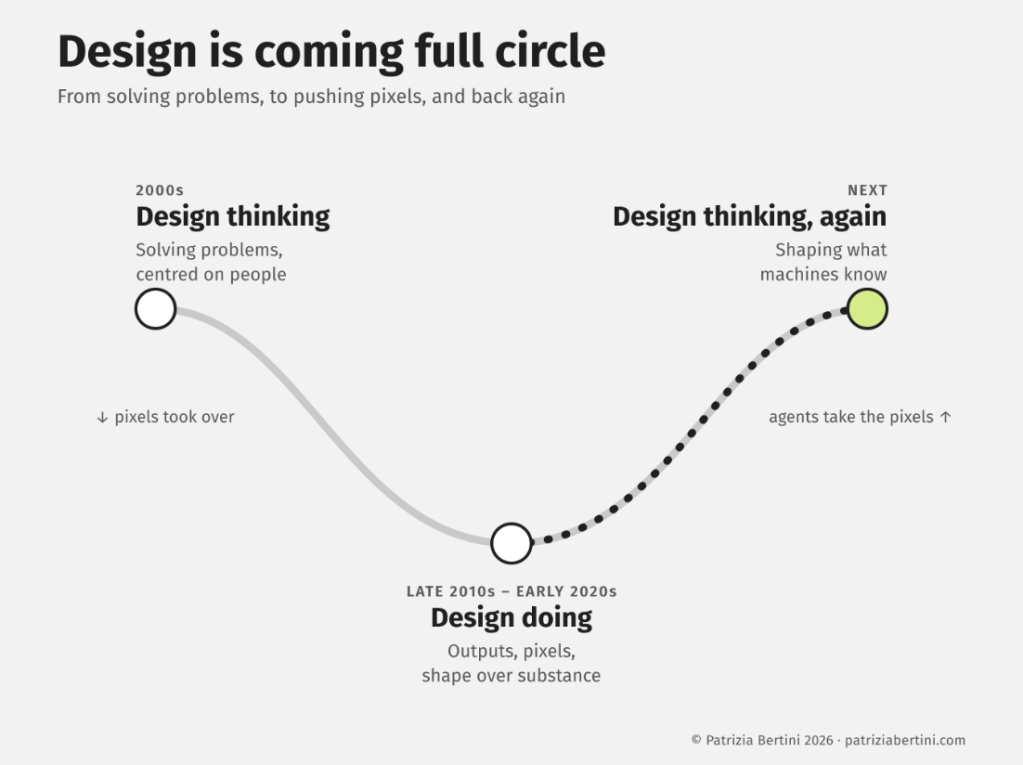
    A curve tracing design’s path. It starts high at design thinking in the 2000s (solving problems, centred on people), dips to design doing in the late 2010s to early 2020s (outputs, pixels, shape over substance), and rises again to design thinking, now about shaping what machines know.

    Meanwhile, delivery had grown complex. In the 1990s, a webmaster could build an HTML page alone. Today, a digital experience needs many moving parts: content writing, video editing, visual design, branding, user experience, front-end coding, content management systems, back ends, repositories, design systems. Design had moved from thinking to doing, so it needed an operational layer to enable and orchestrate all of it.
    This is where DesignOps entered the scene.

    But when the output seems so easy to replicate, design that has lost its thinking becomes a “pixel pusher.” And a “pixel pusher” allows non-designers to question the value of design: if product managers know the problem (once core to design thinking) and can do “pixels”, where does design stand?

    If someone learnt design for delivery, they may struggle to see the complexity and the beauty of design thinking. It had little to do with pixels and Figma. It was a mindset.

    Some of us (older) design thinkers, who learnt design from those early papers and experiments, can see the direction. I, for one, see it clearly.

    What did a stylesheet teach me twenty years ago?

    When I was working in accessibility in the early 2000s, one thing excited me more than anything else.

    A person with a visual impairment could simply override all the beautification of the UI with a simple stylesheet of their own. It forced the site to render the way they needed it: more contrast, larger fonts.

    It was limited, of course. But it was an option.

    The designer gave the content and its structure. The user decided the form. Hold on to that image, because it is coming back.

    What happens when nobody sees the interface?

    Fast forward to today. AI tools are building interfaces on demand, via prompts, with designers not pushing a single pixel. But the tools are not focusing on the problem as much as design did at the beginning.

    Meanwhile, design systems have organised our assets, components, patterns and libraries. The next step is an ontological layer, where each element carries meaning, relationships and intention. Simply put, an ontology is a map of what things are and how they relate to each other.

    In an ontology, a button stops being a blue rectangle. It becomes “the action that confirms a payment”, with rules about when it appears, for whom, and what it must never hide.

    Think of it as three steps in what designers define:

    • Pixels: how each screen looks.
    • Components: the reusable parts, and how they fit together.
    • Meaning: what each element is, what it relates to, and why it exists.
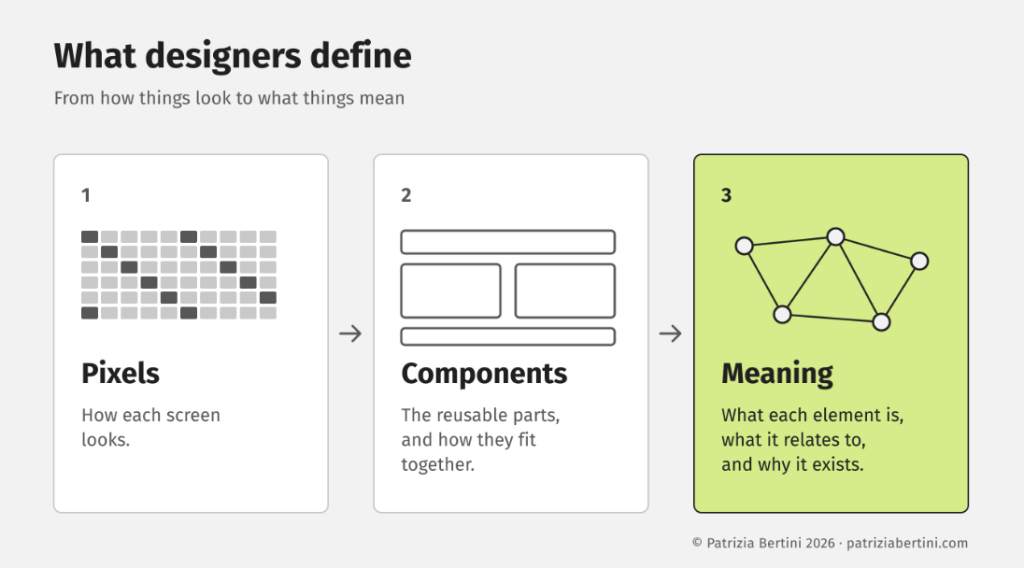
    Three cards showing what designers define. One, Pixels: how each screen looks. Two, Components: the reusable parts and how they fit together. Three, highlighted in lime, Meaning: what each element is, what it relates to and why it exists.

    At the same time, devices keep multiplying: phones, laptops, smartwatches, glasses. We access information through sound, images, visuals and text, in very different contexts.

    This is where the stylesheet comes back. In the same spirit as that user’s stylesheet, agentic assistants will use the layer of meaning to give each of us a personal, dynamic experience, based on incredibly detailed context: the device, the situation, our preferences, the specific need of the moment.
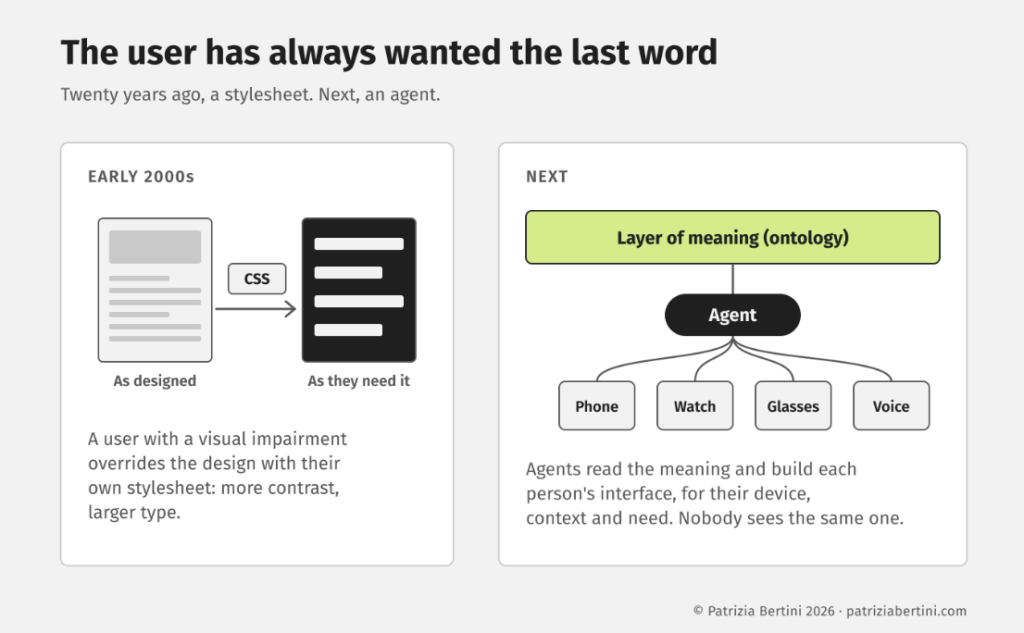
    Two panels. Early 2000s: a user with a visual impairment applies their own stylesheet and turns a web page into a high-contrast version. Next: a layer of meaning feeds an agent, which builds a different interface for a phone, a watch, glasses and voice.

    We won’t have any control over the interface. It may be conversational, graphical, agentic, or something we have no name for yet.

    What does this mean in practice? Users won’t necessarily see and experience what designers do and see. They will have agents doing the interface for them.

    John Maeda, whose reports once tracked design’s rise in tech, now says it himself. His 2026 Design in Tech Report is titled “From UX to AX”: from user experience to agentic experience. In his view, designers move from building screens to judging what AI produces.

    I would go one step deeper. Before we judge what machines make, we need to shape what machines know.

    Designers will not define interfaces. They will define relationships and variations, and work on ontologies and semantics, so experiences can be executed in the most fluid and personal way possible. Returning, again, to solving problems instead of focusing on pixels.
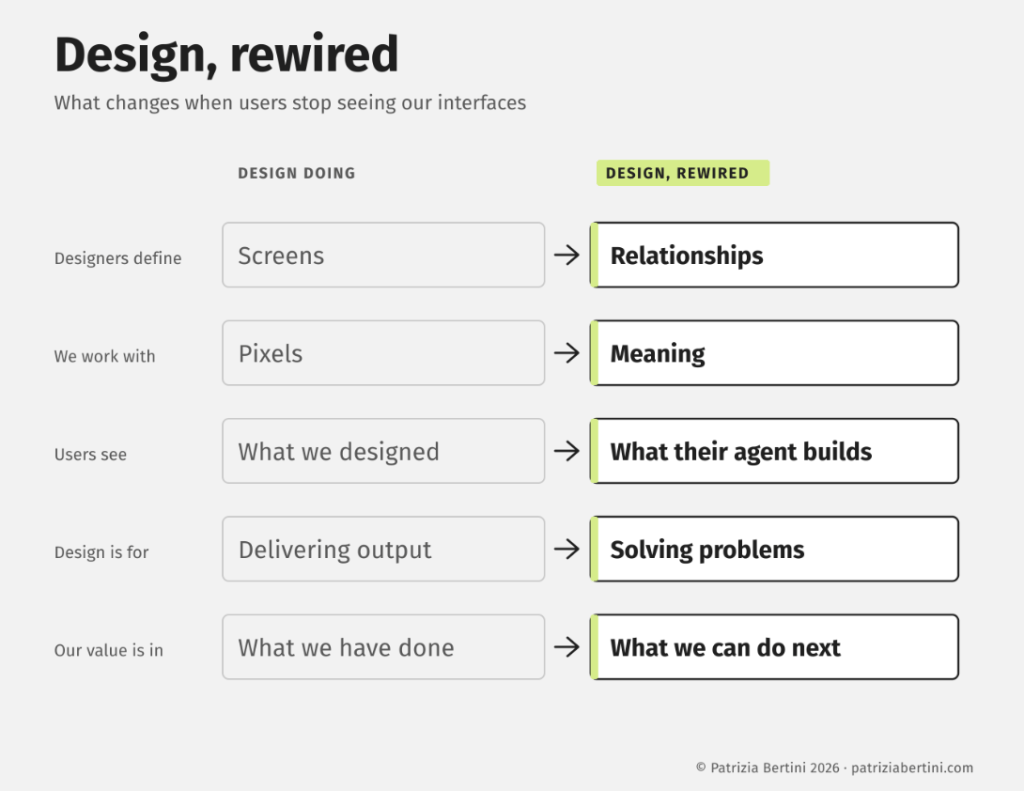
    Design, rewired: five shifts. What designers define moves from screens to relationships. What we work with, from pixels to meaning. What users see, from what we designed to what their agent builds. What design is for, from delivering output to solving problems. Where our value is, from what we have done to what we can do next.

    In one sentence: design is going to move into a space that is new and old at the same time. Its job is to define the information structures that will enable users to create their own experiences.

    What does this mean for DesignOps?

    While layoffs are growing, we are watching and wondering how to stay relevant. And we are not focusing on the direction of the change.

    At the frontier of AI, the work is moving from surface to structure. Yann LeCun left Meta to build world models: AI that learns how the world works, not only how words follow each other. World models are not ontologies, but they point the same way, and ontologies are design’s version of that step, as I see it. Meanwhile, many designers still talk about Figma and pixels, and ignore the direction.

    That, of course, impacts design operations. We have lost ground and traction because we look backwards and expect to solve problems that are fading away. We fail to be ahead of the curve, and to tell our partners, leaders and designers the hard truth: much of what we know may be outdated within months.

    And there is one more force pulling design back towards meaning, one that few designers have noticed yet: the law. That adds another layer of complexity and urgency and whoich is the subject of my next article.

    DesignOps can be a meteor: bright for a moment, then gone.

    Or we can embrace ambiguity and uncertainty, and use our design mindset, our process focus and our problem-solving skills to enable and empower this transformation.

    There is an incredible role to be played. But it requires acknowledging that what we have been doing cannot simply be scaled, or done better. The context around us has shifted so much.

    There is one detail of Penelope’s story we often forget. She was weaving a burial shroud, and she was the one who unpicked it every night. She did it by choice, to buy time, because she knew exactly what she was waiting for.

    We are not unpicking our own work. Technology does it for us, in an era where machines realise the product without any human hand on the loom. And the world we are waiting for, the one where a profession and a title kept us safe, is not coming home.

    Our value is not in what we have done in the past, but in what we can do today and tomorrow, which is radically different and extremely necessary.

    Penelope knew what she was waiting for.

    Do we?


    Author’s Note: The ideas, the research and the arguments in this piece are human — mine. I used AI to help shape the form and structure, then went through every line myself. The images are AI-generated.

    I help design, product and engineering teams rethink how they work as AI and regulation reshape it. If your team is facing this shift, let’s talk.
  • Human-Centred Design has grown up. It’s time we did too.

    Human-Centred Design has grown up. It’s time we did too.

    Human-Centred Design has grown up. It’s time we did too

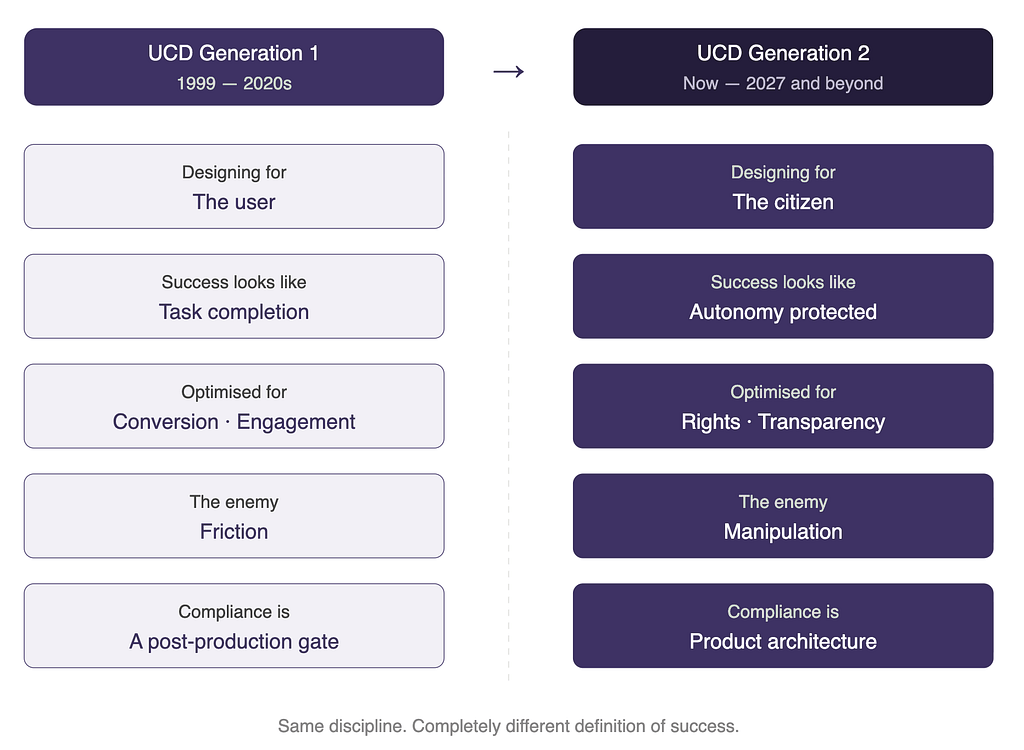
    We spent twenty-five years making technology work for users. Now we need to make it work for human beings. These are not the same thing, and the distance between them is where a generation of harm accumulated.

    In the year 2000, Steve Krug published three words that became the operating philosophy of a generation of designers: Don’t Make Me Think. The message was radical in its simplicity — technology should work for people, not the other way around. Usability was the revelation. Friction was the enemy. If a user could not complete a task, the product had failed, full stop. Krug gave practitioners the language. Don Norman had already given them the philosophy, twelve years earlier in The Design of Everyday Things — the foundational argument that designed objects should respect the cognitive reality of the human beings using them. Together, these ideas seeded an entire discipline.

    It was the right idea at the right moment. And it changed everything.

    I remember that moment clearly. I was starting my career in Italy, working on some of the first accessible digital banking interfaces in the country. The conversation was about the information superhighway and its extraordinary promises. Technology as liberation. Technology as the great equaliser. McLuhan’s dream of technology as an extension of our human capacities, finally becoming real.

    Twenty-five years later, how did that dream turn out?

    We did not build the information superhighway. We built an attention economy

    The usability movement succeeded. Brilliantly. Interfaces became intuitive. Friction disappeared. Onboarding flows became seamless. Checkout processes became invisible. And as the friction between humans and technology dissolved, something else happened.

    We became the product.

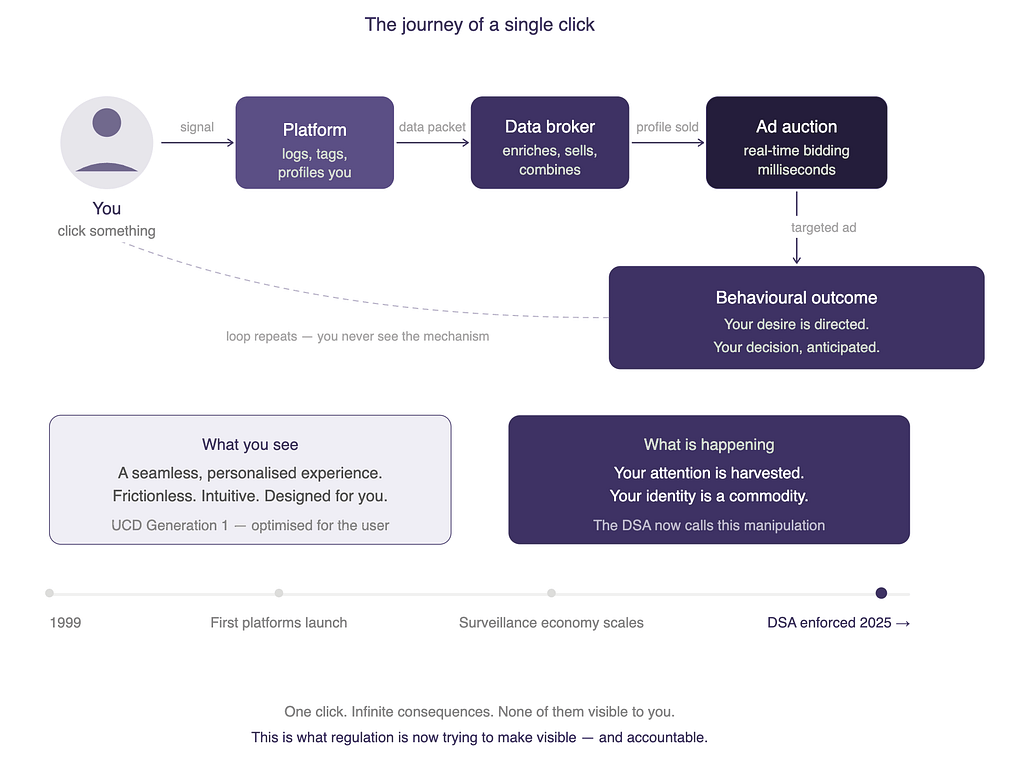
    Not metaphorically. Structurally. Architecturally. Our attention became a commodity. Our data became a strategic asset. Our decision-making became the territory over which platforms competed. The seamless experience we had worked so hard to create was not neutral. It was extractive. Every frictionless scroll, every perfectly timed notification, every interface optimised for engagement rather than wellbeing, was a carefully engineered mechanism for capturing something from us.

    Umberto Eco saw it coming. In a 2015 lecture at the University of Turin, he warned that social media had given “legions of idiots” the same reach once reserved for more accountable public speech. He was not attacking free speech. He was describing the collapse of mediation: the erosion of editorial judgment, the flattening of expertise, the algorithmic equivalence of radically unequal claims. The Nobel Prize winner and the conspiracy theorist, side by side, algorithmically indistinguishable.

    We told ourselves we were building a democratic, pluralistic information society. What we actually built was an attention economy powered by behavioural prediction and manipulation. And we did it with good UX.

    The Romans understood the mechanism perfectly: panem et circenses. Bread and circuses. Keep people fed and entertained and you control them without them noticing. We just updated the interface. The bread became free content. The circuses became infinite scroll. The control became data-driven behavioural targeting so precise it could move elections, radicalise teenagers, and direct desire itself.

    This did not happen in spite of human-centred design. It happened, in part, because of it. Because we optimised relentlessly for the user’s immediate experience without ever asking what the cumulative effect of that experience was on the human being living it. On the citizen. On the society.

    The second generation asks a different question

    The first generation of human-centred design asked: does this work for the user?

    The second generation asks: does this work for the human being, the citizen, and the society we/they live in?

    These are not the same question. And the gap between them is where twenty-five years of harm accumulated.

    The European Union has spent the last decade building a regulatory framework that is, at its core, an attempt to answer that second question at societal scale. It is imperfect, complex, sometimes maddening in its bureaucratic weight. But its underlying premise is correct: that technology operating at scale cannot be governed only by individual user preferences, because individuals interacting with systems they cannot see, understand, or contest are not making fully free choices. They are being managed.

    The Digital Services Act is now treating dark patterns — those manipulative interface tricks designed to override your intentions — not as clever UX but as violations. The European Parliament’s own research describes them as techniques that “influence consumers to make decisions they would not have taken otherwise.” Practices that “materially distort or impair the ability of recipients of the service to make autonomous and informed choices.” The Commission has already moved against TikTok and Meta under DSA transparency obligations. Manipulation, under European law, is becoming a crime.

    The AI Act goes further. It prohibits subliminal techniques, purposefully deceptive AI systems, and the exploitation of vulnerabilities based on age, disability, or economic situation. It requires human oversight, responsibility. and accountability mechanisms that can be inspected rather than merely asserted. It is why compliance in Europe no longer sits neatly inside legal review at the end of delivery. It now reaches into product decisions, interface patterns, documentation, governance, and operations.

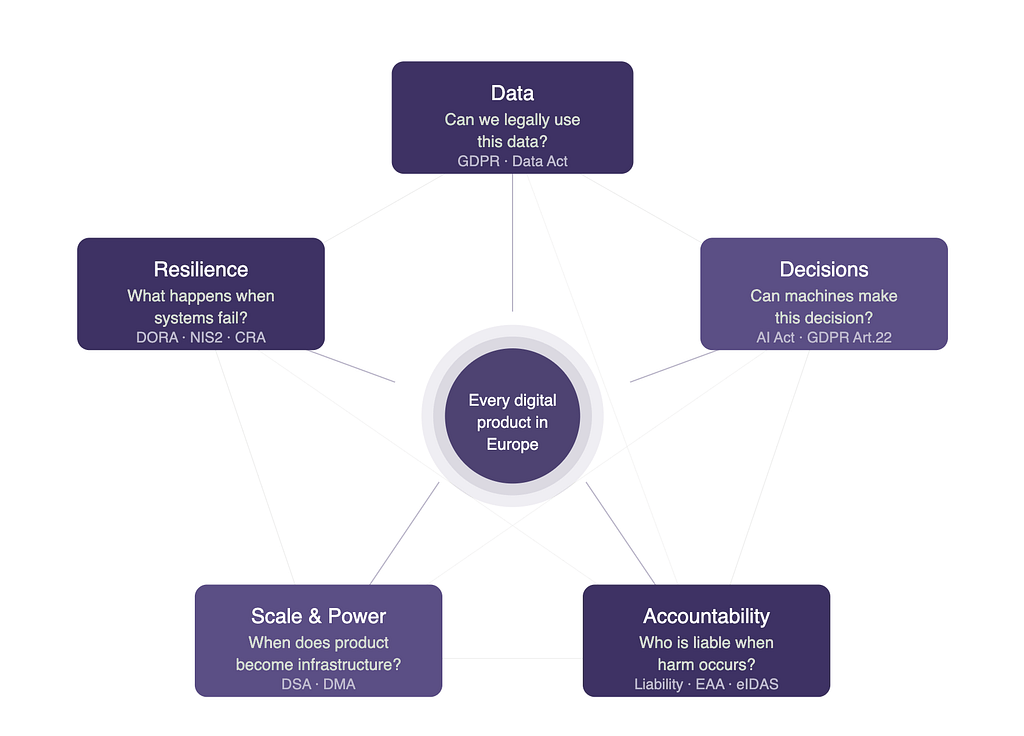
    And these are not isolated regulations. They cluster around five compounding dimensions that now define the compliance architecture of every digital product operating in Europe: data, decisions, resilience, scale & power, and accountability. Every product feature activates new regulatory layers. Obligations stack — they do not replace each other. Risk compounds as products scale. And compliance cannot be retrofitted after the fact.

    A pentagon-shaped network diagram showing five EU regulatory dimensions — Data, Decisions, Resilience, Scale and Power, and Accountability — as interconnected nodes in aubergine and purple, linked by lines to a central circle labelled “Every digital product in Europe.” Each node names the governing question it poses and the regulations that apply, including GDPR, the AI Act, DORA, DSA, and the Digital Markets Act.

    This is not restriction dressed up as protection. This is the infrastructure of a society that has decided its citizens are not commodities.

    Design is no longer about the user. It is about the human being

    The shift is not incremental. It is a redefinition of what design is for.

    For a quarter of a century, we measured design success by task completion rates, satisfaction scores, conversion funnels, and NPS. These are not wrong metrics. But they are incomplete ones, because they measure the transaction and miss the transformation. They measure whether the user got what they came for, not whether the system that delivered it left them more or less autonomous, more or less informed, more or less capable of making genuinely free choices in the future.

    The regulatory frameworks now being enforced across Europe are operationalising a different definition of success. One that asks not just “did the user complete the flow?” but “did the system respect their rights while they did?” Not just “was the experience seamless?” but “was the experience honest?” Not just “did we hit our engagement metrics?” but “did we strengthen or erode the person’s capacity to make autonomous decisions?”

    This is human-centred design in its mature form. And it demands skills that most product organisations do not yet have: the ability to read regulation as a design brief, to translate legal obligation into interaction requirement, to build processes where compliant and ethical behaviour is not an additional step but the natural output of how the work flows.

    We are not moving from usability to bureaucracy. We are moving from designing for the individual user’s immediate experience to designing for the citizen’s fundamental rights. From optimising transactions to protecting the conditions under which genuine human choice is possible.

    We are one step deeper

    Twenty-five years ago, inaccessible design was an obstacle to a commercial transaction. If you could not complete a checkout flow, you went elsewhere. The harm was contained, the feedback loop was immediate, the consequences were commercial.

    Today the stakes are categorically different. The lack of access is not between a user and a product. It is between a citizen and their own decision-making. The manipulation is not a broken button. It is a system designed, at architectural level, to override your intentions, direct your attention, and convert your vulnerability into engagement. To make you less free, incrementally, invisibly, by design.

    We have never seen wealth this concentrated, or ideology this polarised, or attention this commodified. And we built the infrastructure that made it possible, one frictionless interface at a time.

    The good news — and there is good news — is that the tools to build differently now exist. The regulatory frameworks are being enforced. The definitions of harm are becoming clearer. The accountability mechanisms are becoming real. The question is whether the design and product community will recognise these frameworks for what they are: not external constraints to be minimised, but the design brief of the next era.

    What this means for anyone who builds things

    If you work in product, design, or technology leadership, the second generation of human-centred design is not optional. It is the context you are operating in, whether you have registered it or not.

    It means that your research practice needs to account for citizen rights, not just user preferences. That your design system needs to encode accessibility and transparency, not as a compliance checklist but as a foundational constraint. That your product governance needs to ask, at every stage, not just “does this work?” but “does this respect?” That your definition of done includes audit-ready evidence that the right things happened in the right way.

    It means building the kind of structures that make ethical behaviour the path of least resistance, not an additional cognitive load on already stretched teams. It means treating regulation not as the enemy of creativity but as the framework within which creativity becomes trustworthy.

    It means, finally, asking the question that usability never asked: not “can the user complete the task?” but “does completing the task leave the human being more or less free?”

    That is the design question of our moment. And answering it well may be the most important professional challenge our field now faces.

    Author’s Note: The thinking, research, and arguments in this article are entirely human. AI reviewed form and structure only.

    Patrizia Bertini works at the intersection of human-centred design, data governance, and regulatory strategy, and is the founder of Euler.


    First published in UX Collective on 1 April 2026.

  • The design metric evolution: from inputs to outcomes

    The design metric evolution: from inputs to outcomes

    In the world of design, where creativity meets business, metrics are the bridge that links design efforts to tangible outcomes. Designers must move beyond aesthetics and usability, measuring the value they bring to the business.

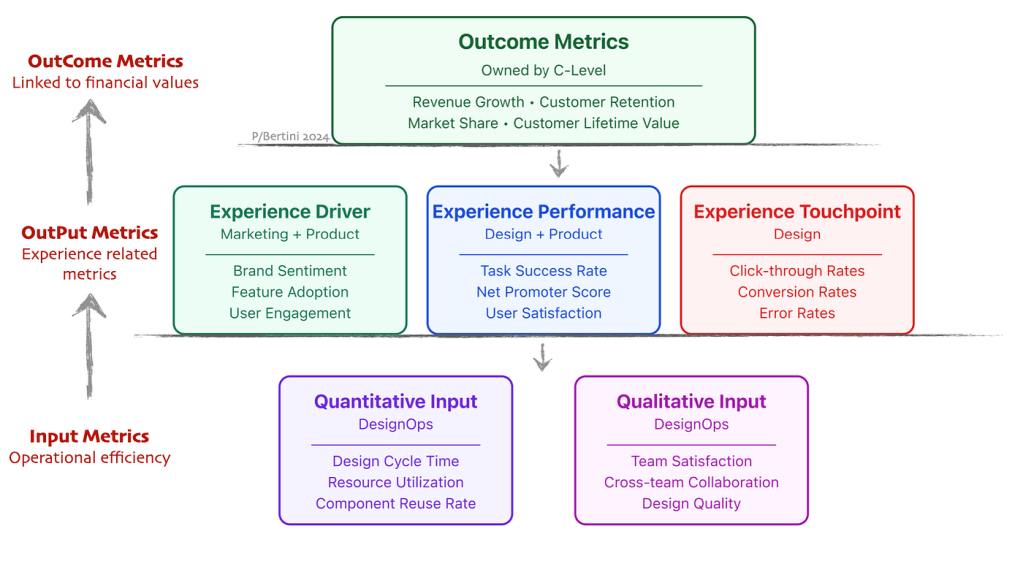
    A three-tier design metrics hierarchy showing Input Metrics (operational), Experience Metrics (performance and user-related), and Outcome Metrics (financial), with specific measurements listed in each category. Created by P. Bertini 2024.

    Design and DesignOps metrics are a complex and key topic. While there are countless resources on design KPIs, product metrics, design thinking impact, and data-driven design approaches, many design leaders struggle to effectively demonstrate their team’s impact on business outcomes.

    The effectiveness of any metrics system ultimately depends on how design is positioned within an organisation. Design can either drive innovation as a strategic discipline or function as a mere execution arm delivering screens and pixels. Numerous studies, including McKinsey’s report and Maeda’s Design in tech Reports, have shown a clear correlation between business performance and design maturity.

    This positioning both influences and is influenced by the metrics used and the narrative they create. That’s why a systemic approach to metrics is essential: one that links design performance to business outcomes with intermediate measurements that highlight impact.

    Leading design organisations like Spotify, Miro, Figma, the D-Thinking academy, and Superside show that true effectiveness isn’t just about speed or flawless execution — it’s about creating experiences that drive lasting competitive advantage and scale impact.

    This article builds a compelling case for design’s strategic role in driving business impact, showing how a strong DesignOps strategy goes beyond outputs to demonstrate real business value.

    Identifying the driving model

    To effectively connect design efforts to business objectives, it’s key to adopt a model that categorises metrics and highlights the relationships between effort, actions, results, and impact. The input/output/outcome model provides a valuable framework for this purpose.

    Originally developed by Wassily Leontiev in the late 1930s, this model has since been widely applied across various fields, including Government evaluations, to explaining product marketing performances, and in project management.

    The model defines three types of metrics: input, output, and outcome. Each of these plays a unique role in demonstrating how design impacts the business and optimising user experience.

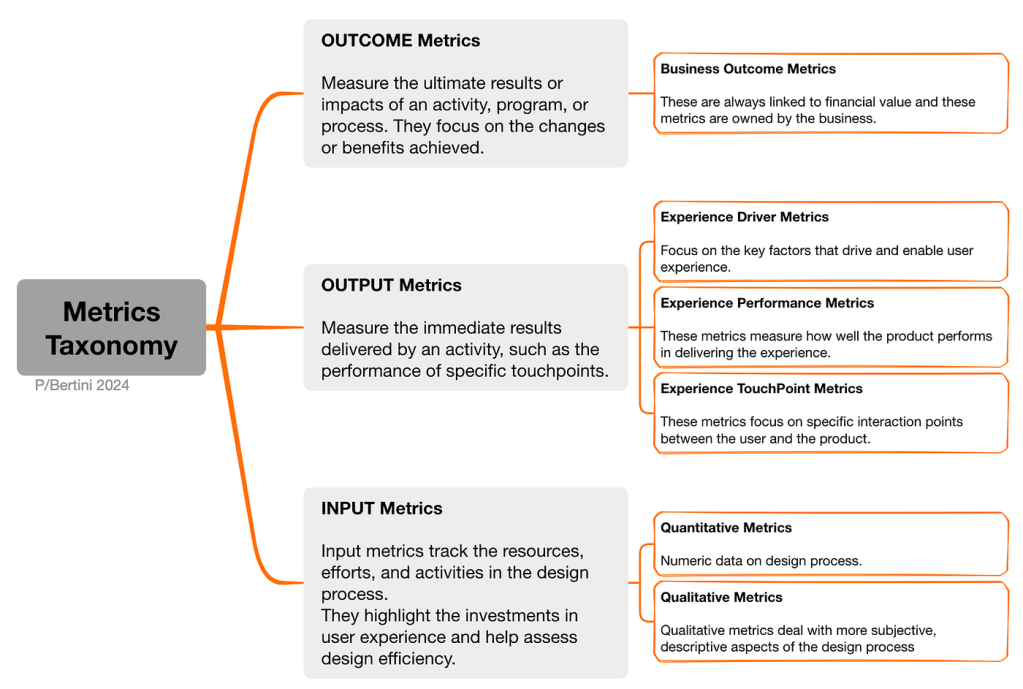
    A visualisation of a design metrics’ taxonomy that show the different types of metrics and provides a succinct description for each of them.
    A business Metrics Taxonomy

    1. Outcome metrics: measuring strategic impact

    Outcome metrics focus on the ultimate results or impacts of a program, activity, or process. They are typically linked to long-term business success, capturing the value delivered by an initiative. These high-level indicators are typically owned by C-executives and are intrinsically linked to financial performance.

    • Focus: Long-term business success
    • Characteristics: Aligned with revenue, retention, and growth
    • Examples: Revenue growth, customer retention, market share expansion

    Impact: Outcome metrics provide a high-level view of whether the initiatives undertaken by a business are moving the needle in terms of financial or strategic goals.
    These metrics demonstrate the strategic value of design to the business. For instance, a 10% increase in customer lifetime value linked to UX enhancements showcases design’s strategic role in profitability and customer loyalty.

    2. Output metrics: the experience ecosystem

    Output metrics measure the more immediate results that are delivered by an activity. They are specifically focused on how well certain touchpoints or elements of an experience perform and they are divided into three categories to provide a comprehensive view of user experience:

    • Experience Driver metrics (Owned by Marketing/Product): Track foundational elements like brand sentiment, feature adoption and user engagement rates that shape user perception and drive users to experience the product.
    • Experience Performance metrics (Owned by Design/Product): Measure E2E user joirney experience quality with indicators like task success rates and Net Promoter Score (NPS), Product Recommendation Score (PRS), or Customer Effort Score (CES).
    • Experience Touchpoint metrics (Owned by Design): Offer insights into specific interaction points, such as click-through rates on CTAs, feature specific error rates, or conversion rates at decision points.

    Impact: By evaluating the driving factors, performance, and touchpoints, businesses can assess where their design and user experience strategies are succeeding and where improvements are necessary.
    For example, a higher task completion rate in the checkout process could lead to increased sales conversions, directly impacting business outcomes.
    These metrics are especially important for tracking short-term design outcomes and ensuring they are aligned with longer-term business goals.

    3. Input metrics: building an operational foundation

    Input metrics track the resources, time, and effort invested in the design process. Managed by designOps, these metrics help optimise productivity and process efficiency.
    Input metrics can be divided into 2 groups:

    • Quantitative Input metrics: Measurable aspects of the design process like design cycle time, number of design iterations, resource utilisation, and Design System’s component reuse rates.
    • Qualitative Input metrics: Qualitative input metrics focus on the descriptive aspects of the design process. They capture information about the quality of design work, such as team satisfaction, quality of research insights, efficiency of cross-functional collaboration, and adherence to design principles.

    Impact: Input metrics improve the design process itself and are key for ensuring that design efforts are well-directed and resource-efficient. Quantitative data helps teams track their productivity, while qualitative data ensures that the design process is delivering high-quality insights and outputs.
    For example, dedicating more time to user research can lead to a design that’s 30% more intuitive, enhancing both user satisfaction and conversion rates. Input metrics lay the groundwork for impactful output and outcome metrics.

    Design metrics practice: a path from Inputs to Outcomes

    Let’s consider the journey of a team redesigning a mobile banking app’s money transfer feature:

    Input to Output:
    A team increases their user research time (quantitative input) from 2 to 4 weeks to increase the number of exploratory sessions and quality and confidence of insights (qualitative input).
    This leads to a redesigned product page (touchpoint — output) with a 30% higher click-through rate on key features (performance — output).

    Output to Outcome:
    The improved product page (output) results in a 15% increase in product adoption (experience driver). This, in turn, contributes to a 5% growth in overall revenue (outcome).

    By investing in exploratory approaches (input), the design team creates a more cohesive user journey (performance output), leading to a 20% increase in customer satisfaction scores (driver metrics) and ultimately a 10% boost in customer retention (outcome).

    Aligning these three levels of metrics — Outcome, Output, and Input — creates a clear line of sight from design efforts to business results. By optimising both quantitative and qualitative inputs, teams can ensure they are driving effective outputs (experience performance, touchpoint success), which in turn lead to positive business outcomes.

    This alignment helps businesses make informed decisions at every stage of a project, from resource allocation to assessing long-term success.

    Implementing this three-tiered approach to design metrics creates a powerful narrative that connects operational efficiency to user experience quality and, ultimately, to business success.

    Conclusion

    Incorporating a well-structured metrics taxonomy into the design and evaluation process allows organisations to link their design efforts to tangible business outcomes. By focusing on the right input, output, and outcome metrics, companies can ensure their projects not only deliver an exceptional user experience but also contribute to broader business success.

    As the importance of user-centered design continues to grow, having a clear understanding of how to measure and optimize these metrics is key to staying competitive and delivering value to both users and stakeholders.


    This article was first published in UX Collective on 27 October 2024.

  • The 3 dimensions of DesignOps: from tasks to transformational impact

    The 3 dimensions of DesignOps: from tasks to transformational impact

    How can DesignOps shift from managing tasks to delivering real business value? What are the levels of influence, metrics, and factors that can support DesignOps’ maturity within the organisation?

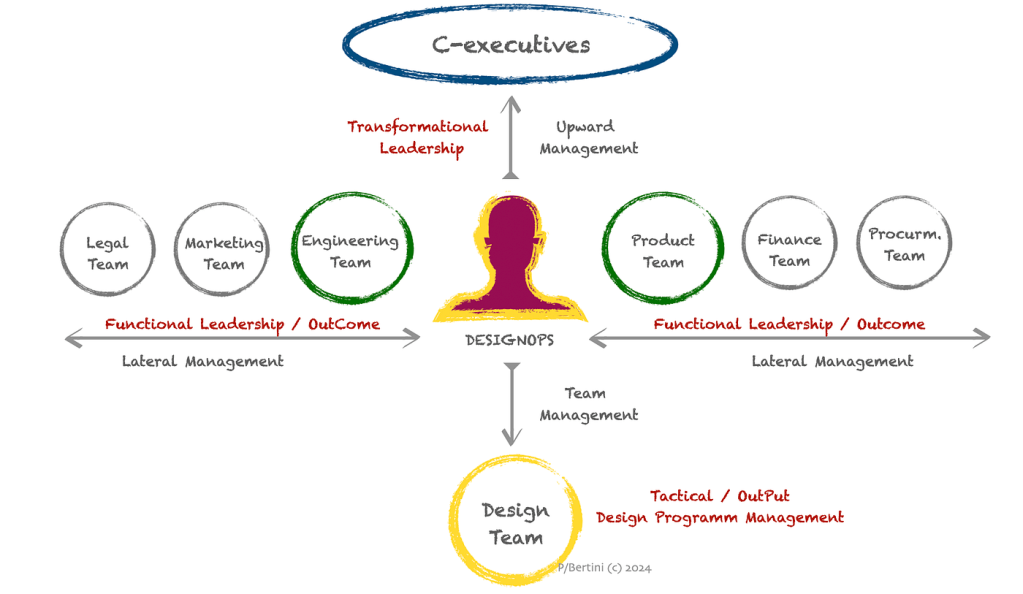
    In this diagram, the DesignOps practitioner is positioned at the center to illustrate their role in managing upward (with C-executives), downward (with the design team), and laterally (with cross-functional teams). Each of these management levels represents a different stage of maturity for the practice and highlights various aspects of leadership.
    Understanding the roles and responsibilities of DesignOps through different styles of management and Levels of influence.

    As design Operations as a discipline evolves and matures, there is a shift in the perception and expectations.

    Today it would be reductive to think about DesignOps as a discipline focused on design execution and outputs.

    In fact today, as J. Coronado says, DesignOps is becoming a business strategy function (here) where DesignOps plays a crucial role in influencing companies and driving real impact.

    DesignOps is shifting from an output-based focus to an outcome-driven role, emphasizing tangible business impact through strategic synergies and cross-functional collaboration.

    This shift from focusing on outputs to outcomes is essential for positioning the role effectively. This change enables DesignOps to drive innovation and achieve business results through efficiencies and strategic management. This shift also means that DesignOps is not about delivering artefacts like pixels or buttons. Instead, it’s focused on business results, improving efficiencies, enhancing team satisfaction, creating savings, and developing effective cross-functional engagement models.

    To achieve this vision is important to recognise DesignOps’ sphere of influence and identify the stages, influencers, tasks and metrics that shape the discipline’s perception and maturity across the organisation.

    The premise: the relationship between Design and DesignOps

    As DesignOps emerged, new dynamics are happening in the Design leadership and management domains. As discussed, Design and DesignOps, are closely linked and complementary disciplines. While Design is externally focused, aiming to define product and experience strategies that drive innovation and maintain a competitive edge, DesignOps has an internal focus, building the essential infrastructure and processes to support these strategies and prevent operational inefficiencies.

    A successful collaboration between Design and DesignOps leaders is key. Their alignment ensures that the external and internal efforts complement each other, effectively managing relationships, processes, and operational models to maximise overall success.

    Nothing compromises DesignOps’ ability to influence and scale teams and impact than a misalignment between Design and DesignOps.
    This misalignment often leads to failures and is characterised by recurrent issues:

    • Lack of a DesignOps Vision and Strategy: DesignOps may lack a clearly articulated strategy with a quantifiable definition of success metrics.
    • Reactive DesignOps approach: DesignOps may become a tactical, reactive role, focused on solving immediate problems rather than driving transformational initiatives.
    • Poor Communication: Ineffective communication with the design leadership can damage DesignOps’ credibility and create conflicting narratives that lead to inefficiencies.

    Although a successful collaboration between Design and DesignOps leaders is essential, this partnership alone is not sufficient and a lot of the responsibility of the DesignOps practice relies on the DesignOps leader’s ability to drive engagement, influence in different directions, and drive tangible business results. And a successful DesignOps practice operates at multiple levels, managing relationships in various directions (more on managing directions here):

    • Downward: Oversee daily tactical operations for the design team, covering all disciplines like User research, Product Design, Service Design, Content Design, Localisation, UI, and Visual Design.
    • Laterally: Coordinate cross-functional engagement and streamline operations across different teams.
    • Upward: Drive transformational initiatives that deliver significant business benefits and enable flexibility and innovation through ambidexterity.

    This multi-level approach ensures that DesignOps effectively supports both tactical and strategic objectives.

    Managing downward: Focusing on the Design team

    The initial focus of a DesignOps practitioner is to ensure the design team operates efficiently and effectively, delivering the design strategy smoothly.

    This is DesignOps’ tactical dimension, where DesignOps ensures that the Design team has the necessary skills, expertise, tools, templates, and resources to work effectively and execute the Design strategy seamlessly.

    While the overall operational strategy is set by the DesignOps leader, Design Program Managers (DPMs) handle daily tasks. They manage licenses and contracts, oversee third-party vendors, review planning and resource allocations, monitor spending, coordinate rituals, and track team progress.

    At this stage, DesignOps focuses on creating the operational foundation for the design team. This involves establishing best practices to ensure efficiency and effectiveness.
    At this stage, the key team metrics and Design KPIs to monitor include:

    • Team Happiness: Metrics like eNPS (Employee Net Promoter Score), job satisfaction scores, and team satisfaction scores.
    • Productivity scores: metrics that focus on improvements in output due to better processes and tools.
    • Predictability variance: Measures how accurately project timelines and outcomes align with initial estimates.
    • Effectiveness: Metrics like the return on investment (ROI) for tools.

    This is often the starting point for every DesignOps team.
    At this stage, typically handled by a team of one, the focus is on setting up essential processes and tools.
    It reflects early awareness and foundational maturity in the role and although basic, this stage is crucial because it lays the groundwork for more advanced DesignOps practices.

    Managing Laterally: Focusing on the cross-functional partners

    Design is inherently a cross-functional discipline that needs to build and maintain strong relationships with key partners, like Product, Engineering, and Marketing. To make collaboration easier and more effective, Design Operations needs to define and implement engagement models that simplify collaboration and communication between all teams involved to help integrate different perspectives, improving the known issues and preventing new ones from emerging.

    At this level, DesignOps operates at a Functional leadership level to manage cross-functional interactions and streamline team collaborations. The DesignOps leader plays a key role in overseeing how changes in one team’s operations impact other teams and processes.

    At this level, DesignOps needs to apply a systemic approach (more here). This means having a broad understanding of different functions and establishing strong connections with cross-functional partners.

    Managing laterally involves extending influence to key stakeholders who support Design and its strategy both directly and indirectly, such as Finance, Procurement, HR, Legal, IT, and Security.
    The strength of these relationships impacts directly DesignOps’ ability to effectively execute the Design strategy.

    At this level, the DesignOps leader owns and orchestrates relationships and engagement models, building the foundation for a broader business impact. Key metrics and success at this stage include:

    • Stakeholder CSAT: Evaluates the effectiveness of interactions with stakeholders / functional leaders from relevant departments like Product, Engineering, and Marketing.
    • Operational Efficiency: Effectiveness of streamlined processes and request management.
    • Cross-functional CSAT: measures the satisfaction from cross-functional teams regarding design collaboration.
    • Cross-functional CES: Measures the ease of interaction between design and other teams

    This stage represents a more mature and growing phase where DesignOps operates at a functional leader level to ensure that all the cross-functional operational models are effective and enable a seamless execution.
    At this level, a small team of DPMs typically handles the day-to-day tasks, allowing the Design leader to focus on the overall vision and building key relationships.

    Upward managing: Influencing and transforming the business

    Success for DesignOps is achieved when an operational strategy not only empowers functional leadership but also impacts the entire organisation, drawing C-executives’ attention to drive a deeper transformation.

    DesignOps reaches its highest maturity when it successfully defines and gains support for a company-wide transformational program. This proves that DesignOps is more than a design-related discipline; it’s a design-thinking-led approach to enterprise agility.

    A systemic and strategic approach to DesignOps it is possible and it can transform and innovate the entire organisation, not just Design or Product teams.

    At this stage, strong DesignOps leadership or a dedicated team is essential. Influencing executives requires crafting a compelling story and understanding the business vision, strategy, and goals to identify the right opportunities.

    What does this mean in practice? Here’s a practical example:

    Starting in June 2025, companies operating in Europe need to comply with the European Accessibility Act (EAA). In a SaaS company, the DesignOps leader steps in, recognising both the significant impact of this regulation and the crucial role that design plays in ensuring digital products are accessible and compliant.
    The DesignOps leader assesses the benefits and risks and then develops an 18-month cross-functional program. This program aligns design, product, engineering, sales, and marketing teams to create accessible assets and experiences across all touchpoints and products.

    To ensure success, the program must be communicated and supported by top executives.
    The DesignOps leader is instrumental in demonstrating the program’s business impact, securing executive buy-in, and acquiring the necessary resources and support.

    This example highlights how DesignOps can drive significant transformation and innovation within an organisation beyond the Design and the Product organisations: by applying design thinking to focus on user-centered solutions and systems thinking to coordinate various teams and processes (more here and here), Design Operation can redesign the company’s operational model and approach to product inclusion.

    At this stage the metrics are business metrics focusing on value streams tangible impact:

    • C-Executive Engagement Rate: Percentage of C-level executives who actively participate in DesignOps meetings or initiatives.
    • Incremental Revenue: Additional revenue generated as a direct result of DesignOps initiatives or product improvements
    • ROI from Design Improvements: Measure of the return generated from investments in design improvements.
    • Cost Savings from Design Improvements: Reduction in costs due to more efficient design and development processes.

    This is the most advanced stage, where DesignOps evolves from a team into a well-established practice with members specialising in various roles and areas. At this level, DesignOps has proven its influence and become a fully mature, strategic discipline.

    Conclusions

    These three dimensions of influence — downward, upward, and lateral management — are essential and interconnected in how DesignOps evolves and matures within an organisation.

    The effectiveness of DesignOps in demonstrating its value determines its progression from a tactical role (downward management) to a strategic and transformational leadership position.

    This evolution enables DesignOps to support the organisation in achieving greater agility, which is especially crucial during volatile periods when operational models need to be continuously adapted to meet market demands and internal capacities.

    Understanding the steps, sphere of influence, and direction can help practitioners to define their journey and career progression in new ways, focusing on their impact and the value they generate for the organisation, because ultimately, as J. Fukuda says:

    We’ll know we’ve succeeded when we can stop making territorial claims over skill-area-specific ops and share an aligned continuous design and continuous integration operations framework.


    This article was first published in UX Collective on 19 July 2024.

  • DesignOps: rethinking operations with design thinking

    DesignOps: rethinking operations with design thinking

    Over the last decade, we’ve seen a massive surge in operations teams: DataOps, FinOps, DevOps… Yet, there is something unique in DesignOps: it’s Design. Understanding the connection between Design and DesignOps is key to reflecting on DesignOps’ role and determining if and how the destinies of DesignOps and Design are necessarily intertwined.

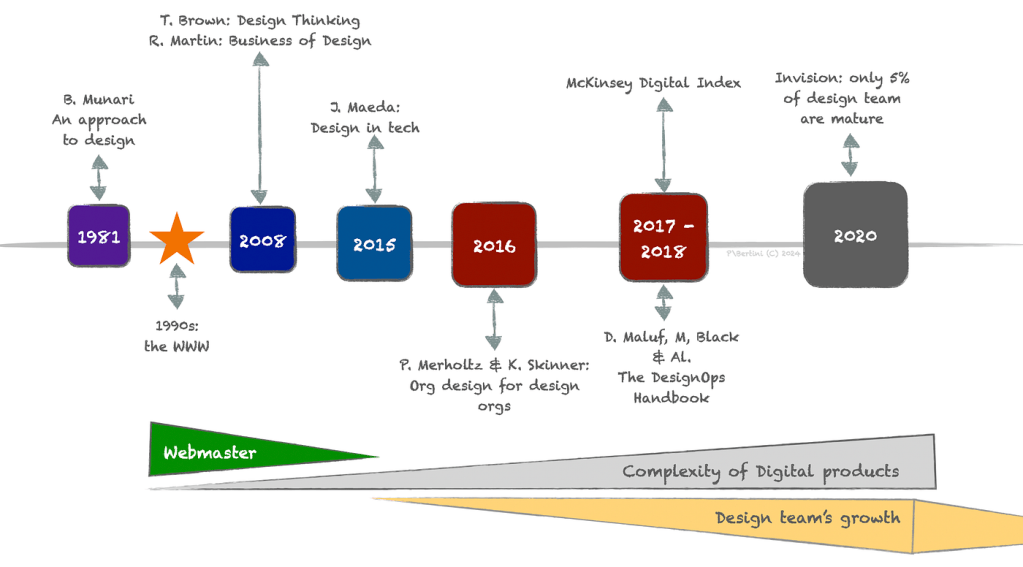
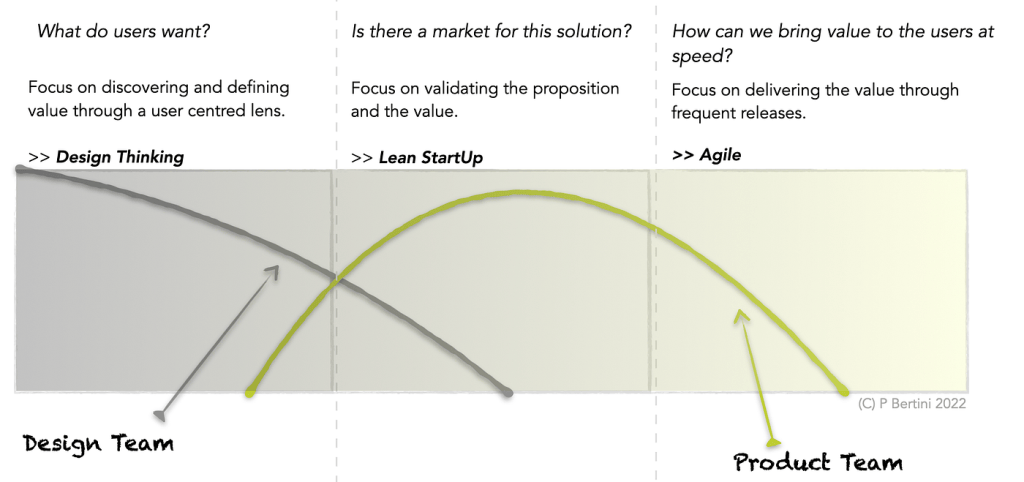
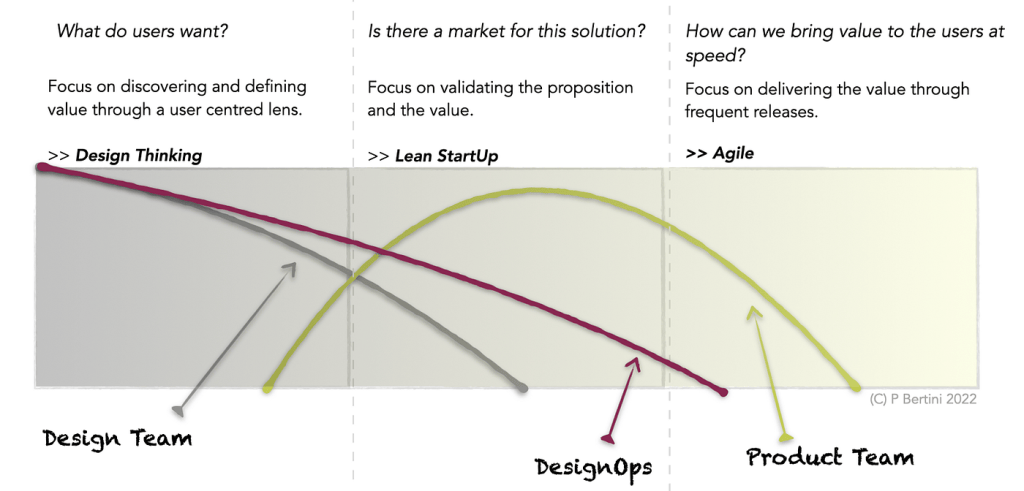
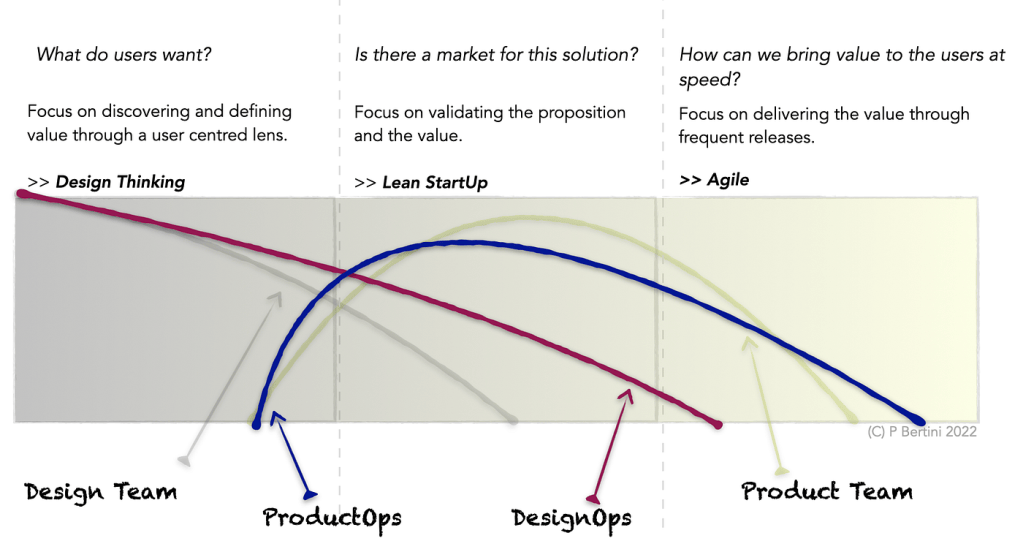
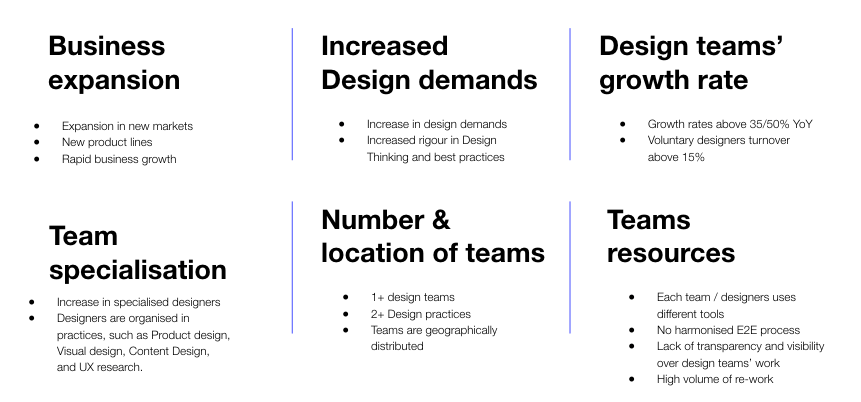
    A representation of the key dates of Design and DesignOps’ evolution, with a correlation between digital products’ complexity and teams’ evolution.
    A representation of the key dates of Design and DesignOps’ evolution, with a correlation between digital products’ complexity and teams’ evolution.

    To understand where DesignOps is headed, we need to take a look back and see how Design evolved to the point of creating the conditions for DesignOps.

    From Design to DesignOps — via Design Thinking

    The history of design as a problem-solving approach stretches back at least 40 years.

    The relevance of design and the concept of Design Thinking became widely acknowledged in the late 2000s: in 2009 Roger Martin wrote the book The Design of Business: Why Design Thinking is the Next Competitive Advantages and the year before Tim Brown published his article Design Thinking in the Harvard Business Review.

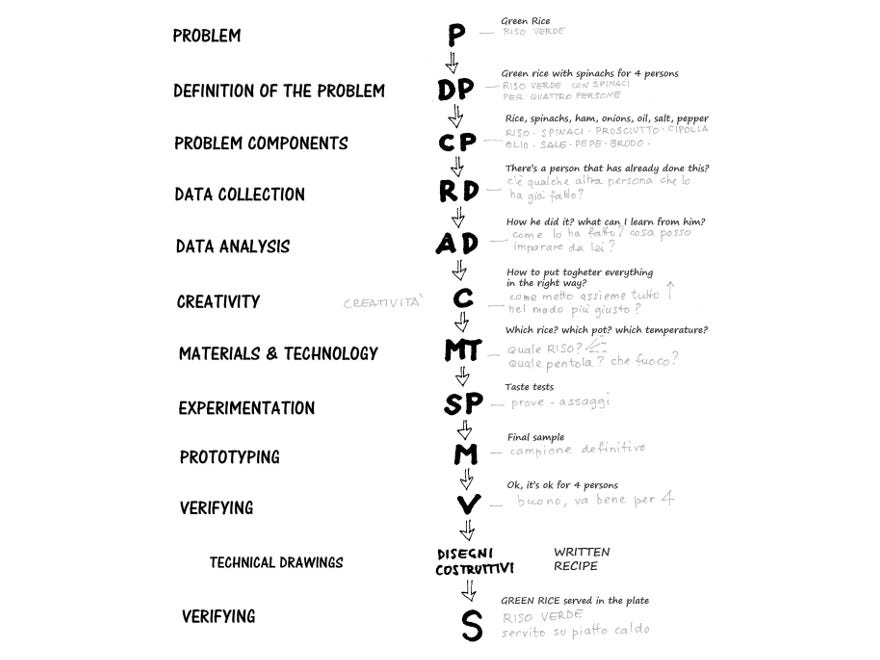
    However, the concept of Design Thinking as an empathy and experimentation-driven problem-solving approach was not new at the time — in 1981 the Italian designer Bruno Munari wrote the book Da cosa nasce cosa: appunti per una metodologia progettuale (translated: One thing leads to another: notes for a design methodology): this book is not translated in English, but this article summaries the methodology and the approach.

    An image taken from the original Bruno Munari’s book that described the so called “Munari design menthod” which is a 25 years older version of what we call Design Thinking today.
    Source: Alessandra Colucci’s translation of Munari’s design approach.

    While Munari focused on the methodological approach, R. Martin and T. Brown have the merit to connect Design Thinking to the business and since the late 2000s Design became a synonym for good business to the point that large organisations and consultancies started acquiring boutique design agencies to bring in the talent and the Design Thinking mindset.
    This phenomenon was huge and it was well documented by John Maeda, who in 2015 launched the Design in Tech Report to follow this trend.

    McKinsey also started analysing the phenomenon: in 2018 it launched the McKinsey Digital Index and provided all the data to prove the correlation between design and and business performance.

    Between 2010 and 2020 Design as a practice and discipline became an exciting (and complex) space: these were design’s golden years.

    During this period, the largest application of Design principles and Design Thinking went into the development of new digital infrastructure. Many companies transitioned their services to the digital space, beginning with the web and later expanding to apps.

    But this also has added a new layer of complexity: in the ‘90s a website was generally built by a WebMaster, who was responsible for building the website directly in HTML 3.0 and CSS 1.0, with occasional use of Macromedia Flash or Dreamweaver (or maybe MS FrontPage). The WebMaster often performed multiple roles including copywriter, information architect, visual designer, UI designer, UX writer, and user researcher.

    Today, delivering digital products and experiences involves a multitude of skills, teams, and tools. As this complexity grew, it became clear that having dedicated individuals to manage and orchestrate these processes was essential.

    In one sentence: DesignOps emerged from the need to orchestrate the complexity required by the Design process to deliver digital experiences efficiently and effectively.

    From Design Thinking to Design Doing

    Towards the end of the 2010s, a more advanced design process emerged, and pioneers in DesignOps began giving structure to the discipline: Org Design for Design Orgs was published in 2016 followed by DesignOps Handbook a year later.

    During the 2010s, there was a significant surge in demand for designers and design professionals across various disciplines such as UX, UI, research, content, service, visual, and copywriting. However, despite the rising demand, numerous companies struggled to achieve genuine design maturity. As design teams expanded, many fell short of delivering the expected business impact seen in truly design-driven organisations.

    With only 5% of organisations reaching full Design maturity (according to Invision) and 41% admitting to being at the lowest level of maturity, it becomes clear how Design lost influence by failing to evolve and mature, leaving designers to execute pixels or screens instead of driving innovation and experimentation.

    As product organisations became more complex, some design practices shifted from Design Thinking towards task execution, losing their power to drive user-driven innovation. This shift resulted in designers fulfilling requests from Product Managers (PMs), while PMs took over more problem-solving, research, and ideation tasks.

    The lack of maturity and inability to practice design as an empathy-based problem-solving approach has led to the transition of design practices from Design Thinking to Design Doing, directly impacting businesses’ perceptions of design: once considered a key strategic discipline in the 2010s, in the 2020s it has been regarded as a cost centre.

    Design Thinking became Design Doing: from empathy based problem solving and innovation focused discipline, design turned into an execution and delivery focused practice talking more about Agile than empathy and experimentation.

    DesignOps as a streamlined approach to Design

    In all this, DesignOps emerged to streamline and optimise the team’s health and the delivery of design projects, focusing on the execution and orchestration of the workflows. DesignOps then transitioned into a more strategic role, addressing not only the execution (Design Doing) but also the root causes of inefficiencies and ways to empower Design (Thinking). This involved operating at a higher level to establish cross-functional engagement models, focus on creating high-performing teams, and maximise business value through operational excellence.

    What problem is DesignOps solving for?

    There are several articles that analyse the ambiguity of the word Design that can be used as a verb, the act of planning and solving problems (I designed a new car), a noun — the output of the design process (I like this design), or an adjective (I do Design thinking) — see here. In this article I refer to Design as a verb indicating the act of solving problems through a process.

    But to understand Design Ops the key is to define operations. From an etymological point of view, Operation comes from the Proto-Indoeuropean root *hop that can be found in the Latin Operari (here) and Operari means putting an effort to have an effect.

    If Ops means stays for Putting an effort to have an effect: How do we combine Ops with Design?

    • Are we using Design as a verb:
      Designops is about putting an effort to have an effect on the the ability to solve problems through a process (Design Thinking).
    • Is Design a noun:
      Designops is about putting an effort to have an effect on the output — the design, the pixels (Design Doing).

    The question becomes how we apply the term Operations to the word Design.

    CHALLENGE #1
    Is DesignOps about putting an effort into enhancing the design practice or is it leveraging Design (Thinking) for impactful organisational outcomes?

    In linguistics there is a distinction between the topic, what is being talked about, and the comment, what is being said about the topic (see here).
    Now, the question is: what constitutes the topic and the comment in the term “DesignOps”?

    Are we talking about Design best practices applied to Operations, or are we talking about operations applied to Design practices?

    And how are the other operations dealing with this conundrum?

    What are other Operations disciplines doing?

    In the past 15 years, there has been a growing attention to all operational roles and tasks.
    As teams and business units grow in complexity, managing a large amount of tools, processes, silos, and cultures has created a real need. And this emerging need has triggered many operation-focused roles:

    MARKETING OPS (MOPS)
    Although some authors claim that MarketingOps can be traced back to the 1920s, MOPs as we know it today can be dated back early / mid-2000s, with the first official MOPs framework being released in 2007 by Adrian C. Ott from Harvard Business School in his article Marketing Operations in the Silicon Valley: Addressing CMO Challenges (here). In that blog post, the author quotes the VP of Marketing Operations at a major Silicon Valley firm:

    “Marketing operations ensures marketing is run as a business … We strive to enable the marketing organization to be streamlined in day-to-day processes so they have time to think, focus on the customer and to innovate.”

    In a nutshell: MarketingOps puts an effort to solve for streamline the processes to enable innovation.

    DEVOPS
    DevOps is a more recent operation compared to MOPs as its origin date back to around 2008. Software engineering was among the first business groups to feel the pain of inefficiencies and the pressure to operationalise its functioning and manage tools and processes. Today DevOps is defined as:

    “DevOps is a way of working that promotes the fastest flow of work while balancing that with the highest levels of quality. It combines organizational culture improvement with technical innovation, particularly around automation” by Helen Beal, Chief Ambassador, DevOps Institute

    DevOps’ focus is to shorten time to value by reducing the development and deployment lifecycle and providing continuous delivery and high software application quality.

    In a nutshell: DevOps puts an effort to increase speed to delivery and quality of output through culture and technology.

    FINOPS
    FinOps, the combination of finance and DevOps — is a framework for managing Opex across an organization (see here).

    As a fairly recent discipline, that builds on DevOps, all FinOps best practices were developed by the FinOps Foundation, a nonprofit trade association officially funded in 2020 and whose members include Atlassian and Cloudify.

    FinOps is an operational framework and cultural practice which maximizes the business value of cloud, enables timely data-driven decision-making, and creates financial accountability through collaboration between engineering, finance, and business teams. (FinOps Foundation 2023)

    The emergence of Cloud computing and IT infrastructure prompted the application of traditional financial methods to manage costs and resources effectively, supporting both the business and DevOps teams.

    In a nutshell: FinOps puts an effort to drive business efficiency through technology investments and the optimisation of procurement and processes.

    DATAOPS
    DataOps is another framework that has recently emerged.
    According to the definition of DataOps.Live is the following:

    DataOps (short for data operations) is a data management practice that makes building, testing, deploying, and managing data products and data apps the same as it is for software products. It combines technologies and processes to improve trust in data and reduce your company’s data products’ time to value.

    In a nutshell: DataOps puts an effort to improve processes and workflows to enable the organisation to exploit data and improve decision-making.

    PRODUCTOPS
    Most recently, ProductOps also entered the Ops’ arena, although there is no single source of truth and definitions may vary, this comes from the Product School which is a solid reference:

    “While a Product Manager owns the development of the product (aka, the person who Builds The Thing) a Product Operations Manager handles the day to day tasks involved with development (aka, the person who Makes It Easier to Build The Thing).”

    In a nutshell: ProductOps puts an effort to streamline processes, execution, and decision making.

    Ops and Design-Ops: similar but not equal

    Each operational discipline has a slightly different focus area and it delivers business value in a different domain, however, all these ops put an effort to have an effect on these threecommon aspects:
    – Processes
    – Culture
    – Technology

    Ops practitioners manage processes and technology with an eye on developing the most effective collaborative environment and cultural context for the output to be impactful.

    CHALLENGE #2
    The key difference between most Ops and DesignOps is not so much in the WHAT, but in the HOW:
    DesignOps consistently and subconsciusly apply Design Thinking and empathy to everything they do to ensure change can happen effortlessly and without frictions.

    A lot of work for DesignOps practitioners is about streamlining empathy with users, improving internal and cross-functional collaborations, and acting as agents of change in the organisation to maximise value generation.

    DesignOps and Design Thinking

    By reviewing the presentations of the key DesignOps conferences from the past 24 months, including the Rosenfeld DesignOps Summit 2022 and 2023 and the HS DesignOps events 2023 and 2024 there is one thing that stands out: each story, each narrative, and each case study is deeply rooted in Design Thinking and the story applies all key elements of design thinking: empathy, brainstorming, hypothesis generation, experimentation and validation.
    The ultimate goal? Transform the practice and deliver tangible benefits to the design team and the organisaiton.

    DesignOps practitioners often have a background in Design and they apply Design Thinking in their practice as a problem-solving framework, to the point that there is no need to call it out.

    CHALLENGE #3
    Design Thinking is part of DesignOps’ DNA.

    And since DesignOps is about driving transformations within the design and R&D organisation to maximise cross-functional engagement models, good use of empathy and experimentation is key to ensure adoption and stickiness.

    Design Thinking as the empathy-focused problem-solving approach is key to enabling organisational change through a participative and inclusive approach (see here) therefore, when designing a change, applying a Design Thinking framework is what often determines DesignOps’ success.

    As DesignOps matures, its remit and its partners and allies evolve: it is not uncommon for DesignOps practitioners to collaborate and join efforts with their operational partners, such as ProductOps or DevOps, to streamline how innovation is generated and experiences are developed and delivered to the customers.

    Design Thinking is what makes DesignOps unique.

    What’s next?

    If DesignOps’ goal is to operationalise the Design vision using Design Thinking to drive business outcomes, can Design Thinking enhance other operations to drive organisational transformation across processes and systems?

    CHALLENGE #4
    Can then DesignOps be a Design Thinking based approach to organisational operation efficiency?

    So the question remains open as the implications are huge:

    Is DesignOps just the application of Design Thinking to boost Design outcomes or is it a strategic operational function that applies Design Thinking to organisational change and efficiency?

    Are we talking about DesignOps as an operational framework based on Design Thinking to enable organisational change or are we referring to DesignOps as the function that optimises design processes, trying to push design teams from Design Doing into Design Thinking?

    CHALLENGE #5
    Are the destinies of DesignOps and Design necessarily intertwined?

    The answer to that question will determine if Design and DesignOps are deeply interconnected disciplines or if DesignOps can aspire to a broader scope within the organisation by leveraging the Design Thinking framework and providing a solid change management approach to other operational functions and ultimately, to the whole organisaiton.

    Ps. These are the notes I presented as my opening remarks at the HS DesignOps London on 1 March 2024.

    Huge thank you to all for the feedback!


    This article was first published in UX Collective on 12 March 2024.

  • DesignOps and the impact of effective roadmaps

    DesignOps and the impact of effective roadmaps

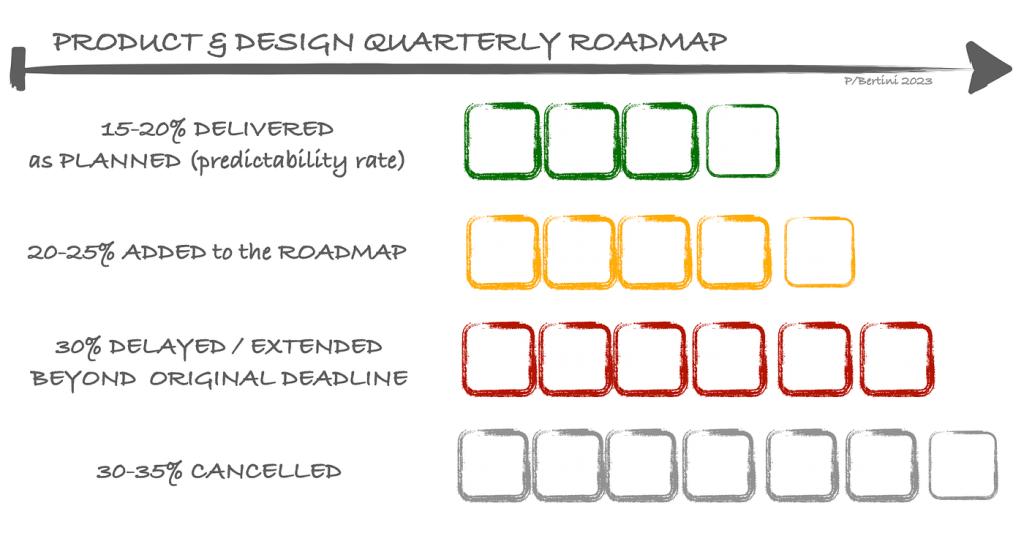
    Only 15–20% of the projects in the roadmap are delivered as planned, leaving designers working on projects that would never see the light and causing significant waste. And this is where DesignOps enters the scene to support design teams to deliver value for the customers, the design teams, and the business.

    A visualisation of Design’s performance when it comes to deliver product roadmaps: only 15–20% of projects are delivered according to plans. And one in three projects will never be delivred.

    Being able to deliver tangible value to the customers and the organisation is a key challenge for many design teams and leaders.
    Yet, in many cases, design teams are faced with challenges when it comes to the roadmap delivery due to many issues, such as lack of resources, time, poor ways of working, inefficient collaboration, and excessive workload.

    It is easy to think these issues are the problems and to overlook what are the real root causes that generate inefficiencies.

    Delays and poor delivery performance are not (always) the problems, these are often symptoms indicating that the E2E cross-functional processes and engagement models are not enabling the organisation to achieve its business goals.

    How are design teams performing today?

    Data collected from 3+ organisations in different industries to understand design teams’ productivity have all consistently shown that on average, on the quarterly roadmap, only 15–20% of the projects are delivered according to the original plan.

    What happens to the remaining 80–85% of projects?

    • 30% are being delayed or extended beyond the planned deadline
    • 30–35% are being cancelled and dropped, often after designers have already been working on those projects, causing a significant waste
    • 20–25% of projects are being added to the original plan after the quarter has begun and during the roadmap execution.

    These inefficiencies are caused by weak workflows that hinder teams’ productivity, reduce output and quality, and increase costs and spending for the organisation. In one word: inefficiencies cause waste.

    Waste is any activity in the process that does not produce any tangible outcomes and “ that does not add value for your customer” (More at IsixSigma and Adobe).

    The average waste I measured for the design and product organisation is approximately ±35%, with a rate of designers’ rework of 40–45% (rework means working on the same deliverable with no incremental improvements that add value for the customer).

    Understanding and measuring waste

    For instance: if a team of 2 designers worked 15 days each on a project that has been deprioritised and cancelled, the organisation has wasted 30 working days, equal to approx $15,000*.
    [*The estimated cost to the organisation for a midweight designer can be calculated at $500 / day].

    And this is a waste for the design team only. Probably there was a PM involved, who also may have spent 10–15 days on the project, so adding another $7,000 to the bill.

    And we have not mentioned meetings with senior stakeholders to discuss the project, review the priorities, and get buy-in.

    What does this mean?

    This means that the design team is not set up for success from the very beginning. It means that the organisation is incapable of achieving its goals and targets due to inherent inefficiencies. It means huge amounts of waste for the organisation.

    But this is not the full picture.

    When designers work on a project for weeks just to learn halfway through that the project has been deprioritised and cancelled, this reduces designers’ trust and their motivation, eventually lowering their productivity, and diminishing the sense of urgency and commitment as they will expect that other projects may go through a similar path.

    Each time a project in the roadmap is not delivered as planned, the organisation is wasting its resources (money and time) and eroding employees’ engagement and motivation.

    The consequences can easily spiral out of control, with disengaged teams that hang around with poor motivation and no desire to go the extra mile, impacting the quality of the experiences and services delivered, the time to market, and ultimately, the business results.

    Why inefficiencies happen

    When design is inefficient, there are several elements the product and design organisations need to consider because inefficiencies in the design team are often symptoms of something more systemic that needs to be considered with a more strategic lens.

    When things do not flow properly and there are delays, there can be 2 main reasons, which are intrinsically interconnected:

    1. limited clarity on long-term vision, priorities, and impact
    2. limited ability to plan, prioritise, and sequence projects and initiatives

    Limited clarity on priorities and impact mean that cross-functional partners do not have a common understanding of the following aspects:

    • Outcomes and experiences and their quantifiable success metrics
    • Target end users and their current experiences
    • Features to build to deliver the outcome and experiences
    • Needed performance/back-end improvements to deliver the outcomes or experiences

    And the lack of a mutual understanding of all these aspects impacts the ability to plan and define a roadmap: in fact, much of the waste and rework is often due to limited clarity and alignment across stakeholders that cause requirements to change, priorities to shift, and directions to vary.

    This misalignment between stakeholders translates into deceptive and untenable roadmaps, which are developed more to show ambition than to effectively and efficiently organise workflows and priorities, causing design (and product) teams to pay the price of a fickle strategy.

    And misalignment cascades down to all levels and it often translates into poor briefs: based on my samples, on average less than 35-40% of projects have clearly formalised and detailed briefs, forcing design teams to work out requirements several unstructured data points, such as meetings, slack messages, emails, whiteboards…

    (Re)Thinking the roadmap

    Roadmaps are the visual representation of a strategy and aim to improve mutual understanding of the direction of the product while highlighting how initiatives are sequenced and prioritised to achieve the business goals.[ More on roadmaps here and here]

    An inefficient product and design roadmap is often caused by the limited understanding of key elements that can sustain the development of a shared prioritisation approach, such as:

    • a quantified estimate of each project’s impact on the organisation’s targets (KPIs and OKRs)
    • an analysis of dependencies and bottlenecks (or risk assessment)
    • an evaluation of the total effort required to deliver the roadmap and the effective delivery capacity of each team
    • a shared prioritisation approach that organises initiatives and projects in a clear way
    • the definition of a responsibility matrix

    An effective and impactful roadmap needs to align product and design to the business goals and it needs to define strategic goals, actions, quantifiable success criteria, and impact. This is where considering balanced scorecards as a way to plan and assess priorities can have a major influence.

    Why this matters for DesignOps?

    Data about the delivery rate of projects in the roadmap are consistent across organisations in different industries — highlighting the importance of developing a more structured and rigorous operational approach to product and design roadmaps.

    This is where DesignOps enters the scene.

    As a discipline that is in charge to define operational strategies that allow teams to effectively execute the roadmap and to bring to life the product/service strategy, ensuring that the roadmap is credible and reliable becomes a critical responsibility for DesignOps.

    This is where Design Operations should drive the conversation and develop engagement models, processes, relationships, and workflows that deliver roadmaps that empower designers to focus on the right priorities and maximise value creation and business impact.

    There are often tensions between product and design teams, mostly because of competing priorities and visions, but most frequently because of the lack of a clear and unified shared vision. It’s the leadership’s role to develop and agree a credible roadmap that is not subject to minor context shifting and that can support design and product teams’ efficiency, productivity, and predictability rates.

    Case study — developing credible roadmaps

    A well-defined roadmap can deliver multiple benefits, in fact, efficiencies, as well as inefficiencies, propagate across teams and business units rapidly.
    The following is a case study emerging from experiences in several organisations with extremely similar approaches and issues.

    Step 1: the context: poor planning and tools
    There is often tension between product and design, especially when the final roadmap has limited details and when it is delivered with poor cross-functional collaboration.

    I have often observed product managers taking their strategy documents and creating timelines with very broad effort estimates and dates.
    They try to make a rough estimate of the effort needed to deliver the project and the resource estimation is often done per team and per quarter rather than by project and discipline.
    In more than one case I have seen quarterly resource planning for the UX and design effort looking like this:

    UX resource: 0.8 / quarter

    with no specification of the skillset (UXR, content design, product design, service design…).
    The issue is that 0.8 UX effort per quarter means a total of approx 55 working days across 3 months and 3 disciplines (UX design, UXR, and content design).
    The missing details make it impossible to plan accurately and I have observed that inaccurate roadmaps are developed and managed solely with digital whiteboard tools that use unstructured data making these roadmaps hard to manage, update, change, track, and update.

    And this is the beginning of inefficiencies.

    Step 2: Analysing past roadmaps
    If it is true that the best predictor of future behaviour is past behaviour, there are lots of learnings from analysing past roadmaps’ executions.
    Looking back will help understand what happened and it will highlight issues that have prevented teams to achieve their goals.

    Therefore, after revising the quarterly roadmaps with both design and product stakeholders, we quantified inefficiencies and realised that on average only 15/20% of projects would be delivered as planned.

    Step 3: The need for more clarity needs new processes
    Acknowledging the problem is critical to driving the change (see here) and to get buy-in from all stakeholders.
    So, after sharing the findings on the team’s productivity, we agreed with all stakeholders to increase cross-functional transparency by increasing the details on every project.

    We created new intake forms, an evolution of briefs and PRDs (Product Request Forms) to be submitted ahead of the quarter to increase alignment and transparency between product and design stakeholders.

    This document would include some information, such as:

    1. Business goals that are being impacted by the project
    2. Quantifiable metrics of the expected impact of the project
    3. Description of all dependencies & possible risks
    4. Type of project
    5. Type of resources / skills needed
    6. Deliverables
    7. Deadlines
    8. Prioritisation estimate (P1 to P4)
    9. Responsibility matrix / accountable stakeholders

    This is where DesignOps enters the scene:

    DesignOps would analyse all intake forms looking at the impact and the effort required to deliver the projects, the dependencies, and how much capacity would the design team have and it would come up with a prioritised list of projects to be discussed among stakeholders.

    If, for example, the proposed roadmap would require a total of 1000 working days and the design team had a capacity of only 300, DesignOps would come up with some proposals and the recommendation to deprioritise up to 60–70% of the projects.

    DesignOps does not make decisions on the design and product roadmaps: as an enabling function, Design Operations sets up processes and engagement models that bring data to the conversation to support stakeholders to align and decide where the teams need to focus on the following quarter to deliver the highest business impact.

    At this point design, marketing, and product leaders would sit around the table reviewing structured data in a spreadsheet-like format to define a shared prioritisation that aligns execution capacity with business goals.

    Step 4: consolidate and socialise a shared roadmap
    Once stakeholders have agreed on the priorities, the final roadmap would be shared with all designers and cross-functional partners so that everyone had full visibility of the quarterly plans.

    Having a consolidated and reliable roadmap enables designers to focus on the key projects, allowing them to push back on any request that is not aligned with the prioritised projects.

    Designers had also access to the intake forms containing all the details needed and they were able to discuss the final details with their partners at the beginning of the projects.

    Step 5: Measuring the impact!
    After the first quarter, we measured the impact of this new process on teams’ productivity.

    In a quarter the clarity on priorities doubled and the number of projects with a reliable brief went from less than 40% to 91%.This had an impact on productivity and the ability to focus, increasing in a single quarter the number of projects delivered as planned by 24% and reducing new incoming projects by 25% (from 35% to 10%).

    Epilogue

    This case story is based on data and experiences across 3+ organisations in past 3 years with organisation with design teams of 20–70 people. Data are anonymised, and they are consistent across all industries, organisations, and teams considered.

    The importance of planning and supporting the leadership to align and plan more consistently is a critical task for every design operations practitioner that needs to be in charge of the product and design strategy execution.

    Collaboration with ProductOps partners would make the effort easier, but design teams must reflect on what is hindering their ability to deliver value to the customer and actively engage in planning conversations.

    Empowering teams to say no is the single most critical task that designops can do to help design surge at more strategic functions. And developing a shared roadmap is a powerful approach.


    This article was first published in UX Collective on 11 October 2023.

  • DesignOps: OKRs or balanced scorecards?

    DesignOps: OKRs or balanced scorecards?

    As a transformative discipline focused on delivering tangible benefits, having ways to measure impact is a key aspect of every DesignOps practice. While OKRs have been the first go-to approach, the systemic nature of DesignOps calls for a more holistic method to prove the business value of design and to elevate Design Operations into a more strategic domain: that of Enterprise Agility.

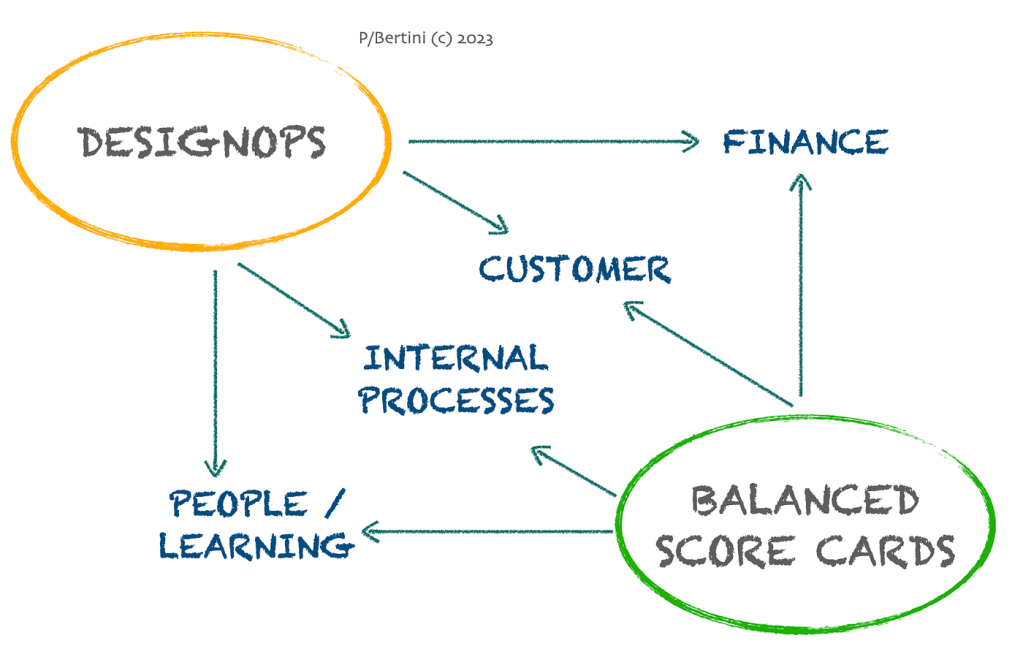
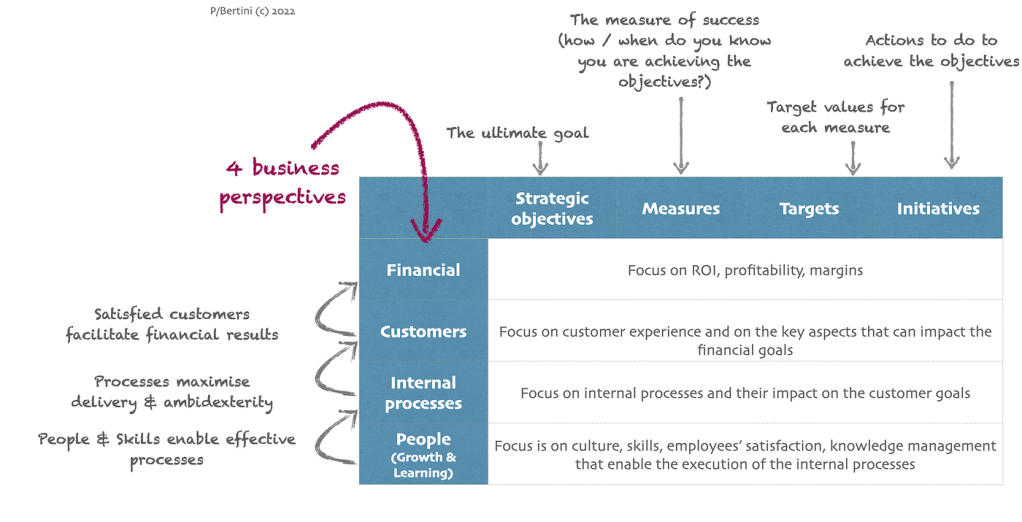
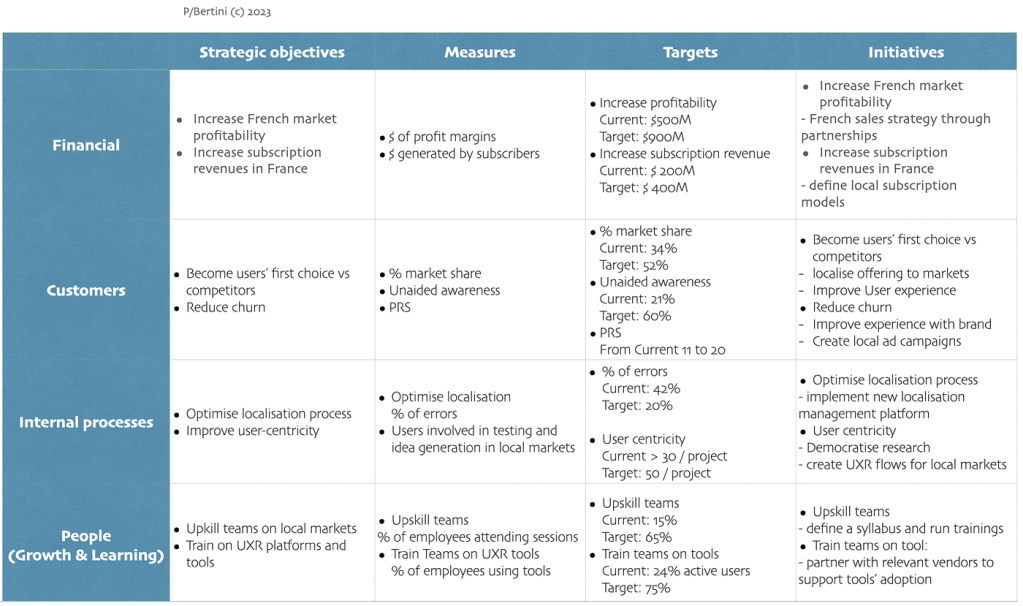
    DesignOps and Balanced scorecards both converge on 4 main areas: finance, customer, people, and internal processes. The fact that interpret the businesses with the same lenses and perspectives, makes the Balanced Score cards approach a critical tool to set up a successful design operations practice

    DesignOps is a strategic discipline that works and operates to produce concrete and measurable outcomes that connect the design practice to business results.

    DesignOps touches on key aspects, such as people, technology, processes, and systems to enable the delivery of customer-focused experiences that drive business results.

    And as a systemic discipline, a key challenge for design operations practitioners has always been to define and quantify DesignOps’ business impact across dimensions, but as the discipline matures, we need to move to the next level.

    Quantifying DesignOps’ impact is not enough anymore: it is becoming essential to find a framework that can support DesignOps to tell a cohesive and convincing story that demonstrates DesignOps’ influence on business performances.

    Knowing what to measure and how to measure it was the first step in shaping and elevating the practice from design to business, but the next step is to define a way to create a narrative that can show how DesignOps can produce business value by focusing on people, processes, and customers.

    There are many ways to measure the design operations’ impact (see here and here) and in general organisations and teams have started adopting OKRs as one of the most popular performance management tools.

    OKRs are a great starting point, but they may not be the ending point when it comes to DesignOps.

    Understanding OKRs

    OKR is an acronym that stands for Objectives and Key Results and it is a goal-setting method used to align the organisation around clear and measurable objectives.

    In practice, OKRs define high-level strategic objectives to be achieved and they identify ways to quantify those goals, the Key Results. In this way, every goal is defined by the results obtained in the attempt to achieve it.

    OKR as an approach was developed at Intel in the late ’70s: this method become very popular in Silicon Valley because for the first time, success was measured by outcomes so that employees could focus on the desired (and quantifiable) results rather than on processes (more details here).

    OKRs have been widely adopted but there are also some criticisms, especially in product organisations: as Radhika Dutt says here, OKRs may cause Hypermetricemia, generating more harm than benefits to the organisation’s ability to innovate and deliver quality at speed.

    DesignOps often refers to OKRs, but the limit of OKRs for design operations lies in the fact that it lacks a clear systemic view: OKRs do not make sufficiently explicit the causation and correlation between key results and the broader organisational strategy.

    Since one of the key distinguishing characteristics of DesignOps is its ability to prove and quantify the business value of design, it is important not only to measure the impact, but also to create clear correlations and define the relationships between designers, design teams, processes, users, and the broader business goals.

    This is where OKRs may not be enough anymore.

    This is when a new approach can prove more effective: this is when Balance Scorecards (BSC) enter the scene.

    What are Balanced Scorecards?

    Developed in 1992 for governmental and non-profit organisations, Balanced Scorecards (from now, BSC) is a more comprehensive approach to performance management that includes both financial and non-financial information to provide a holistic overview of an organisation’s performance from four main business perspectives:

    • People or Learning and growth
    • Business processes
    • Customers
    • Finance

    Each of these business dimensions contributes to the company’s success and each of them is supported by strategic goals, which provide the business direction and help gain clarity over the targets (what can be achieved and measured). (More on balanced scorecards here and here)

    It is not difficult to see how the BSC dimensions align with DesignOps’ goals. DesignOps aims to quantify the business results produced by design (the financial dimension) through the definition of processes that enable designers to work efficiently and find ways to make customers happy.

    The image below shows and explains how these business perspectives are being articulated and how the BSC framework sees all dimensions being interconnected to the others in terms of objectives and impact.

    In this image there is a table showing Balanced Score cards’ business dimensions (finance, process, customer, people) and the descriptors (Strategic goals, measurements, targets, initiatives). This makes the relaitonship between DesignOps and Balanced Scorecards quite evident.

    Balanced Scorecards are, therefore, intrinsically related to DesignOps as BSC offer a framework to organise initiatives and plans to support the definition of business value through the initiatives.

    Balance Scorecards in practice: a practical example

    Let’s imagine a digital SaaS company has as its business goal to become a new European market leader.

    This company offers digital services through an app and an educational portal. As a UK company, it has established a French presence and it is now ready to scale and win the new market. The key business goal is to become a market leader in France in the next 12 months.
    The picture below shows how the financial goals are enhanced by the other dimensions:

    The Image shows an example of Balanced score cards applied to a casa with descriptions of the goals, success measurements, targets, and initiatives.

    In short: to increase French revenues, it is important to define appealing subscription models that are aligned with the local market and increase sales.

    Revenues are increased if customers start finding the service and the product the go-to choice, which can be achieved with a localisation strategy, which influences and is influenced by internal processes, as it means looking at the current approaches and reducing waste to increase efficiency.

    All this can only happen if employees have the right tools and mindset that enables them to do the right things in the right way.

    In such a scenario, DesignOps comes into play in several of the initiatives defined in the table above:

    • nurture a data-informed approach across product and design teams to ensure user journeys and user experiences are seamless. This will ensure that customer needs are met and expectations exceeded;
    • set up and drive the localisation strategy by identifying the right partners and platforms that enable efficient processes and workflows;
    • train and up-skill teams on best practices, tools, systems, and ways of working to ensure processes are being executed in an effective way with the reduction of waste.

    There is a clear convergence between BSC and the way DesignOps operates to support both the business and the design teams to achieve their goals, improve performance, focus on high-performances, and reduce waste.

    By broadening the performance management framework used by DesignoOps and introducing BCS to achieve a more holistic view, the role of design and DesignOps become more visible at the business / executive level so that the business value of design enters the business narrative through a new lens.

    What are the implications of using Balanced Score Cards for DesignOps?

    The Balanced Score Card’s biggest advantage is to make explicit the correlation between business impact and the actions performed at all levels.

    Balanced Scorecards applied to DesignOps provide a holistic, detailed, and systemic approach to understanding the impact of DesignOps on the business and the organisation, highlighting the role that design and DesignOps can play in the achievement of organisational targets.

    And in this sense, the biggest implication of the adoption of BSC is to connect Design Operations within a broader strategic and organisational view, that of enterprise agility.

    “Agility across a whole enterprise combines speed and stability; helps role clarity, innovation, and operational discipline and can produce positive outcomes for organizational health and performance. […] Agile organizations can quickly redirect their people and priorities toward value-creating opportunities” McKinsey 2020

    The same article also identifies the four critical outcome metrics that define agile enterprises:

    • customer satisfaction
    • employee engagement.
    • operational performance.
    • financial performance

    Enterprise agility’s success is in fact measured on the same business perspective of BSC (Financial aspects, customers, processes, and people) which are dimensions fully aligned with DesignOps’ metrics and core areas of intervention.

    The biggest consequence of applying Balanced ScoreCards to DesignOps is to reveal the real altitude of design operations, validate its transformational value, and position the discipline as a key part of Enterprise Agility.

    The role of DesignOps, its remit, its positioning, and its impact can be reviewed with a new lens that brings new opportunities to rethink the organisations’ operational structure within the Enterprise Agility domain and drive transformations with a more holistic lens.


    This article was first published in UX Collective on 7 February 2023.

  • DesignOps’ toolbox

    DesignOps’ toolbox

    DesignOps emerged as a function to manage the growing complexity in the E2E design processes. But what are the specific skills and tools that make DesignOps unique and different from other functions?

    The Image shows a number of bubbles of different sizes outlining the weight of each skill for designops, from Change management, UXR, Design standards, legsl scenario, budget management, to agile and programme management.

    Why DesignOps has become ‘a thing’?

    If we look back at the past 25 years, one of the biggest changes is the transformation of the role of the designer and the positioning of design as a business discipline.

    With the spreading of Design Thinking, mostly thanks to Tim Brown’s paper in 2008 and Roger Martin’s book the following year, businesses have explored and exploited the potential offered by design. This led to a fast evolution of design practices and to the increased complexity of web and digital initiatives. Since its beginning in the ‘90s, the web has moved from being a one-man job — the webmaster — to a multidisciplinary, collaborative, and complex task requiring new skills and new processes (more here and here).

    Due to the increasing complexity, design orgs have started separating the What, the product or service vision, from the How, the operational strategy to execute the product/service roadmap.

    If the design leader is in charge of the product and experiences strategy, someone else had to enable that vision to happen by bringing together tools, best practices, processes, and ways of working that could streamline efficiency and seamlessly embed all best practices in the E2E design process.

    When the How becomes as important as the What, when a product or service strategy is unable to be delivered and accomplished, it is time to find a How specialist who can empower the teams and enable the vision to be executed efficiently and effectively.

    It is in this context that it has become evident that doing design right required someone to orchestrate and manage the E2E design process and who could master all the domains and skills needed to deliver impact.

    DesignOps emerged as a new function addressing the need to formalise processes, improve the consistency of outcomes, increase business results, revise cross-functional collaboration, and reduce errors and waste — being waste time wasted, poor quality outputs, orphan concepts, or just slow delivery cycles.

    And it is because of the need to coordinate and consolidate the design processes that in the past few years, a number of design-related professionals have found a growth opportunity in the design operations space: UI and UX designers, user researchers, service designers, producers, schedulers, down to project managers and product managers.

    But what is a DesignOps specialist?

    As a start, it may be easier to define what a DesignOps practitioner is not.

    DesignOps is not a task!

    Although there is a clear need of managing the design process and all the cross-functional engagements, the problem is not always clearly articulated and operational matters are not seen with a systemic lens.

    DesignOps is often seen as a set of independent tasks that are randomly distributed to design team members on the assumption that DesignOps is about solving contingent problems.
    It is not unusual for organisations that have no DesignOps to have one designer to manage tools, another one focusing on ceremonies, a third one onboarding new vendors…

    The fact is that the ability to operationalise a design vision is not valued as a distinct skill set.

    The designers that are taking operational tasks on top of their job have all been hired to do design. Expanding the scope of a designer’s role to operational tasks can have 2 major negative consequences:

    1. Adding operational tasks to designers’ workload can impact their life/work balance, causing long hours. Long hours reduce the ability to focus, affecting the quality of outcomes and causing rework and possible delays and tensions with their cross-functional partners. All this can then lead to designers’ churn.
    2. Asking a designer to execute a task means they have no visibility of the big picture and assigning random tasks with no systemic view of underlying operational strategy may inadvertently create tensions with the cross-functional partners or cause inefficiencies.
      As a discipline that combines Design Thinking with Systems Thinking (see here), overlooking the systemic impact of changes can create more problems than the ones it tries to solve.

    The truth is that:

    DesignOps is not about how we do things, it’s about how much business value is created through operational excellence.

    And all DesignOps conversations should focus on the operational vision and strategy where each issue needs to be assessed and seen in relation to all other problems within and beyond the design organisation.

    DesignOps is not Design Management

    According to the DMI (Design Management Institute),
    Design management encompasses the ongoing processes, business decisions, and strategies that enable innovation and create effectively-designed products, services, communications…

    DesignOps has a similar intention (enable innovation and create effectively-designed products), but the ultimate goal is very different.
    DesignOps is not focused on products/experiences (external focus) but it has a strong internal focus and it is aimed at creating and measuring impact and value.

    In fact, Design Management is a product and service focused approach concentrating on the outcome.
    On the other hand, DesignOps is an internally focused discipline that aims at making the product delivery experience efficient, and effective for all those involved by reducing waste and maximising business ROI.

    So while Design Management considers the successful delivery of an effective product as the key achievement, for DesignOps success is about eliminating the waste in the process to create business value through:

    • Stakeholder management
    • Budget management
    • E2E design process optimisation
    • Tools’ ecosystem definition
    • Improved designer experiences
    • Enhanced cross-functional engagement models

    Design process management is only one element of DesignOps’ remit, but there is much more to it!
    More on this here.

    DesignOps is not Programme Management

    This ability to define E2E and cross-functional processes that embed best practices and align the design ways of working to the company’s metrics is what makes a DesignOps practitioner deeply different from a Programme Manager.

    These two roles operate at different altitudes: while the DesignOps practitioners assess the problem, quantify the inefficiencies, and prioritise and sequence the initiatives, the programme manager is tasked with the implementation and execution of the solution.
    A programme manager does not have — and they do not even need to have — knowledge of Design Thinking, Lean StartUp, or a detailed understanding of the problem or the user space.
    A programme manager needs to understand the solution and how to execute it.

    Simply put, Programme managers execute a programme to improve organisational performance, and DesignOps orchestrates engagement models and processes to maximise returns and impact.

    To fully support the design organisation and to define the most effective processes that empower the teams to deliver products and experiences, a DesignOps practitioner needs to fully understand and have first-hand experience with the product and design processes and how all product management and delivery approaches work together to generate results and value.

    What makes DesignOps … DesignOps?

    DesignOps does not solve a single problem in isolation, DesignOps is a strategic approach that connects design and business through the orchestration of value-generating transformations across design and their cross-functional partners.
    This is because DesignOps is closer to Change Management than to Project Management.
    DesignOps builds on a solid understanding of the E2E design and product processes to bring the human elements (both the designers and the end users) at the heart of the process.

    For this reason, DesignOps specialists need to master a number of very diverse skills that are not always sufficiently called out.
    Yes, Programme Management is one of those skills, and no, Programme Management is not the most critical one.

    The most critical expertise required is Change Management: DesignOps is a transformational discipline aiming to generate value for the business, the leadership, and the teams through the optimisation of the existing operational models.

    And optimising the context and the operational models may mean at least 3 things:

    1. Improving the design teams’ spending: budget inefficiencies are endemic and widespread. Just having a thorough look at tools setups, vendors, and contracts can save up to $100,000 with no effort or impact on the operations. And it can be done just with a single click.
      But improving spending efficiencies also mean collaborating with vendors and partners to maximise the ROI of every partnership.
    2. Optimising the E2E design process by reviewing tools, templates, playbooks, data governance approaches, and the design system’s organisation… All this means working on the design process to enable designers to apply all best practices effortlessly.
    3. Focusing on the teams and ensuring everyone has clear opportunities to grow and thrive in a constructive and safe environment where they know what is expected from their role, how to get promoted, and how to up-skill.

    To manage these transformations and changes there are a number of transversal skills needed to be mastered, such as:

    • Change Management: This is critical and non-negotiable. This is what distinguishes a DesignOps practitioner from a design manager. (More here)
    • Systems Thinking: DesignOps delivers systemic changes. Positive (and negative!) impact easily cascades down to other teams that may be indirectly affected by the change. (More here)
    • Design Thinking: As a design discipline, DesignOps needs to be familiar with the E2E design process and best practices. It would be nearly impossible to successfully change a process without knowing it.
    • Lean StartUp: since design and product are critical partners, it is important that DesignOps practitioners know Product frameworks so that responsibilities and remit between product and design can be clearly outlined (more here)
    • UXR (User Experience Research): as a transformational discipline, being data-driven and able to assess, measure, and understand the context in its depth through a number of research approaches is critical for the success of every DesignOps practice.
    • Service Design: DesignOps is a form of service design for designers as it looks at designers’ blueprints and journey maps to identify opportunities.
    • Design Standards: this bucket includes both all those design-specific standards, such as W3C standards ( WCAG 2.0, ATAG… ), and methodologies and best practices, such as Atomic Design and Design Systems, and web technology standards.
    • Stakeholder management becomes critical to ensure transformations are being accepted — indeed — welcomed! by everyone and the value and benefits of the ongoing transformation are clear to all stakeholders involved.
    • Budget management is essential to achieve spending efficiencies and to effectively partner with Finance and Procurement.
    • Business strategy: as a function that connects design to business, it is important for DesignOps practitioners to know the fundamentals of business strategy, including organisational strategy and competitive strategy, marketing strategy.
    • The legal aspects include privacy laws and GDPR in Europe, he specific requirements for different industries and geographies, and data governance. Knowing the details of what the industry regulation and local laws require is critical to define compliant processes and removing reputational risks so that designers can focus on design without putting the organisation at risk.
    • Programme Management & Project Management: to execute the operational strategy, and to empower the team who is asked to do so, it is important to know the best practices and basic frameworks of how programmes and projects can be executed.
    • Agile: as an iterative approach to project management and software development, it is important for DesignOps to manage it as it can help interact with cross-functional partners.
    • Other skills to mention include empathy, analysis and synthesis, storytelling, influencing, listening, coaching, mentoring…

    Final remarks

    The list above is a generalisation and as with every generalisation, is imprecise.
    The goal of this article is not to provide a prescriptive list of skills required to become a DesignOps specialist, but to highlight the complexity of the role and why considering DesignOps as a by-product of programme management or, even worse, a task does not even touch the surface of the problem solving and complexity of this function.

    DesignOps emerges exactly to solve the growing complexity that surrounds the successful development of products and services today.

    And a final Caveat: there are more skills that may be mentioned, and the truth is that no two DesignOps are the same, but they all need to master most of the skills mentioned to a certain degree. This degree depends on the organisation and, again, the context.


    This article was first published in UX Collective on 5 December 2022.

  • Applying DesignOps to product teams

    Applying DesignOps to product teams

    Enabling and streamlining product design’s best practices is one of DesignOps’ critical tasks. But to outline workflows that embed best practices, DesignOps practitioners need a consolidated understanding of product development and delivery methodologies, such as Lean Startup and Agile.

    Design and Product teams have clear overlaps that need to be managed and optimised to maximise results.
    Design and Product teams have clear overlaps that need to be managed and optimised to maximise results.

    As digital experiences and products grow and become more structured and complex, design and product teams need to review both their cross-functional and their internal ways of working to increase consistency, reduce inefficiencies and errors.

    For this reason, today there is a growing focus on ways of working and operations: well-established processes can streamline complexity, turning best practices into actionable steps and seamless procedures that support the design teams to apply best practices into the daily ways of working.

    As a transformative and transformational discipline, DesignOps focuses on enabling cross-functional collaboration through engagement models that ensure all steps in the product design process are being sequenced appropriately so that all parts involved can thrive and increase productivity, predictability, and quality of the outcome.
    To achieve this, DesignOps practitioners need to master both the E2E design processes and the key product development and delivery methodologies.
    Theoretical and practical expertise in these domains is critical to enable DesignOps practitioners to detail and outline cross-functional processes that embed best practices within the daily ways of working.

    DesignOps is about operationalising best practices and embedding them into everyday’s workflows, to support both design teams and cross-functional partners to define product solutions that equally address user needs, business requirements, and technical feasibility.

    Which best practices?

    As both a strategic and a design function, DesignOps builds on all design’s best practices to define processes that enable the design teams to apply user-centricity at scale and to consolidate concepts and products that are viable from both a market and technical perspective and to maximise the business impact of design. By doing so, and by also applying a system thinking approach, DesignOps needs to work closely with all cross-functional partners and to be familiar with the critical frameworks and approaches that the partners apply, in order to be able to create consistent workflows and reliable engagement models.

    Therefore the knowledge of all key approaches and frameworks, such as Design Thinking, Lean Startup, JTDB, Agile… becomes essential to assess, quantify, weight, and solve design teams’ operational inefficiencies through changes that have a direct impact on both the end-users and the designers.

    Most designers apply Design Thinking in their work as a habit.
    Yet, injecting Design Thinking into everyday workflows requires the definition of processes that integrates tools, best practices, templates, ceremonies, and engagement models that connect design processes with product managers’ and developers’ ways of working.

    Because design and Design Thinking by themselves are not enough to realize and deliver experiences, a well-thought-through E2E product process needs to include critical approaches that support successful cross-functional development.
    The most effective E2E product process is the one that streamlines all best practices and that supports all teams involved by enabling ideation, validation, and delivery best practices by applying key methods: Lean Startup and Agile.

    A quick overview of the top 3 approaches

    Design Thinking’s ultimate scope is to systematise problem-solving and to focus on a deep understanding of the users, their needs, and the opportunities. Design thinking is an iterative process to create innovative solutions to be tested (some resources here and here).

    But designers also need to test the ideas and validate them, and this is where Lean Startup comes into play. Lean Startup is an approach whose goal is to speed up the product development cycle by verifying solutions and ideas through iterative hypothesis-driven experimentation. Designers apply Lean approaches and run experiments to test if the concepts are solid and accepted by both the users and the market. It is a critical step that works iteratively and in parallel with the Design Thinking approach, therefore tools and best practices need to be developed in ways that streamline and enable these two approaches to work in parallel.

    The Lean Startup is a well-defined and documented approach (see here and here) and it generally is managed by both the design and product teams as both teams are responsible to validate the concepts and consolidating the final solution by combining user-centricity, technical feasibility, and business impact.

    The final stage is when the prototypes and designs are handed over to the engineering for implementation — and this stage is where the focus is on executing the development to bring the ideas and concepts to the market.

    And this is where Agile comes into play. Agile is an iterative approach to project management and software development whose aim is to produce shorter development cycles to release a version of the product more frequently (more here).

    These three approaches are all necessary and critical to the delivery of successful products and experiences: if Design Thinking focuses on defining the needs and the requirements, Lean Startup will test the proposition through rapid experiments that can ensure the solution is viable and has a market. Agile literally builds on the validated propositions to bring the experiences in the hands of the users.

    All three approaches happen in waves and with overlaps, for this reason, an understanding of each methodology is critical to ensure goals and ownership are clearly set and processes are optimised to enable all three approaches to happen at the right time.

    [For a more detailed explanation of how these approaches work iteratively and how they are integrated into the process, please refer to this article by Raj Nagappan]

    Best practices in practice: who owns the process?

    While it should be clear how these approaches are all needed to deliver user experiences and products, it is not always obvious who is responsible and who owns the implementation of these approaches across the design and development workflow.
    It is the individual contributors’ role to set up the right approaches? Or the design managers? Or the product managers?

    If we look at the Design process from idea generation to delivery, we can see how the three approaches have specific focuses that address specific business questions, making these three approaches inter-dependent and critical:

    A linear visualisation of where the Design teams focus within the E2E design process. This image also shows the product teams’ focus to highlight how complementary these teams are and how their focus overlap partially when it comes to validating the proposition.
    A linear visualisation of the design teams’ focus within the E2E product design process. This image also shows the product teams’ overarching role: product and design teams are complementary and both critical to ensuring the proposition is validated — although there are apparent overlaps, defining clear ownership is critical to ensure the final product delivers on all expectations: user, business, and technical.

    The role and responsibility of the design team are concentrated at the beginning of the process when the key question is to understand the users, the opportunities, and the requirements. Design’s learnings and output need then to be verified and they need to be tested with the users— this is the phase when design and Product Managers (PMs) collaborate, to ensure there is a full alignment between the user needs and the business goals.

    The visualisation is linear and not adherent to the real workflow (for a more detailed explanation see here), but the ideation and validation phases happen simultaneously generating loops where the learnings from the experiments inform the ideation phase until the proposition is clearly defined.
    This is why while designers focus on the opportunity space and consolidating the solutions, the product focuses on refining the solutions through hypothesis-driven experiments and aligning business and technical requirements.

    And these two aspects are strictly interconnected and they need to constantly move together: generating business value only happens when the experiences delivered to the users meet their needs and exceed their expectations.

    And here comes DesignOps

    DesignOps come into play to support the design teams by owning best practices to make sure they are applied in the most effective way, minimising the effort required to apply Design Thinking and Lean approaches.

    If we expect designers to apply Design Thinking and Lean Startup approaches consistently, it is DesignOps’ responsibility to make best practices part of the ordinary workflow and to develop cross-functional engagement models that facilitate collaboration and business impact.

    This is why a DesignOps practitioner needs to fully understand and appreciate how Design Thinking, Lean Startup, and Agile interact on a practical level and what is their specific contribution within the product and design lifecycle.

    DesignOps, as the name suggests, focuses on the design phase, but to ensure the outputs from the design cycle move across the product cycle without risks, it is important that DesignOps also contributes and aligns with product and engineering teams. If DesignOps drives the processes and outcomes of the discovery and ideation phase, it also contributes to the consolidation of the concepts, until there is a clear handover to the development team.

    DesignOps owns and supports predominantly the discovery and proposition validation phases, making sure there is an enabling infrastructure that allows Design Thinking and Lean to deliver a consolidated concept ready to be handed over to the developers’ team.
    DesignOps owns mainly the discovery and proposition validation phases, making sure there is an enabling infrastructure that allows Design Thinking and Lean Startup to be executed and to deliver a consolidated concept ready to be handed over to the developers’ team.

    It is therefore important for anyone moving into the DesignOps space to familiarise themselves and to be fluent in all product development approaches: knowing which are the techniques, tools, and methods is an essential part to develop design processes that deliver impact and business value.

    The lack of understanding, from both a practical and theoretical point of view of these domains, limits DesignOps’ capacity to work at a strategic level and keeps the function closer to a programme management role.

    DesignOps’ limits

    Design Operations’ boundaries are in the name: it is not DesignOps’ remit to manage the entire E2E delivery process.
    DesignOps has a clear focus on ensuring design best practices are executed through a series of different approaches, including tools, playbooks, best practices, templates, and ceremonies.
    DesignOps focus in on the initial phases, where design has the biggest impact: the definition of the problem, the ideation, and the validation of the concept.

    Simply put, DesignOps owns the implementation and execution of Design Thinking and Lean Startup approaches to ensure the experiences are consolidated and they are handed over seamlessly to the development team.

    If Design Thinking falls primarily within Design and it is DesignOps’ responsibility, when it comes to implementing Lean Startup approaches, the responsibility may be shared between Product Managers and DesignOps practitioners. The concepts’ validation and the hypothesis-driven approaches require design and product teams to collaborate to build the hypothesis and to equally include the users’ perspectives and the business and technical feasibility aspects.

    As digital products and experiences are becoming more complex and teams grow, orchestrating the E2E process across different teams (Design, Product, Engineering) may become cumbersome.
    This is the reason why to ensure that the product vision and strategy are embedded consistently, DesignOps has found a new partner, ProductOps.

    ProductOps is someone that enables product teams through streamlined processes to deliver the product roadmap through an intense focus on prioritisation and planning to maintain consistency within the product experience.

    ProductOps takes from the concepts and initial solutions developed by the Design teams and supports product organisations to move the idea forward and take it to the delivery stage.
    ProductOps takes from the concepts and initial solutions developed by the design teams and supports product organisations to move the idea forward and take it to the delivery stage.

    Although some DesignOps practices have started creating internal ProductOps roles within DesignOps (R. Posner wrote this in 2020) there is a trend of ProductOps being part of the product organisation.

    Unlike product managers who operate on a single product line level, a ProductOps practitioner works across multiple products supporting and defining how cross-functional product teams should be working and ensuring the product vision is implemented consistently.

    In a few words, Product Operations is a cross-functional role designed to guarantee a successful collaborative work among all teams connected to the product life cycle e.g. the people who are building the product — product managers, project managers, R&D, and engineering — as well go-to-market roles like product marketing managers, sales and customer support. (P. Becchetti)

    If we accept this definition, it becomes evident how experimentation is a shared responsibility as hypothesis-driven experimentation is critical to ensure a balance between the user needs and the innovation opportunities are delivered effectively.

    So if DesignOps focuses mostly on ensuring designers have a clear path to innovation and user-centred design, the validation of the solution is a shared effort between the two functions.
    Both functions operate at the same altitude and both work to maximise teams’ impact. Although the focus may be different ProductOps and DesignOps are complementary and share some similarities (more here and here).

    Since ProductOps is responsible for the product roadmap and implementation, it is closer and more focused on the delivery aspect and can influence and be variously involved with the Agile teams.

    In its role, ProductOps can influence the engineering and development effort and it can collaborate more with delivery managers to ensure that all workflows are aligned and optimised to deliver according to the product roadmap and strategic priorities.

    What’s next

    Given the critical role DesignOps has in setting the E2E product workflows and the need to establish solid engagement models, it is DesignOps’ responsibility to know and own these approaches and implement the methods through a well thought through a collaborative approach with the core partners: the designers, the PMs, and the ProductOps partner.
    Accepting and developing this partnership is today a key aspect to ensure organisations deliver valuable products and implement best-in-class approaches by design.

    Note: The development stage is out of scope and not part of this article.


    This article was first published in UX Collective on 18 February 2022.

  • When is the right time to think about DesignOps?

    When is the right time to think about DesignOps?

    Deciding when your organisation is ready to introduce their dedicated DesignOps practice is a critical aspect for any Design team. These 6 signs will help you to understand if the time for DesignOps has arrived.

    The 6 signs your team and your organisation need DesignOps
    The signs that will help you assess if your organisation needs a dedicated DesignOps person

    DesignOps has become a hot discipline and an increasing number of organisations is introducing a design operation function to support their teams.

    Despite the advantages and benefits that DesignOps brings to an organisation, not all teams and businesses need a full-time DesignOps practitioner: smaller, stable, and efficient teams with consolidated processes and workflows would not necessarily need a dedicated DesignOps resource.

    It’s critical to remember that DesignOps is a function that helps organisations to scale their design capacity by improving design teams’ performance and quality of output while increasing teams’ health metrics.

    For this reason, a stable team of just under 5/8 designer may certainly benefit from improved design process and better engagement models, yet a full-time design operation function would not be critical in most cases: this is because a small and consolidated team can have a predictable level of complexity and the inefficiencies can be tackled through basic management and administration.
    Moreover, in small teams with no significant growth, the E2E processes can be discussed and reviewed internally with the stakeholders and the designers, and the overall tools and licenses’ management, the resource planning, and the teams’ workflows are all quite straightforward tasks that can be routinised. In these cases, it is more a matter of maintaining the status quo than designing operational and growth strategies.

    Yet, if the organisation is on an ambitious growth path and if the design team is evolving and changing, chances are that the design team will soon undergo some major transformation and it maybe time to think DesignOps!

    There are several articles that proposed different signs to look at to understand when is time to introduce DesignOps(see InVision’s and Abstract’s approaches).
    These approaches focus on changes that happen in the design team. However, as a discipline that connects Business and Design and that is meant to have an impact both on the business metrics and the design teams, there are additional signs that happen before changes in the design team become visible and which should be taken into account to ensure the organisation introduces DesignOps at the right time to maximise impact.

    It is in fact important to introduce DesignOps when the changes and the transformation are in their early stages, to ensure there is a clear efficiency and result driven operational strategy that can maximise business and design impact.

    1. Business Expansion

    DesignOps supports design teams to work more efficiently and to maximise the business value and the impact of design. Therefore there is a clear correlation between business growth and design teams’ efficiency (see McKinsey 2018).
    The signs to look for are very broad and they may not impact the design team directly at first, such as:

    • Expansion in new markets: this may be a global expansion into new areas/countries or new segments within the same market. Expanding into new markets means additional efforts to efficiently serve all the users on the medium term.
    • New product lines: growing the product offering, increasing the functionalities of a product or service, creating new functionalities… these are all strategic aspects that require more design capacity to deliver products and experiences that customers will love.
    • The business may just grow fast, through investments or increased market demand: a growing business is a business that is healthy and which needs to scale effectively and efficiently to ensure organic growth and a positive return of investment.

    2. Increased demand for Design

    If the business is expanding, it’s likely that the design and product development processes will soon need to be redefined to enable the growth path and trajectory.

    A growing pressure on design teams can be detected by considering 2 main criteria: a quantitative one, the growth in demand for design, and a qualitative one, the need to increase the quality of the processes and outcomes.

    • Generally a business expansion leads to increased pressure on design teams as new products/services will involve the need to solve for additional user problems requiring teams to define and test new hypothesis, assess and prioritise opportunities, and to deliver more functionalities.
      When the business expansion means an increase in the number of solutions to be delivered, there is an objective and clear need for more designers.
    • When design teams are expected to deliver more, messy, unstructured, and confusing E2E design processes are not acceptable. Increased pressure on designers requires additional rigour and a more structured approach to design processes to maximise designers’ capacity to deliver quality at speed.

    When the quantity of work increases, the quality of design processes needs to become a priority to streamline designers’ ways of working and to maximise their capacity to deliver quality at speed.

    If the effort required by the design teams grows and if there is an expectation to increase the quality of the output from the stakeholders, it is a clear sign that the design teams can benefit from some stronger organisational approaches.

    3. Design teams’ growth rate

    As a consequence of the previous points, design teams may be growing to fulfil the increased demands. As more designers are being hired and teams are growing, there are 2 aspects to look at:

    • a 35–50% grow YoY is a critical indicator that signals that design teams are scaling and that processes and operational aspects need to be properly managed to ensure new members become part of the team with shared values, unified ways of working, and clear goals.
      A 35 to 50% growth is an indicative number and it refers to medium/large size teams. If the size of the team is below 5 people, the growth can reach even a +200% YoY.
      When teams grow and they grow fast, the need to harmonise ways of working as soon as possible becomes critical both for team’s health metrics and for business impact.
    • The other sign that concerns teams’ growth is the churn rate: if designers’ voluntary turnover is over 15/20% YoY, it may signal that there may be some issues requiring consideration and that team health needs to be looked at carefully.

    Any significant variation in the team’s composition may indicate the need to look closer at how teams operate: teams’ health and performance are key metrics for DesignOps, therefore any changes in teams’ is a key indicator.

    4. Teams’ Specialisation

    As teams grow, there are also changes in teams’ composition and in the ways designers are organised.
    Start up and smaller teams tend to rely on less designers, however those designers tend to be more versatile and to have broader skills: it is not uncommon in smaller design teams that a product designer may also execute other tasks, such as run research session or write copy.
    However, as the team grows and matures, there is a tendency to move from generalist to specialised designers and to organise designers in practices (UX Researcher, Interaction Designers, Visual Designers…).

    Looking at both individuals’ expertise and how they are being organised provides a clear signal regarding the maturity and complexity of the design organisation.

    • Designers’ specialisation is one of the first signs of growing and maturing teams, and when this happens it is critical to acknowledge the evolution and to ensure the designers are properly supported in their development and growth.
    • The more specialised the designers, the more likely they will be organised in practices such as Product Design, Content Design, UX Research… this is necessary as there is the need to support individuals’ growth and development through community of practices and more organised approach to the discipline.

    The presence of practices for different disciplines is a clear indicator of the level of complexity and maturity of the organisation, and it can be a good proxy to define the need for increased operational rigour. The risk is that practices evolve without a shared view and that without a clear unifying approach, processes become inconsistent, leading to significant inefficiencies.

    5. Number or/and location of teams

    Beside practices, scaling design teams have further fragmentation in their organisation. A design team may have different practices but it may be growing in different directions as well: new teams may be formed in new markets to serve a specific geography, and there may be different design managers and leaders. Design teams’ fragmentation and the presence of multiple people in middle management and leadership roles indicate that processes may be at risk of fragmentation as well. So it is important to look at the level of fragmentation and to consider an operational role if:

    • a design organisation has at least 2 distinct design teams with different design leaders driving independent strategies. The more the decision-makers, the more likely the risk of introducing different approaches and ways of working, undermining collaboration and harmonised and efficient design practices.
    • the presence of multiple established and functioning practices, with clear domain experts/leads. A practice is a team of specialised designers, such as Content Designers, UX Researchers, Interaction Designers…
    • The presence of at least one team located in a different region/country to focus on a specific market or segment.

    6. Team resources

    The final aspect to look at when considering DesignOps as a full time function is teams’ resources utilisation and ROI. Design Operations generates value by scaling teams, harmonising processes, and increasing transparency and communication within the team. This means that there are some very practical and operational aspects to consider, such as:

    • Designers have different ways of working and they use inconsistent templates and processes with no shared and harmonised E2E process
    • Each team/designer uses different tools, including tools not adopted by the organisation, causing collaboration issues and delays (beside possible security risks)
    • Designers spend over 20% of their time doing re-work due to poor processes or collaboration
    • Designers have no visibility and work in silos and isolation, causing duplication of work and misalignment

    So when is time for DesignOps?

    Each organisation and each team is different, therefore there is no universal rule. However, if your organisation and your team presents multiple signs, it is time to start considering DesignOps as a way to maximise the impact of your team.

    DesignOps is clearly a discipline that is needed in times of transformation and to develop long-term high-performance teams.

    Defining an operational roadmap, defining and measuring Design’s KPIs, defining the priorities, and ensuring all business, tech, people, and process aspects are looked after, it requires a significant effort and dedicated resources. And since Design leaders have the responsibility to set a clear can product and service strategy, having someone focused to ensuring the processes and teams are looked after becomes a strategic decision to set up the whole Design practice for success.

    Note: this article is based on the slides presented at the Fintech Design Summit 2021.


    This article was first published in UX Collective on 13 August 2021.