
AI already builds interfaces without a designer pushing a single pixel. Soon, users will not even see the interfaces we design: their agents will. Design can burn out like a meteor, or go back to what it was always meant to be: solving problems.
Design is changing. DesignOps is changing.
Our role as humans is changing. Our brains are being rewired.
Our ways of working are reinvented every day. Like modern-day Penelopes, we weave during the day, and at night the speed of technology unpicks our work. And we start again.
We hang on to what we know, to our familiar ways of thinking and doing. We read books. We search for answers in the wisdom of the past, in what we learnt and in what we have been taught.
We live, not rhetorically but factually, in unprecedented times.
What we knew about the world has collapsed.
For around 300,000 years, our species lived by hunting and gathering. Farming arrived about 12,000 years ago. The factory, about 250 years ago.
Then the timeline collapsed. ARPANET sent its first message in 1969. The web reached the public in the early 1990s. Generative AI reached everyone’s desk in the 2020s. Today we talk about agents, and about recursive self-improvement: AI that helps build better AI. Since 2020, the computing power used to train frontier language models has grown about five times every year (Epoch AI).
We have compressed into decades, and now into years, a change that once took millennia. The world as we know it is already an old model.
And yet many of us still believe that a profession and a specialised education will save us. That they will grant us a social and economic position, as they did for centuries. This is one of the biggest mistakes professionals can make today. Closer to home, it is the mistake designers, DesignOps professionals and digital product workers are making right now.
Design is going to be transformed in ways we are not preparing for.
How did design lose its thinking?
To understand where design is headed, we need to take a look back.
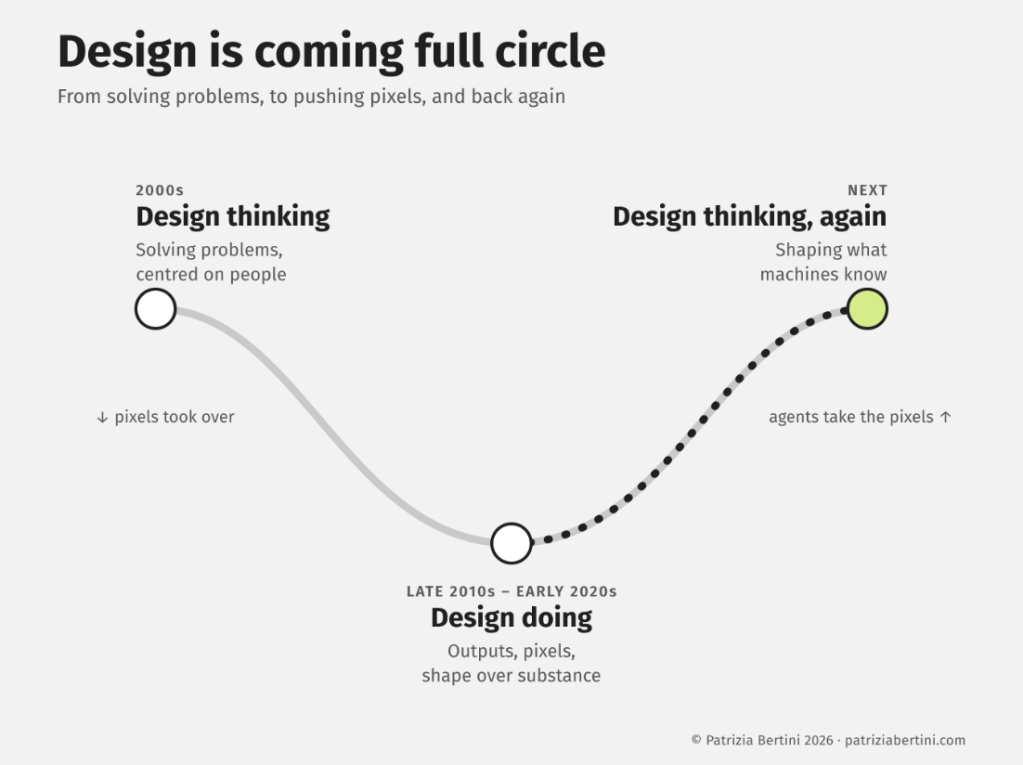
In 2008, Tim Brown of IDEO brought design thinking to a business audience in Harvard Business Review, and a year later Roger Martin made its business case: design as the art of solving problems, centred on people and driven by experiments. Boutique agencies boomed, large corporations bought them, and John Maeda tracked the wave in his first Design in Tech Report in 2015. I was part of that wave myself.
And this is how we moved from design thinking into design doing: the focus on outputs, pixels, layouts, expression. Shape more than substance.
It did not happen overnight. In my view, design doing took hold in the late 2010s and early 2020s, when three things happened at the same time.
- The tool became the studio. Figma launched in 2016, in the browser, built for teams, and within a few years design lived inside it. In 2022, Adobe agreed to buy it for $20 billion, a deal later abandoned under regulatory pressure. When one tool becomes the place where design happens, the work starts to look like … the tool.
- Value got a number. In 2018, McKinsey’s The Business Value of Design found that the top design performers had 32 percentage points higher revenue growth than their peers over five years. The report argued for design as a leadership practice. Many organisations heard something simpler: more design, more growth. So they scaled what was easiest to count: the output.
- Design joined the sprint. Designers moved into product squads and agile delivery. Design became a lane in the backlog, measured by tickets closed and screens shipped.
Then came the correction. From 2022, waves of tech layoffs, and design teams were not spared. In November 2022, ChatGPT arrived. The craft we had spent a decade optimising for was about to become the cheapest thing in the room.
Meanwhile, delivery had grown complex. In the 1990s, a webmaster could build an HTML page alone. Today, a digital experience needs many moving parts: content writing, video editing, visual design, branding, user experience, front-end coding, content management systems, back ends, repositories, design systems. Design had moved from thinking to doing, so it needed an operational layer to enable and orchestrate all of it.
This is where DesignOps entered the scene.
But when the output seems so easy to replicate, design that has lost its thinking becomes a “pixel pusher.” And a “pixel pusher” allows non-designers to question the value of design: if product managers know the problem (once core to design thinking) and can do “pixels”, where does design stand?
If someone learnt design for delivery, they may struggle to see the complexity and the beauty of design thinking. It had little to do with pixels and Figma. It was a mindset.
Some of us (older) design thinkers, who learnt design from those early papers and experiments, can see the direction. I, for one, see it clearly.
What did a stylesheet teach me twenty years ago?
When I was working in accessibility in the early 2000s, one thing excited me more than anything else.
A person with a visual impairment could simply override all the beautification of the UI with a simple stylesheet of their own. It forced the site to render the way they needed it: more contrast, larger fonts.
It was limited, of course. But it was an option.
The designer gave the content and its structure. The user decided the form. Hold on to that image, because it is coming back.
What happens when nobody sees the interface?
Fast forward to today. AI tools are building interfaces on demand, via prompts, with designers not pushing a single pixel. But the tools are not focusing on the problem as much as design did at the beginning.
Meanwhile, design systems have organised our assets, components, patterns and libraries. The next step is an ontological layer, where each element carries meaning, relationships and intention. Simply put, an ontology is a map of what things are and how they relate to each other.
In an ontology, a button stops being a blue rectangle. It becomes “the action that confirms a payment”, with rules about when it appears, for whom, and what it must never hide.
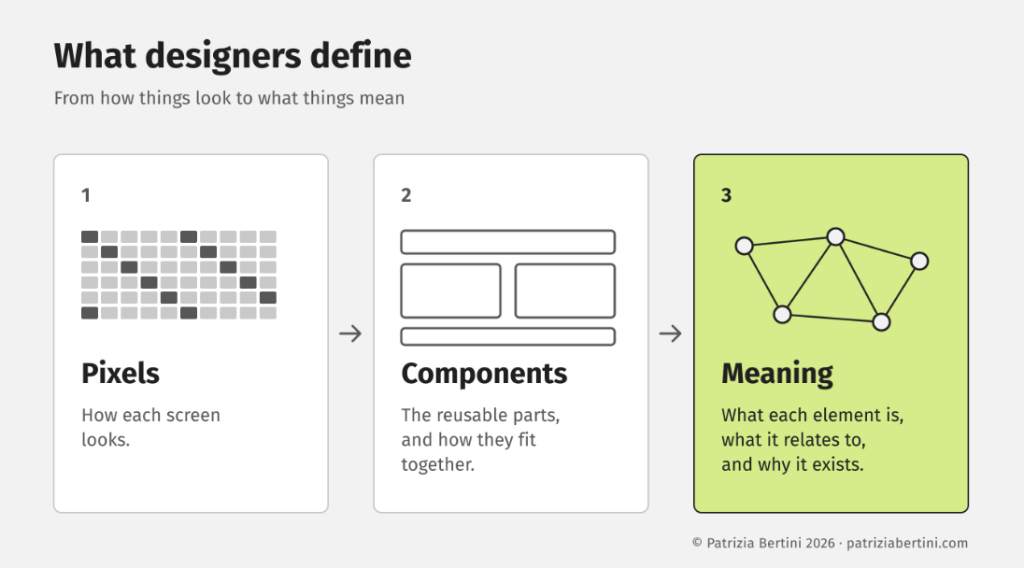
Think of it as three steps in what designers define:
- Pixels: how each screen looks.
- Components: the reusable parts, and how they fit together.
- Meaning: what each element is, what it relates to, and why it exists.
At the same time, devices keep multiplying: phones, laptops, smartwatches, glasses. We access information through sound, images, visuals and text, in very different contexts.
This is where the stylesheet comes back. In the same spirit as that user’s stylesheet, agentic assistants will use the layer of meaning to give each of us a personal, dynamic experience, based on incredibly detailed context: the device, the situation, our preferences, the specific need of the moment.
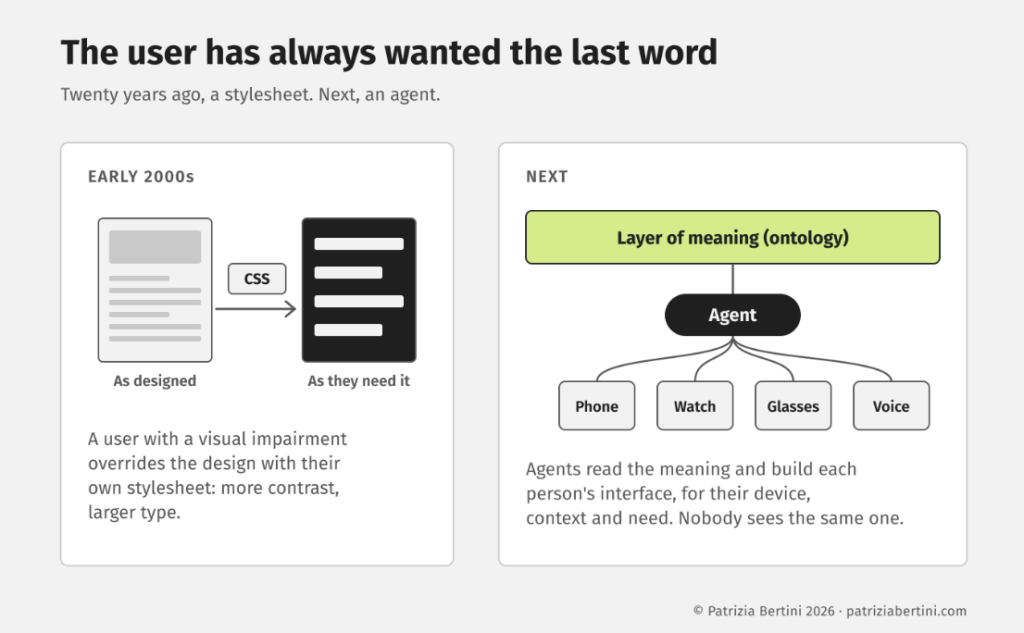
We won’t have any control over the interface. It may be conversational, graphical, agentic, or something we have no name for yet.
What does this mean in practice? Users won’t necessarily see and experience what designers do and see. They will have agents doing the interface for them.
John Maeda, whose reports once tracked design’s rise in tech, now says it himself. His 2026 Design in Tech Report is titled “From UX to AX”: from user experience to agentic experience. In his view, designers move from building screens to judging what AI produces.
I would go one step deeper. Before we judge what machines make, we need to shape what machines know.
Designers will not define interfaces. They will define relationships and variations, and work on ontologies and semantics, so experiences can be executed in the most fluid and personal way possible. Returning, again, to solving problems instead of focusing on pixels.
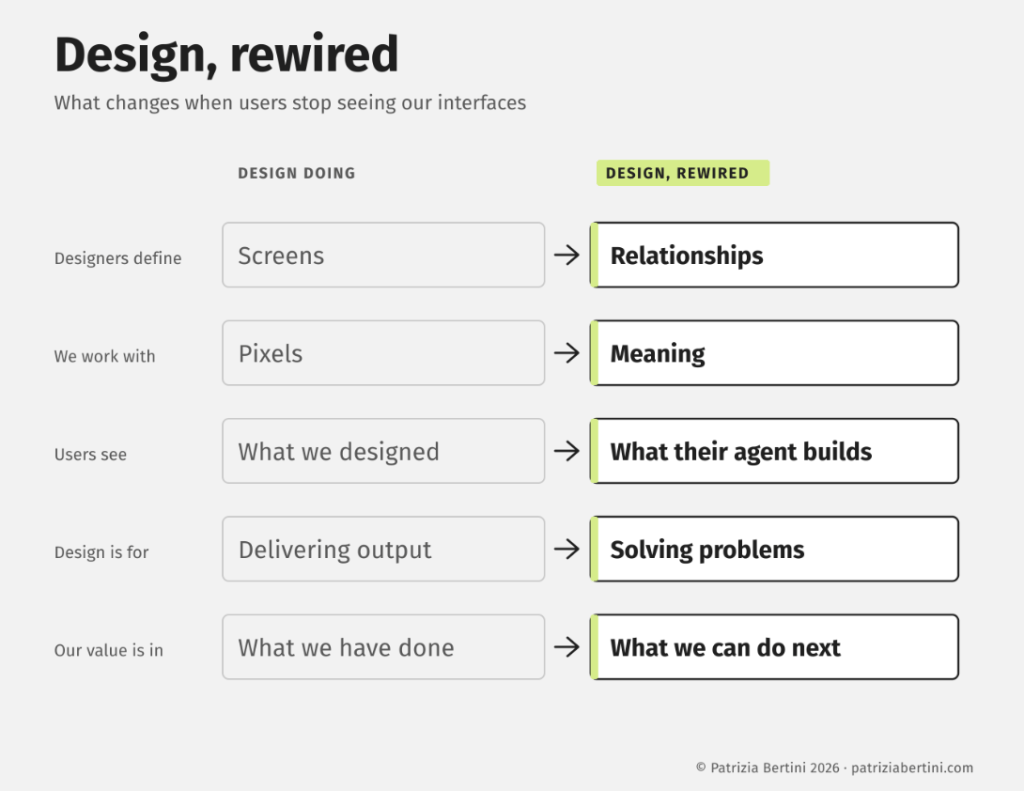
In one sentence: design is going to move into a space that is new and old at the same time. Its job is to define the information structures that will enable users to create their own experiences.
What does this mean for DesignOps?
While layoffs are growing, we are watching and wondering how to stay relevant. And we are not focusing on the direction of the change.
At the frontier of AI, the work is moving from surface to structure. Yann LeCun left Meta to build world models: AI that learns how the world works, not only how words follow each other. World models are not ontologies, but they point the same way, and ontologies are design’s version of that step, as I see it. Meanwhile, many designers still talk about Figma and pixels, and ignore the direction.
That, of course, impacts design operations. We have lost ground and traction because we look backwards and expect to solve problems that are fading away. We fail to be ahead of the curve, and to tell our partners, leaders and designers the hard truth: much of what we know may be outdated within months.
And there is one more force pulling design back towards meaning, one that few designers have noticed yet: the law. That adds another layer of complexity and urgency and whoich is the subject of my next article.
DesignOps can be a meteor: bright for a moment, then gone.
Or we can embrace ambiguity and uncertainty, and use our design mindset, our process focus and our problem-solving skills to enable and empower this transformation.
There is an incredible role to be played. But it requires acknowledging that what we have been doing cannot simply be scaled, or done better. The context around us has shifted so much.
There is one detail of Penelope’s story we often forget. She was weaving a burial shroud, and she was the one who unpicked it every night. She did it by choice, to buy time, because she knew exactly what she was waiting for.
We are not unpicking our own work. Technology does it for us, in an era where machines realise the product without any human hand on the loom. And the world we are waiting for, the one where a profession and a title kept us safe, is not coming home.
Our value is not in what we have done in the past, but in what we can do today and tomorrow, which is radically different and extremely necessary.
Penelope knew what she was waiting for.
Do we?
Thank you for reading. I write about design, systems and the human side of AI, and I work with organisations that want to get it right. You’ll find more of my work at PatriziaBertini.com.
Author’s Note: The ideas, the research and the arguments in this piece are human — mine. I used AI to help shape the form and structure, then went through every line myself. The images are AI-generated.


You must be logged in to post a comment.