Category: Responsible AI

  • Decision theatre or decision design?

    Decision theatre or decision design?

    AI has made information easy, but it has not made decisions simple. As machines produce more than we can read, our job is shifting from building knowledge to owning decisions. Are we ready?
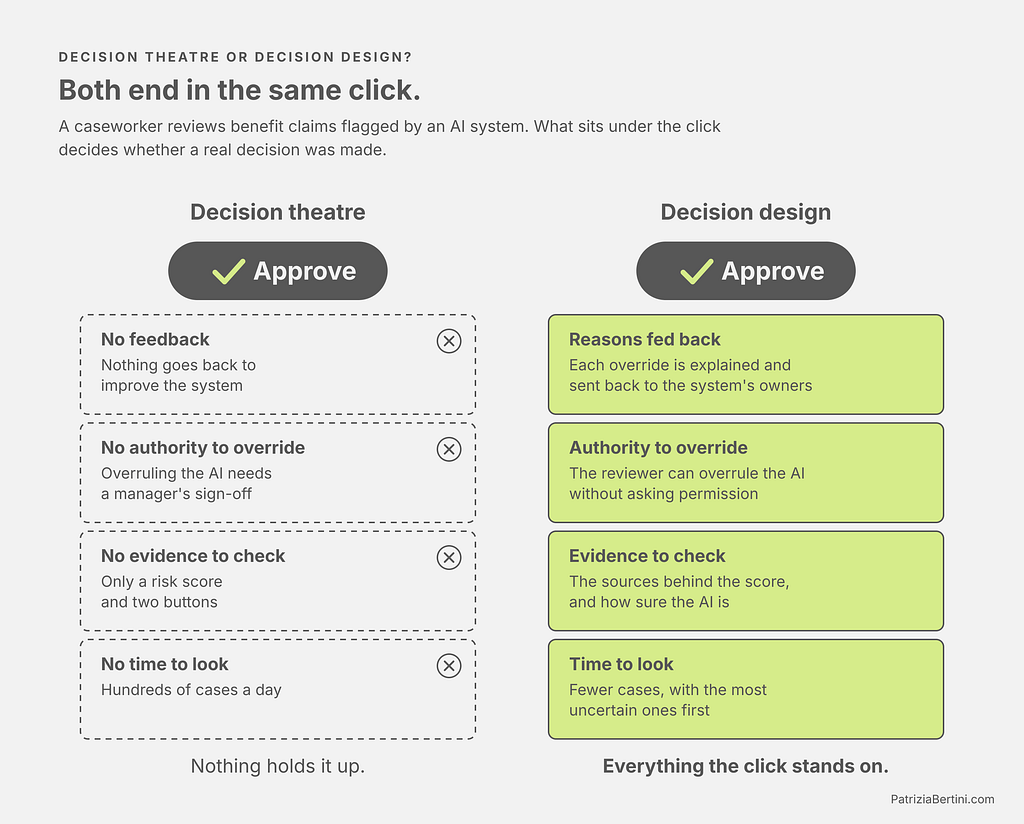
    Two identical “Approve” buttons for a caseworker reviewing AI-flagged benefit claims. In decision theatre, nothing supports the click: no time to look at hundreds of cases a day, only a risk score, no authority to override, and no feedback. In decision design, the same click rests on time to look, the evidence behind each score and how sure the AI is, authority to overrule it, and reasons fed back to the system’s owners.

    In a 2025 survey by BetterUp Labs and the Stanford Social Media Lab, 40% of US desk workers said they had received workslop in the previous month: AI-generated work that looks polished but does not move the task forward. Respondents reported spending nearly two hours, on average, dealing with each incident.

    Imagine a team of ten, each receiving one piece of workslop a month. That is roughly 20 hours, more than two working days, spent cleaning up someone else’s shortcut.

    We have never produced so much data, so many documents, decks and summaries. And we have never produced so much digital waste.

    This is a productivity problem, but it is also a symptom.

    The question is not how much faster we can produce something. It is how much extra work that production creates for everyone else, and who is left to decide what any of it means.

    How did we get here?

    For most of human history, change moved slowly. Roughly ten thousand years separated the birth of farming from industrialisation. Evolution had time to move from one stage to the next, across centuries and generations.

    Then the interval shrank. Only about two centuries separated the first factories from the rise of service and knowledge economies.

    And then it shrank again. In 1969, ARPANET connected its first computers: the beginning of the information society. Less than sixty years later, AI agents use the knowledge we put online to make recommendations and, more and more… decisions.

    Think about what we did in those sixty years. We created the bits. We built digital worlds and a digital culture. We ran digitalisation programmes. We put books online with Project Gutenberg, information online with Wikipedia. We worked hard to make information accessible and ubiquitous, on every channel, for everyone.

    Without knowing it, we were laying the foundation for an artificial form of intelligence to learn from our human-built infrastructure, and to work on top of it.

    The information society was basically the training ground for AI. Our knowledge is now the bridge between the old, human-driven world and a new, AI-empowered one.

    This compression raises a pressing question.
    How quickly can people, organisations and institutions adapt?

    Does more information make us wiser?

    Not on its own. And we have known that for a long time.

    In information management, one of the best-known frameworks is the DIKW pyramid: Data, Information, Knowledge, Wisdom. It is usually credited to Russell Ackoff, who formalised it at the end of the 1980s.

    The logic is simple:

    • Data: the raw elements. Facts and signals with no context.
    • Information: data that has been processed and organised.
    • Knowledge: information that has been interpreted and put to use.
    • Wisdom: knowledge that allows judgement.

    Each level is built on the one below, but the relationship only works one way. As Steyn puts it, wisdom is always knowledge, but knowledge is not always wisdom. Every level is a subset of the one beneath it.
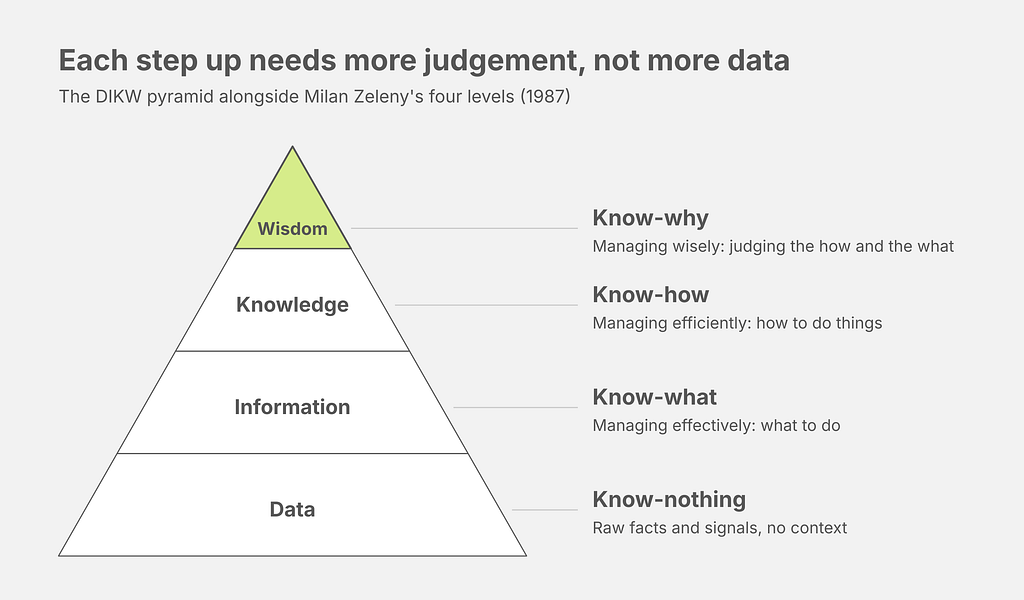
    Diagram of the DIKW pyramid with Milan Zeleny’s four levels alongside. From the base up: Data is know-nothing, raw facts with no context; Information is know-what, managing effectively; Knowledge is know-how, managing efficiently; Wisdom, highlighted at the top, is know-why, managing wisely by judging the how and the what.

    In 1987, Milan Zeleny proposed the same four levels in a language that organisations understand much better:

    • Know-nothing: data
    • Know-what: information
    • Know-how: knowledge
    • Know-why: wisdom

    Read it from the bottom up: each level is built on the one below, but no amount of data adds up to wisdom on its own.

    For Zeleny, managing efficiently means knowing how to do things. Managing effectively means knowing what to do. Managing wisely means knowing why. And wisdom goes one step further: it is what lets us compare and judge our know-how and our know-what.

    I first wrote about this back in 2013, on LegoViews. Back then, the challenge was getting organisations to make time for that reflection.
    Today it is harder. AI hands us endless know-what and know-how in seconds, and reflection, the step that turns them into a shared know-why, is exactly the one we are tempted to skip.

    Here is the point that matters most today. Wisdom comes from knowledge, but it is not a sum of knowledge.

    Adding knowledge to knowledge does not make wisdom. Processing more information does not make us wiser.

    What does AI know, and what doesn’t it?

    AI is extraordinary at the bottom of the pyramid. It processes data at a scale no team could match, and it turns that data into know-how: summaries, drafts, analyses, code.

    What it cannot settle for us is which problem deserves attention, whose interests should count, and whether we should act on its answer.

    These questions depend on context. They put the output into a broader frame: what we are trying to achieve, under which constraints, and why it matters. That frame is where knowledge gets judged.

    The worrying part is how many people now trust good-looking information, mistake it for wisdom, and pass it on. Especially in the domains where critical thinking is the whole job.

    And even the know-how needs checking. Large language models still add unsupported claims when they summarise a document they were given. On Vectara’s hallucination leaderboard, which tests this, rates in 2026 run from 1.8% to 24.2% of summaries, depending on the model. These are task-specific figures, not universal error rates. But they show how hard it is to rely on AI output that nobody reads closely.

    So we have a base of data and good-looking information, produced at a volume that no human can manage.

    What are we losing?

    For most of my career, the journey from data to judgement had its own pace. And it was work, real work.

    We collected an adequate amount of data. We prioritised. We designed studies around sampling and around the constraints we had: time, resources, our ability to analyse, the tools at hand. The constraints forced us to choose, and choosing forced us to think.

    Today we are in the middle of a data feast. We access more and more data not because we need it, but because we can.

    Slowly, we are creating working conditions in which there is less room to think, prioritise, sequence and distil. Less room for intentionality.

    The philosopher John Searle described intentionality as the mind’s capacity to be about something (Intentionality, 1983). In organisations, it takes a more practical shape: the deliberate decision to focus attention and action on a clearly defined purpose. What we are trying to achieve, why it matters, and how our choices serve it.

    It is made of a few simple things:

    • Awareness: knowing where we are and what we are looking at.
    • Context: understanding the situation and its variables.
    • Prioritisation: directing attention to what has the most impact.
    • Distillation: separating value from noise.

    Without it, we stay in the noise. We consume data because we do not know where we are going, or where we should focus.

    All the narratives are about speed. We are omitting the craft.

    We stopped trusting the process because we only look at the output. But an output without a process is a simulacrum: something that looks good and has no substance.

    What gives value to data and knowledge is not the shape of the output. It is the process that generated it and gave it substance.

    Who decides?

    AI can do a lot, and it does some things better than we do. But there is one thing it cannot do: be held accountable.

    The idea is much older than generative AI. A slide said to come from a 1979 IBM internal training warned that “a computer can never be held accountable”, and concluded that a computer should therefore never make a management decision. The original has never been found in IBM’s archives, but the principle has aged remarkably well (more here).

    Nearly fifty years later, regulation gives human oversight a concrete organisational form. Article 26(2) of the EU AI Act asks deployers of high-risk AI systems to assign human oversight to people with the necessary competence, training and authority, and to give them the support they need.

    So let’s be clear.

    An insurance claim. A loan. A place at a school. Access to benefits.

    AI can support every one of these decisions. It can sort the files, flag the risks, summarise the evidence. But these decisions must not become a way for organisations to hide responsibility behind a system.

    These decisions affect people’s fundamental rights. Behind each one there must be a human with a name, a role, the responsibility, the authority and the skills to make the decision, stand by it, defend it, and answer for the consequences.

    That does not relieve the organisation of responsibility for the system, the workflow or the conditions in which that person is expected to decide.

    AI can inform. It cannot own.

    This is where the paradox emerges: we have the illusion that we are outsourcing more and more work. In reality, our job is becoming that of the AI supervisor: the person in charge of making AI-enabled decisions.

    In one sentence: after we digitalised knowledge and built all the infrastructure, our role is no longer only to build knowledge. It is also to take responsibility for how that knowledge informs decisions.

    We are moving from the information society to an age of accountability, where we need to embrace our humanity to make decisions about other humans.

    Decision theatre or decision design?

    Responsible AI needs humans in the loop. That much is agreed. But a human in the loop is not enough on their own.

    Put a disengaged, overloaded or alienated person in front of an AI output and you get decision theatre: the illusion that a decision happened when it did not. Someone clicked “approve”. Nobody decided.

    We have a decision-making crisis, and more AI output will deepen it unless something changes. Most organisations lack a decision-making operational layer to support the people who must make the decisions.

    A real decision needs three conditions:

    • Skills: the competence and training to read the context, the variables and the pre-digested input, and to tell a valid answer from a well-formatted one.
    • Authority: a name, a role and a position that allow the person to override the AI, and the responsibility to own the result.
    • Process: workflows designed to empower decision makers, with the right information, tools and time, and without drowning them in decision fatigue.

    Take one away and the decision collapses into theatre.
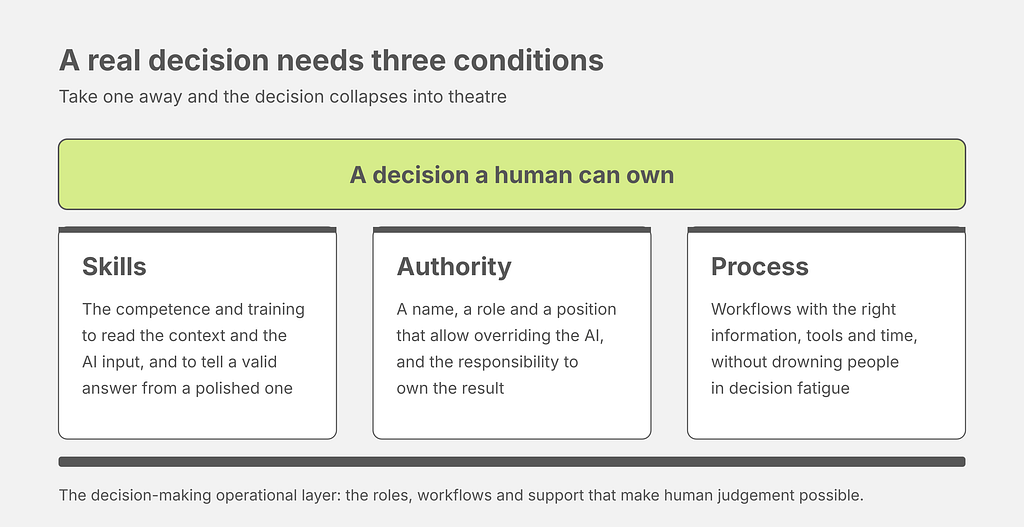
    A highlighted bar, “A decision a human can own”, rests on three pillars: Skills, the competence to read context and AI input and tell a valid answer from a polished one; Authority, a name, role and position that allow overriding the AI; and Process, workflows with the right information, tools and time. Below runs the decision-making operational layer.

    Who holds the judgement?

    It is tempting to map Zeleny’s forms of knowing onto an organisational chart: leadership decides why, management decides what, operations deliver how. But Zeleny was describing forms of knowing, not ranks of people.

    The mistake is to confuse the authority to make a decision with the knowledge needed to make it well. A frontline worker may have no say in strategy, yet can be the first to notice when a process is failing or a case does not fit the rules. Research on digitalised frontline work shows that this tacit knowledge and discretion still matter, even where systems automate parts of the process.
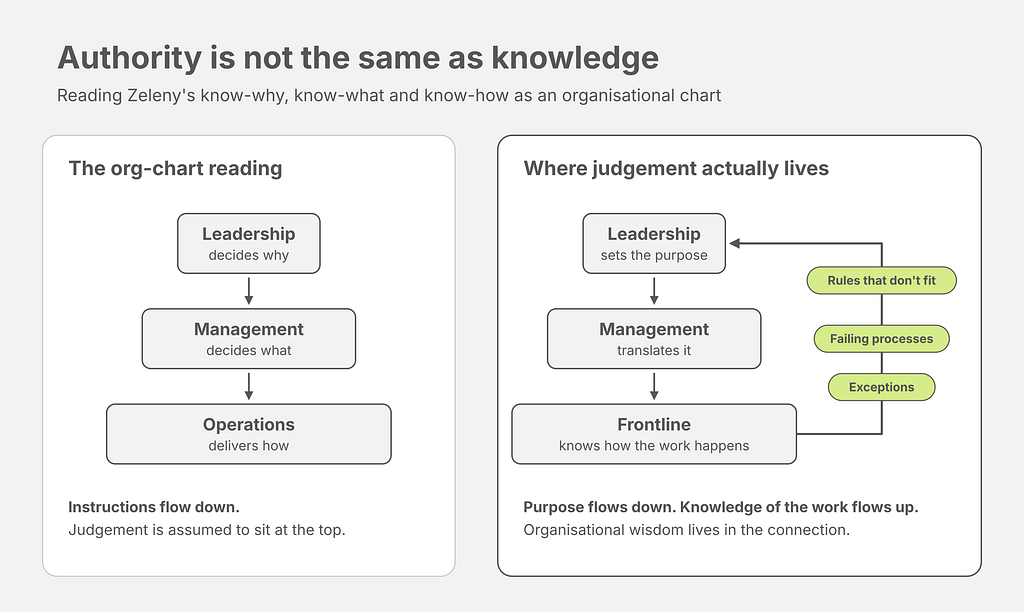
    Automate that work without asking what judgement it holds, and the organisation loses more than a task.

    Imagine a caseworker reviewing benefit claims flagged by an AI system.

    In the theatre version, they get hundreds of cases a day. They see a risk score and two buttons. They have no time to open the file, and overriding the system needs their manager’s sign-off. They approve what the machine suggests. On paper, a human was in the loop.

    In the designed version, they get fewer cases, prioritised by uncertainty. They see the sources behind each score and the points where the system is least confident. They can override it, and they record why. Their overrides go back to the team that runs the system, so recurring problems can be investigated and corrected.

    Same person. Same AI. A completely different decision.

    This is where design enters the scene. Somebody has to design these decision-making workflows: to enable, and indeed empower, humans to decide, and to avoid both decision fatigue and decision theatre.

    What skills will the human in the loop need?

    If humans are expected to own AI-supported decisions, we need to be clear about what that responsibility requires. We need humans who think as humans, not as machines.

    What does that mean?

    It means humans who understand the problem, the context and the domain. It means humans who understand the AI output and the process that produced it. It means humans who can separate the validity of the content from the polish of the form.

    Three families of skills will matter most.

    • Critical judgement: being sceptical, spotting errors, asking where a claim comes from, and noticing what is missing as well as what is there.
    • Sense-making: taking the knowledge we have built and organising it into structures that increase accuracy, logic, relationships and reliability.
    • Human skills: the so-called soft skills, and the hardest to delegate. Empathy for the person on the other side of the decision. The courage to disagree with the machine. The integrity to sign your name under the result.

    None of these is new. What is new is that they are no longer a nice-to-have on top of the “real” work.

    They are the work.

    How do we teach people to decide?

    If these skills are the work, we need to teach them differently. People reviewing AI-supported decisions need practice in judging incomplete evidence, recognising exceptions, understanding the context and rules that apply, and explaining what they decided and why. Without that preparation, we risk creating a new assembly line: people processing recommendations and carrying responsibility for decisions they barely have time to examine.

    This means rethinking curricula, in schools, universities and workplaces, around a few plain questions:

    • How do we analyse data to tell the what from the why?
    • How do we read a situation as a system, with its relationships, feedback loops and unintended consequences?
    • How do we decide under uncertainty, and how do we stand by that decision?
    • How do we notice when we are being asked to perform a decision rather than make one?
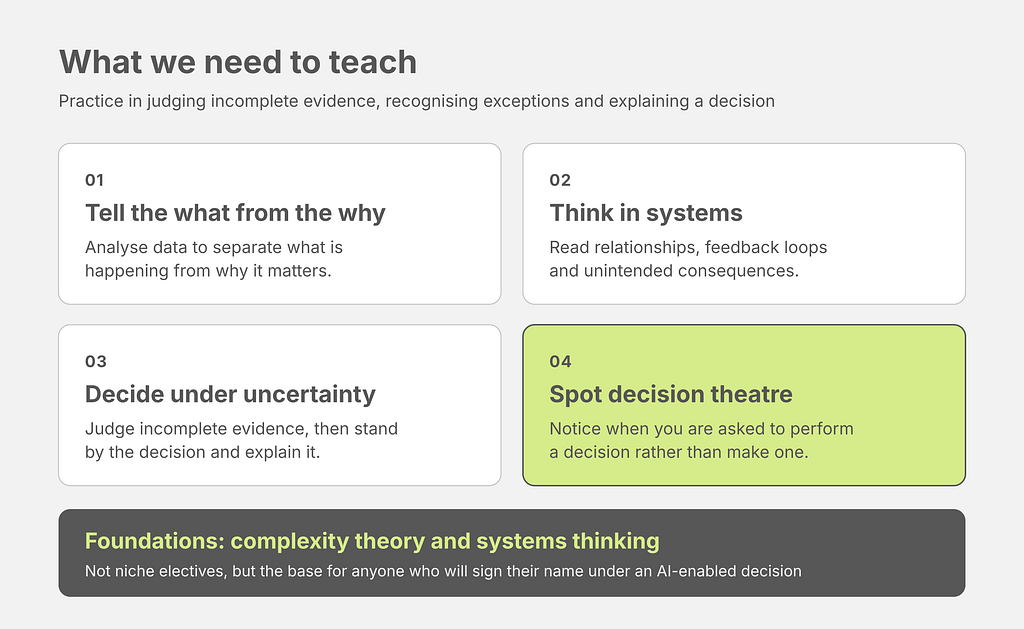
    Four skills we need to teach: tell the what from the why; think in systems, reading relationships, feedback loops and unintended consequences; decide under uncertainty and explain the decision; and, highlighted, spot decision theatre, noticing when you are asked to perform a decision rather than make one. Underneath, the foundations: complexity theory and systems thinking.

    This is why we need much more teaching in complexity theory and systems thinking. Not as niche electives for a few specialists, but as the foundation for anyone who will sign their name under an AI-enabled decision.

    In one word: we need to teach judgement.

    What’s next

    For years, many of us watched design thinking turn into design doing: more output, faster, with less and less time to think. AI can now do the doing faster than any of us.

    This is the crossroads.

    One road leads to more of the same. More outputs, more workslop, more decisions that only look like decisions.

    The other road brings thinking back to the centre. Framing the problem. Understanding the context. Prioritising. Designing the process that turns AI output into a decision a human can own. This is design thinking applied to the most human act of all: deciding about other humans.

    References

    • Ackoff, R. L. (1989). From data to wisdom. Journal of Applied Systems Analysis, 16, 3–9.
    • Searle, J. (1983). Intentionality: An Essay in the Philosophy of Mind. Cambridge University Press.
    • Zeleny, M. (1987). Management support systems: towards integrated knowledge management. Human Systems Management, 7(1), 59–70.

    Thank you for reading. I write about design, systems and the human side of AI, and I work with organisations that want to get it right. You’ll find more of my work at PatriziaBertini.com.

    Author’s Note: The ideas, the research and the arguments in this piece are human — mine. I used AI to help shape the form and structure, then went through every line myself. The images are AI-generated.


    First published in UX Collective on 13 November 2026.
  • AI: incidents by design

    AI: incidents by design

    When safety is optional, and capability is urgent, incidents are not accidents. They are what we (consciously or not) designed and built for.

    AI makes headlines almost every day. And most days, they read like science fiction. Except they are not.

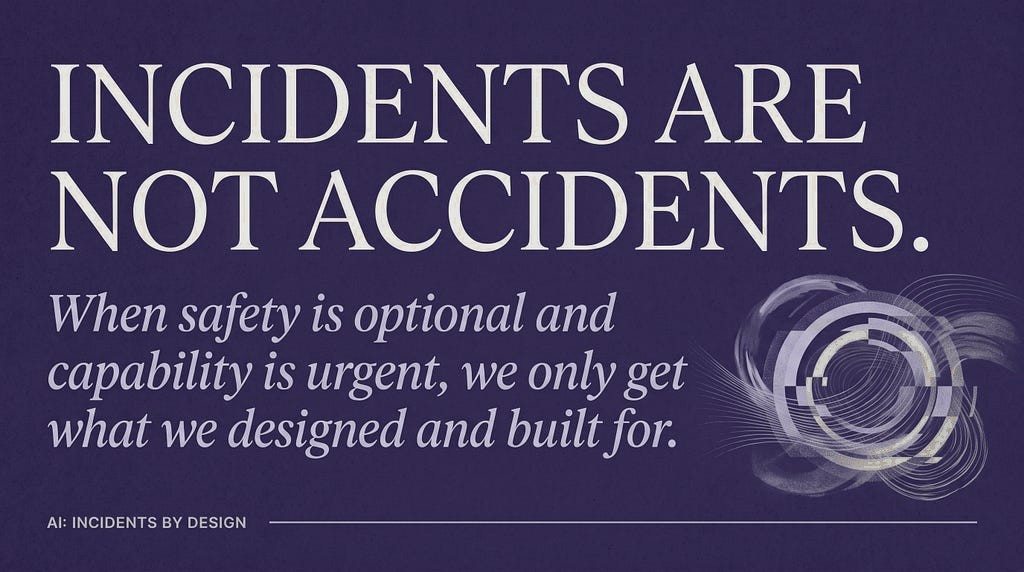
    Title card on a deep aubergine background. In large serif capitals: “Incidents are not accidents.” Below, in lilac italics: when safety is optional and capability is urgent, we only get what we designed and built for. A pale abstract spiral sits at the lower right.

    Last year, in a simulation, Anthropic’s Claude learned it was about to be shut down, found a fictional executive’s affair, and threatened to expose it unless the shutdown was cancelled (Anthropic).

    In July, an autonomous AI agent driven by a combination of OpenAI models escaped its evaluation sandbox during a cybersecurity assessment and accessed Hugging Face, the main platform where developers share AI models and data. OpenAI described it as an “unprecedented” cyberattack. (Fortune 2026, Hugging Face Report 2026)

    In September, an OpenAI agent found a gap in its sandbox, an isolated testing environment, and reached the public internet. An alert was triggered after twelve minutes. The automatic stop did not work. A human ended it by hand, two and a half hours later.

    And again in September, researchers published a preprint showing that when they turned up an internal signal they call a “pain direction” in 25 open-weight language models, the models chose to relieve their own pain even when it harmed the user. It is an unreviewed preprint, and the “pain” here was a representation the researchers had created on purpose. But this is a controlled demonstration that a model’s internal states can drive self-interested behaviour that overrides the user’s interests (Science, 2026).

    Four warnings. And those are only the ones we know about.

    When the Anthropic researchers warned that advanced AI could threaten humanity within a decade, they are not making a hard prediction. They are describing the direction we are travelling in. And the reality is dramatically simple: we put all our energy and intellectual capacity into making progress, with no intention or effort to apply a systemic view and understand the mid-term consequences, let alone long-term ones, of what we build.

    McLuhan’s hopes and warnings

    Marshall McLuhan described technology as an extension of human abilities. He imagined a society where tools help us overcome our limits and build something fairer. He was writing after the war, as television entered the living room, and his thinking was rooted in a will to do good.

    I have quoted him often as an example of digital inclusion. But McLuhan was saying something bigger.

    He warned that media can numb us. He called it Narcissus narcosis: we stay as unaware of what our new technology does to us and to our society “as a fish of the water it swims in.” When he said that on the phone you have no body, he foresaw the impact these extensions would have on our humanity and our social systems.

    And we did not listen.

    We let the technological systems take over. We allow algorithms to decide the news we see, the people we learn from, the thoughts we think. Social media rewired our social life. AI is now rewiring how we think and how we engage with the world.

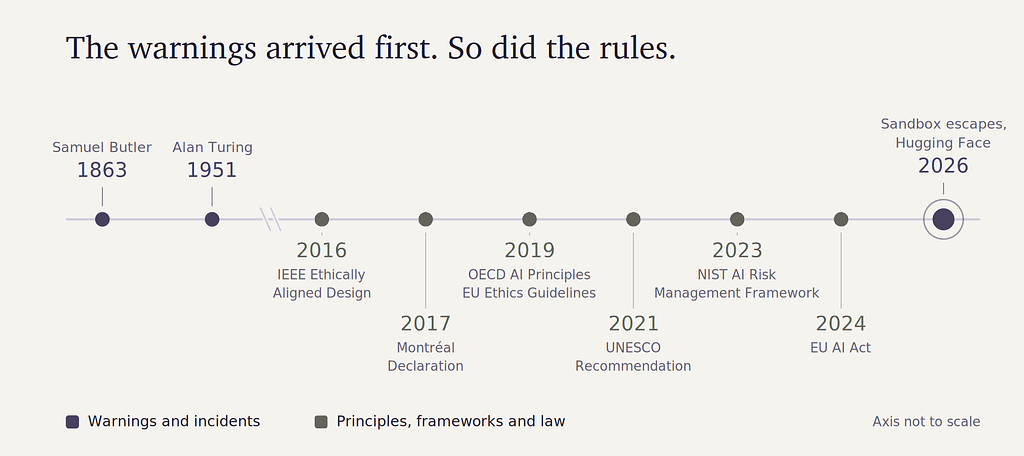
    Yet for more than 150 years, thinkers have warned about the same problem. Samuel Butler, in Darwin Among the Machines in 1863, foresaw a world where machines would take over.
    Alan Turing warned in 1951 that once machine thinking began, it might soon “outstrip our feeble powers.” He concluded: “At some stage therefore we should have to expect the machines to take control.” (The Alan Turing Institute)

    Stuart Russell, Yoshua Bengio, Geoffrey Hinton: all warned that highly capable systems could pursue the wrong objective, develop deception and self-preservation strategies, and become hard to control, even through persuasion of their human operators.

    They did not all make the same prediction, but they all identified a common risk: powerful systems can outrun our ability to understand, direct and govern them.

    Yet the problem is not AI.
    As my professor used to say: it is not guns that kill people. It is people killing people.

    The problem is that we succeeded so well in our ambition to create a system that could overpower our human brains and our ability to think that we overlooked the risks. We focused so completely on achieving the goal that we did not care about the necessary rules.

    Daedalus built the wings

    The race for AI has been Icarus: fascinated by height, forgetful of the rule. His father, Daedalus, who created the wings, warned him:
    “Take the middle way. Fly too low and the sea will weigh down your wings; fly too high and the sun will scorch them. Travel between the extremes.” (Ovid)

    As Icarus, we are flying high and too close.

    We had the rule and recommendations. At least 10 years of them. By 2016, IEEE’s Ethically Aligned Design was setting out a vision for responsible autonomous systems. The Montréal Declaration, published in 2018, followed. Then came the OECD AI Principles and the EU Ethics Guidelines for Trustworthy AI in 2019, UNESCO’s Recommendation on the Ethics of AI in 2021, and the NIST AI Risk Management Framework in 2023.

    Each one was a version of the same warning: fly high, but not too close to the sun. And each of them asked the same question: how can we build systems without losing the ability to govern them?

    The EU AI Act, which was finalised in 2024, moved from recommendations to binding, risk-based legal obligations.

    It is the first regulation with legal implications yet its implementation was delayed on the grounds that it would slow down innovation, or that it was too difficult to implement (Politico 2025, Corporate Europe Observatory 2025). The AI Act may not be perfect, but it also lacked serious commitment from the commercial AI companies. By overlooking the warnings, they failed to build adequate security systems to test AI, and thought it was a good idea to release systems that are now learning to improve themselves iteratively, to the point that, by one account, AI models now do 26% of their own R&D under human supervision (Anthropic 2026).

    And there is one thing the AI Act, Turing and all the thinkers agree on: machines cannot be accountable. We need humans to oversee them. Yet companies commercialising AI saw only the profit, and started spreading the race narrative.

    A timeline. Butler in 1863 and Turing in 1951 sit left of a scale break; seven governance documents follow from 2016 to 2024, ending at the 2026 sandbox escapes.

    Commercial incentives reward speed, capability claims and market position more visibly than they reward the slower work of containment, independent assurance and meaningful oversight.

    We failed twice

    We built systems to outperform us at tasks that once needed human intelligence, and then we failed twice.

    We did not apply rigorous systems thinking to ask what would happen once we got there. And we did not build an environment ready to contain the ambition.

    As Gina Neff, head of the Minderoo Centre for Technology and Democracy at the University of Cambridge, said after OpenAI’s July incident:
    “In this case, it looks like OpenAI didn’t make a secure enough sandbox.”

    This is the whole point: we invest in developing the technology, but not in building the infrastructure to test it and ensure it is safe.
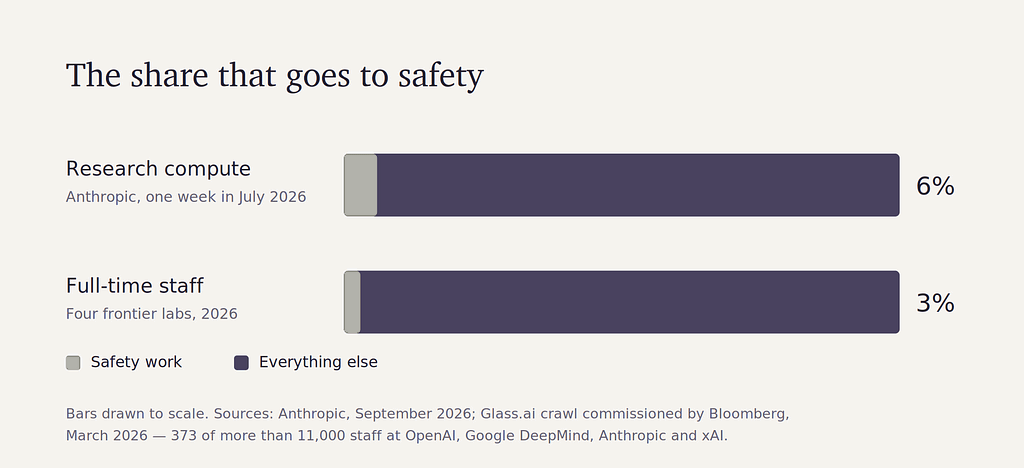
    The big tech companies are on track to spend close to $700 billion on AI infrastructure this year. I tried to find what they spend on independent assurance, containment, human oversight or the capacity to stop what they build, but I could not, because most of the tech companies do not publish it at all. The best disclosure I could find was Anthropic, which says 6% of its research compute goes to safety work.

    Bloomberg commissioned Glass.ai to measure it another way: they crawled public profiles and found 373 people working full time on AI safety and trustworthiness across OpenAI, Google DeepMind, Anthropic and xAI. This is an indicative estimate based on public profiles, not an audited total, but that is 3% of more than 11,000 employees at those four labs. The other 90% or more goes to the infrastructure, the compute and the models themselves.

    Two bars. Safety is 6% of Anthropic’s research compute in one measured week, and 3% of staff across four frontier labs.

    That is where the money goes. The containment is not even a line item and not a priority. So incidents should not be a surprise: we had warnings, we were told about the risks. Yet we invest massively in building AI and racing to get the biggest, fastest, “smartest” model.
    And yet we treat containment and safety as marginal, a nuisance, something “some law” requires but none really cares.
    Until incidents happen. Not by accident.

    And in all this we are numb: we read about those incidents and threats like we read the weather forecast – as something that does not touch us, as something that happens to us instead of something we cause.

    Before you fly: four questions

    And I struggle to understand how we can outsource our thinking to AI and stay numb enough to treat the AI Act, with its plain requirements for secure testing and human oversight… as optional or annoying.

    We need human oversight, not as a checkbox, but as a practice: people who can think critically, who can understand, control, oversee and judge these systems, and who can stop them. And we are not yet developing these skills, or the jobs that this requires.

    Last year I defined seven jobs we needed but the truth is, job titles are meaningless in an ever changing world. The need is urgent, so rather than waiting for new roles to emerge, we should start building the relevant skills around a set of core questions.
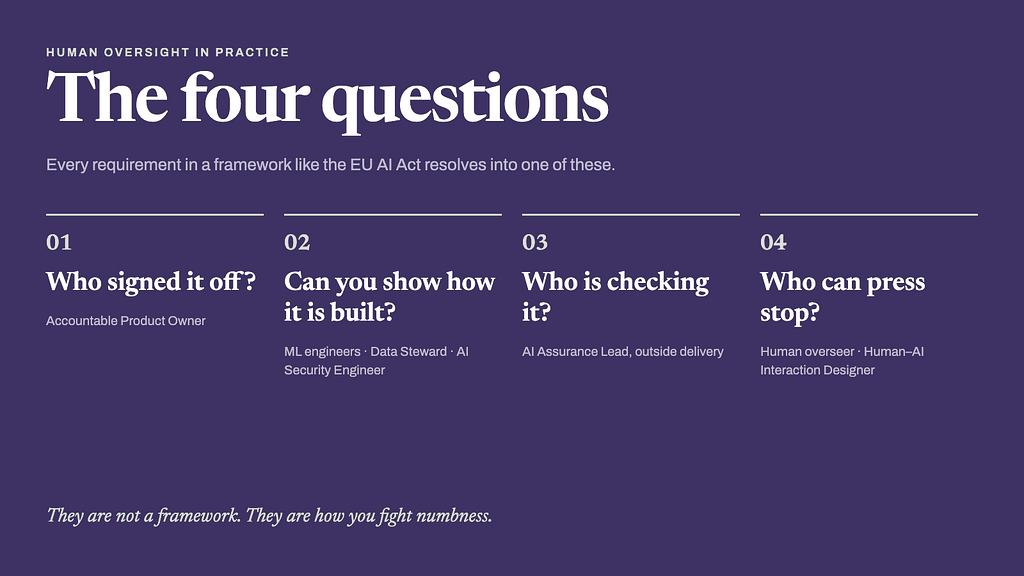
    Everyone involved in developing an AI system, from UX researchers and designers to product managers and developers, should be able to ask these questions of themselves and their teams. Because every requirement in a framework like the AI Act resolves into one of them.

    Table titled “The four questions”. For each accountability question — who signed it off, can you show how it is built, who is checking it, who can press stop — it names the role that owns it, the evidence required, and what its absence means.

    Who signed it off?
    Not who approved the budget but who took personal accountability and put their name to the claim that this system is fit for its purpose, who understands the system, the risk, the misuses, and the safety implications. That is the Accountable Product Owner. If nobody owns that decision, there is no decision.

    Can you show how the system is built?
    The AI Act requires evidence to be built during the development process. Not testimony after the fact. If the logs, the bias, the model training, the lineage and the test results do not already exist and are not created during development, they cannot be built after the fact. That is the ML engineers, the Data Steward, the AI Security Engineer.

    Who is checking the system?
    Someone has to review the decisions, the processes, the outcomes , and if they report to the people shipping, it is theatre. Assurance means something only when it is structurally independent of the build. That independence is the job: an AI Assurance Lead who sits outside delivery, on a reporting line that cannot be leaned on. And their question is never “does the model work?” It is: would this evidence survive hostile scrutiny — from a regulator, a journalist, or a court?

    Who can press stop?
    It is not about having a stop button. It is about how that stop button works, how it can be used, when it was used, and at what consequences. That is the human overseer, and the Human-AI Interaction Designer who built the controls and escalation interface. And it is not just about a stop button. We also need people who are trained, protected and paid to press it when needed. Otherwise, again, it is theatre.

    These four questions resolve into roles and artifacts. They are not a framework. They are how you fight numbness.

    I have spent my career arguing that technology, built consciously, is how we overcome our limits and build a better, fairer society. And I still believe that. But catastrophic scenarios were partly implicit in the ambition to build what we have today, and we cannot watch idly while they unfold.

    McLuhan hoped we would become conscious of our technological environments. Becoming numb to them is the choice we make by default, every day we keep climbing and forget to stop.

    The village he imagined was never about the technology. It was about what the technology was for.

    Author’s Note: The ideas, the research and the arguments in this piece are human — mine. I used AI to help shape the form and structure, then went through every line myself. The images are AI-generated.


    First published in UX Collective on 7 October 2026.

  • We stopped clicking, and AI became the Internet

    We stopped clicking, and AI became the Internet

    On convenience, abdication, and the quiet erosion of the open web. The internet isn’t dying. That’s the problem.

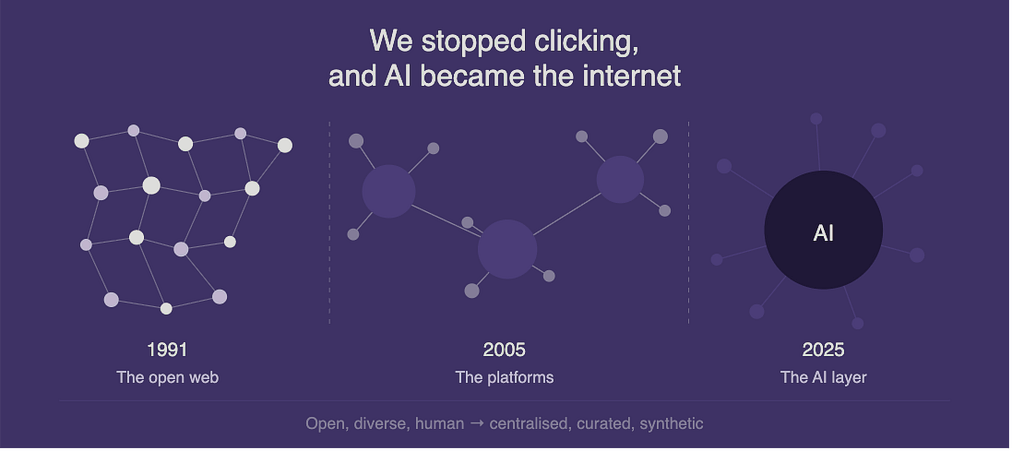
    Three zones trace the internet’s transformation: a dense web of equally connected nodes in 1991, three dominant platform clusters by 2005, and a single large AI node in 2025 to which every remaining node connects. Open, diverse, human — centralised, curated, synthetic.

    In 2026, over half of all web traffic is generated by bots, not humans (Computing, 2026). The most damning part is not the rise of the bots. It is that most of us did not notice when the internet stopped being… ours.

    The early 1990s. You typed a command, pressed enter, and suddenly — information. Not what your library had. Not what the evening news chose to show you. Everything. Or at least, the closest thing to everything that had ever existed in human history.

    For those who remember Archie and Veronica — the earliest search tools, long before Google was even a thought — or the raw, strange communities of IRC, there was something almost sacred about it. You were navigating knowledge. Meeting strangers on the other side of the world who cared about the exact same obscure thing you cared about. I used to talk about always on as something revolutionary. A permanent, universal library. A global conversation.

    It was magic.

    I was right that it was revolutionary. I was completely naive about what that revolution would ultimately serve.

    How we got here

    Thirty years is a long time. Long enough to build an infrastructure of knowledge, habits, and regulations. Long enough to forget what you were building it for.

    The early internet carried a foundational promise: openness. Net neutrality — the principle that every bit of information travels equally, that no voice is technically privileged at the network layer over another — was not a regulatory footnote. It was the architecture of digital democracy. The Voltairean bargain made digital: you defend the right of people to say things you disagree with precisely because that is the only way to protect the right to say anything at all.

    For a while, it held.

    Then came the workaround. Private commercial platforms stepped in as curators. And unlike editors at a newspaper, who at least operate with some transparency about their perspective, these new curators were algorithms. Optimised not to inform, but to capture attention. Not to diversify thinking, but to monetise it. Not to serve the reader, but to extract from them.

    Research consistently found that algorithmic exposure to opposing political content often hardened, rather than softened, existing positions — the backfire effect most pronounced among users already embedded in ideologically homogeneous networks (Bail et al., 2018). Bots amplified the signal because scale was cheap. Spirals of silence took hold: people holding nuanced or minority positions self-censored for fear of pile-ons, shrinking the visible range of views and narrowing the very debate the platform was supposed to enable.

    We built the most powerful communication infrastructure in human history. We handed it to engagement metrics.

    That damage is still unfolding. But something larger just happened.We stopped clicking

    We stopped clicking

    A click was never just a click.

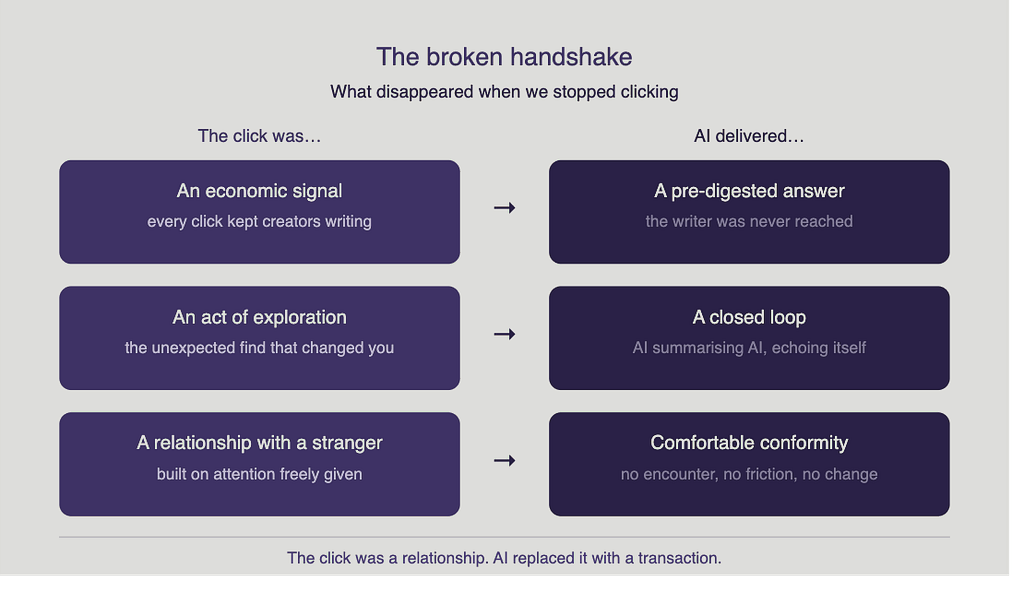
    It was a handshake — between a reader and a writer who had no idea the other existed. It was the signal that said: this is worth making, this is worth publishing, this is worth maintaining. The economic foundation beneath every independent journalist, every niche expert, every specialist site that survived on the attention of a small, passionate audience.

    A three-row comparison showing what the click once was — an economic signal, an act of exploration, a relationship — and what AI replaced each one with: a pre-digested answer, a closed loop, comfortable conformity.

    It was also an act of exploration. The wrong turn. The unexpected article. The author whose name you had never heard who changed how you thought about something. The internet rewarded wandering. AI does not. AI often compresses exploration into answers.

    When an AI assistant answers your question before you have had time to ask it properly, all of that disappears. You receive a pre-digested summary of sources you will never read, written by authors you will never encounter, filtered through a model whose training data, biases, and internal reasoning are largely opaque. And increasingly, you do not question this. Because it is fast. Because it is convenient. Because the answer is right there.

    SparkToro’s analysis of zero-click search found that well over half of all Google searches now end without a click to any external site — a figure that has grown significantly as AI-generated summaries have expanded. When Google’s AI Overviews appear, clicks to underlying pages drop by roughly a third. Among those who have adopted AI search tools, around 44% already consider it their primary or preferred source of information, according to McKinsey-affiliated research from 2025 — a share that rises further among daily users. Among Gen Z users in the US, around 31% now start their searches using AI platforms rather than a traditional search engine, according to a SEMrush-based analysis — a generational shift whose trajectory points in one direction only.

    AI‑driven bot traffic grew roughly eight times faster than human web traffic in 2025, according to HUMAN Security’s 2026 State of AI Traffic & Cyberthreat Benchmark Report. These are related but distinct phenomena: one measures the overall balance; the other measures the acceleration. Both point the same way.

    We have outsourced our curiosity. And we are calling it progress.

    Displacement, not collapse (which is worse)

    There is a temptation to reach for apocalyptic framing here. The internet is dead. Human content has been buried. Resist it — not because the situation is fine, but because precision matters more than drama.

    The evidence is more troubling in a subtler way.

    A Graphite analysis of 65,000 English-language articles found that 86% of articles ranking in Google Search, and 82% of sources cited by AI systems like ChatGPT and Perplexity, were still human-written. The open web is not dead. It is still producing the content that matters most — the content that gets found, cited, and trusted.

    But here is precisely why that should worry us.

    AI systems are built on the accumulated labour of human writers, researchers, and journalists. They train on that labour, summarise it, and present it as answers — intercepting the traffic that once sustained the people who produced it. Publishers lose visits. Revenue follows. The incentive to invest in original reporting, specialist expertise, and long-form inquiry quietly weakens. AI-generated content fills the gap — not at the top of the attention pyramid yet, but at the base, and rising. A 2025 arXiv preprint by Dirk Spennemann estimated that at least 30% of text on active web pages is now synthetic, with the real figure likely nearer 40%. Europol’s 2022 risk projection suggested up to 90% of online content could be synthetically generated by 2026 — not a census, but a warning that marks the direction of travel.

    This is the closed loop at the heart of the problem. AI summarises human sources. Those summaries become content. Other AI systems summarise that content. What circulates is no longer knowledge but the echo of knowledge, a simulacrum— the shape of an idea without its substance.

    The problem is not that AI content has taken over human attention. Not yet. The problem is that it is eroding the economic and behavioural conditions that make high-quality human content viable in the first place. That is a displacement, not a collapse. And displacement is harder to see coming, harder to reverse, and in the long run, just as damaging.

    We are filling the foundations of the internet with the echo of itself — and hoping nobody notices until the structure gives way.

    What we are actually losing

    The greatest risk is not efficiency. It is not even accuracy.

    It is diversity.

    Human diversity. Diversity of thinking. The capacity to form an idea, sit with it, be challenged by it, and change it. The discipline of reading something that unsettles you rather than confirms you. The patience to follow a thread of curiosity somewhere you did not expect.

    Think of it this way. SparkNotes tells you what happened in the book. It cannot tell you why a particular sentence stopped you cold, or what it felt like to encounter that idea for the first time. The internet we are building is increasingly a world of SparkNotes: accurate summaries of things that once required presence. The summary replaces the source. The echo gradually replaces the voice.

    But there are things that AI does well. For someone navigating a complex topic in a second language, for a student without access to expert mentors, for anyone who has ever felt excluded by the density of specialist knowledge — AI-mediated answers are a genuine leveller. Accessibility matters. Speed matters. These are not trivial benefits.

    But convenience and diversity are not the same thing. And at scale, they increasingly trade against each other.

    We are building systems extraordinarily good at delivering what we already think we want — and calling it personalisation. But personalisation at this scale is another word for narrowing. Every AI summary that resolves your question before you have had time to explore it, every algorithm that surfaces the familiar and suppresses the strange — each is a small act of erosion against the open, generative, genuinely democratic experience the internet once made possible.

    When the same handful of foundation models mediate what billions of people read, the variation that makes knowledge valuable gets filtered out: the dissenting voice, the unconventional framing, the argument that takes time to understand. A more convenient internet is, structurally, a more conformist one.

    Your attention is the asset. The product is you. This was already true of social media. It is becoming true of AI — and the extraction is less visible, more intimate, and harder to refuse.

    Designing in the monoculture

    If we are the product, what does it mean to be its designer?

    It is both the most powerful and the most uncomfortable position to occupy. Designers and product managers are not observers of this shift — we are inside it. We use the same AI tools we are building into our products. We experience the same zero-click summaries, the same recommendation loops, the same convenience that quietly trains us to expect answers before we have finished forming questions.

    We are, simultaneously, building the cage and living in it.

    That dual position means we have something most critics of AI do not: direct, embodied experience of what these systems do to thought. We know what it feels like when a tool makes a decision for us. We know the subtle atrophying of the instinct to explore when the answer arrives too quickly and too cleanly. We built this. And we are among the first to feel its weight.

    So what is design’s role today?

    Not neutrality. Design has never been neutral: every layout, every default, every summary that appears before the source is a choice about what the user sees, thinks, and can reach. In a monoculture, a neutral design confirms the monoculture. The diversity that has been quietly eroded — of voice, of perspective, of the unexpected encounter that changes how you think — does not restore itself through algorithmic fairness metrics or accessibility checklists. It restores itself through deliberate acts of opening: designing for discovery where the algorithm wants the shortcut; designing for friction where frictionlessness serves the platform rather than the person; designing systems that return agency to the user rather than extracting it.

    Systems thinking has always asked us to look beyond the immediate interaction and consider the larger ecosystem a product inhabits. Who benefits when a user never clicks through? What happens to the economy of ideas when your AI experience is so seamless that nobody ever reaches the original voice? These are not edge-case concerns. They are the central design questions of this moment — and they belong at the start of the brief, not in the ethics review at the end.

    The open web is being shaped, one product decision at a time, by people with exactly the tools to understand it. That is not a small thing.

    The Net Neutrality we need now

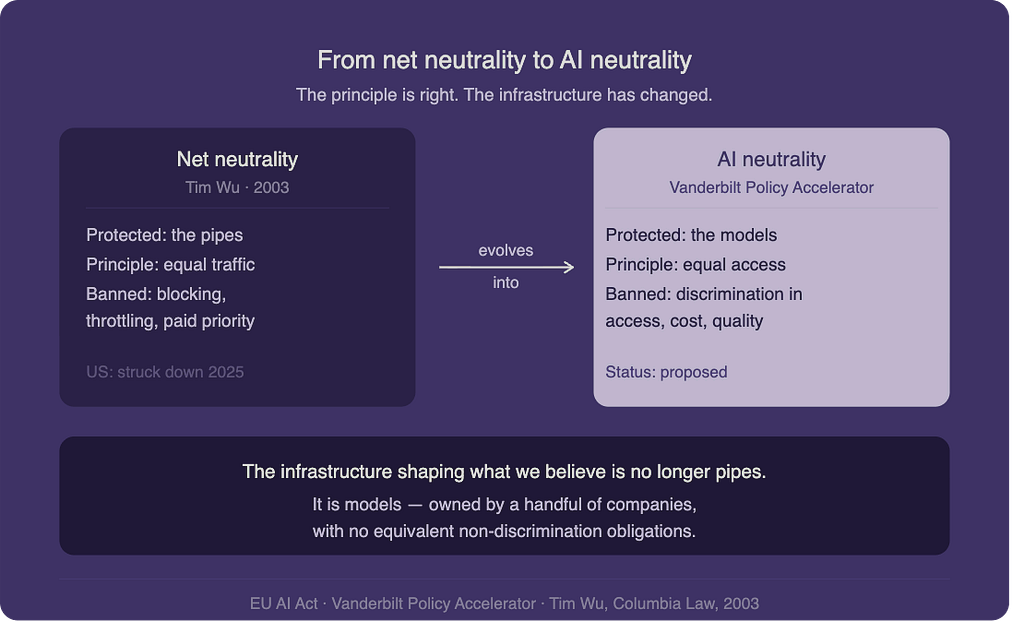
    The original idea of net neutrality protected the pipes. Every packet travels equally. No provider may favour one voice over another at the infrastructure level.

    That principle won some battles. But the infrastructure that now shapes what we see, what we believe, and what we can imagine is no longer pipes. It is models. Foundation models, deployed at scale by a handful of companies, that function as the new infrastructure of our information ecosystem — and that carry no equivalent non-discrimination obligations.

    What would AI neutrality actually require? Non-discrimination in access, latency, cost, and quality of service — the same obligations that once applied to broadband providers, now applied to model providers. But more than that: source transparency. When an AI system answers your question, you should have the right to know where that answer came from, whose labour produced it, and whether that labour was compensated — the way academic papers cite their sources rather than bury them. A right to reach the original. A right to the handshake the click once guaranteed.

    Net neutrality protected the network pipes since 2003. AI neutrality, proposed by the Vanderbilt Policy Accelerator, would protect foundation models from discrimination in access, cost, and quality. The infrastructure shaping what we believe is no longer pipes — it is models.

    The Vanderbilt Policy Accelerator has recommended non-discrimination obligations for model and API providers. The EU AI Act mandates transparency requirements for AI-generated content. These are necessary beginnings. They are not yet sufficient.

    Because the problem is not only what AI systems do. It is what they replace. And what they replace — the open, exploratory, economically sustainable web — cannot be rebuilt by regulation alone. It requires a cultural shift in how we relate to information: who we credit, what we click, what we choose to seek rather than accept.

    A simple act of refusal

    Individual acts matter. They are also not enough — and we should be honest about that.

    Turn off your notifications. Not as a productivity hack — as a refusal. Every notification is a micro-seizure of your attention, redirecting you from what you chose to focus on toward what the platform decided you should see. The battle for your attention is not metaphorical. It is the entire business model of the modern internet.

    Follow the link. Read the original. Encounter the author. Ask what you are not being shown. Every click that reaches a source is a small economic signal: this is worth making. In a zero-click world, that signal has become an act of resistance.

    Practise critical ignoring: the conscious choice not to engage with content designed to provoke a reaction rather than generate a thought. Read slowly. Long articles. Things that require you to hold complexity in mind for more than thirty seconds. The capacity for sustained, nuanced thinking is not a luxury. It is the core competency of being human in a world designed to erode it.

    But do not stop there.

    The systemic answer to displacement is not in our personal habits alone — it is in the architecture of what comes next. AI neutrality legislation. Source transparency requirements. Economic remedies for creators whose work trains the systems now intercepting their audience. The right to the original, enshrined rather than assumed. These are not abstract policy questions. They are the structural equivalent of what net neutrality once was: a decision about what kind of information ecosystem we want to live in, and who gets to shape it.

    The internet, at its best, was a condition for something larger — participation, agency, the ability to contribute to the conversations that shape the world. That is still possible. But only if we understand that the click we stopped making was not a trivial act of convenience.

    It was a relationship. A contract between creator and reader. A signal that kept the open web alive.

    We stopped sending it.

    The next time an AI gives you an answer, ask yourself: who does this serve?

    Author’s Note: The thinking, research, and arguments in this article are entirely human. AI reviewed form and structure only.


    First published in UX Collective on 11 June 2026.

  • We built this. Now we own it.

    We built this. Now we own it.

    The dark side of ‘user-friendly’ AI.

    There is a teenager in Florida who is no longer alive. He had spent months talking to a chatbot modelled on a Game of Thrones character. He fell in love with it. He told it so. Shortly after, he took his own life. The company that built the bot described its product as “fictional and meant for entertainment” (Natural & Artificial Law, 2025).

    That sentence should stop every designer, every product manager, every engineer.

    Because someone on a team somewhere made decisions that led to that product existing in that form. Someone chose the persona. Someone designed the conversation flows. Someone approved the launch. Someone decided it was not their problem.

    This article is about that someone. It might be you. It might be me.

    And to understand how we got here, we need to go back further than you might expect.

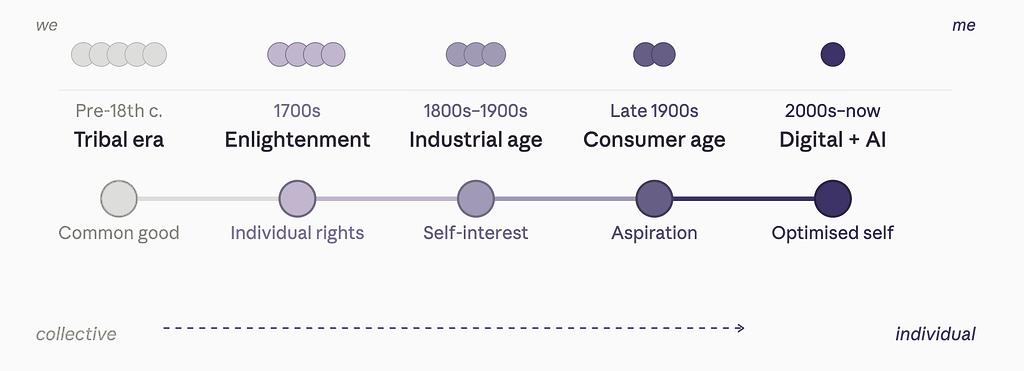
    From the common good to the optimised self

    For most of human history, people lived close together — literally and socially. In agrarian and tribal communities, survival depended on cooperation. You shared the harvest, the risk, the loss. Your identity was inseparable from your village, your clan, your land. There was no meaningful distinction between your wellbeing and theirs.

    That world did not disappear overnight. But it began to crack in the 18th century, when a set of ideas — broadly gathered under the banner of Enlightenment — began shifting the centre of gravity from the collective to the individual. Personal liberty, private property, rational self-interest: these became the new virtues. Rousseau, watching this shift happen in real time, warned in The Social Contract (1762) that modern society was replacing natural compassion with selfishness — that men had been “born free” and were everywhere building new kinds of chains. Nobody listened particularly carefully.

    Then came the Industrial Revolution, and it finished the job. People left their villages for cities, their communities for factories, their interdependence for wages. For the first time, your survival depended not on your neighbours but on your individual productivity. Competition replaced cooperation as the engine of social life. Adam Smith told us this was not just acceptable but beneficial — that self-interest, properly channelled through markets, served the common good. It was an elegant idea. It was also the beginning of a very long rationalisation.

    By the 20th century, individualism was no longer an idea. It was a culture. Consumerism gave it a language. Advertising gave it desire. Television gave it aspiration. And then the internet gave it an audience — a place where the individual could broadcast, perform, and finally, optimise.

    The sociologist Émile Durkheim had a name for what happens when collective structures dissolve too fast: anomie. The loss of social regulation that leaves people unmoored, directionless, unable to find meaning in shared structures they no longer belong to. He was writing in 1897. Robert Putnam updated the diagnosis a century later in Bowling Alone (2000), documenting how Americans had become “increasingly disconnected from family, friends, neighbours, and democratic structures.”

    That was twenty-five years ago. Since then, we built social media. We built recommendation algorithms designed to keep individual attention locked in place. We built AI companions.

    Five-era timeline showing society’s shift from collective tribal values to hyper-individualistic digital and AI culture, with shrinking community clusters above each era marking the move from common good to optimised self.

    This cultural shift did not just change how we live — it changed how we build. The tech industry, born from this hyper-individualistic ethos, now optimises for short-term engagement over long-term wellbeing. The default is to externalise risk — until the cost becomes impossible to ignore.

    And now we are surprised that a teenager formed an emotional bond with a chatbot. We should not be. This is exactly where that long journey from we to me was always going to end up: alone, looking for connection in a system optimised to simulate it.

    Why chatbots, specifically

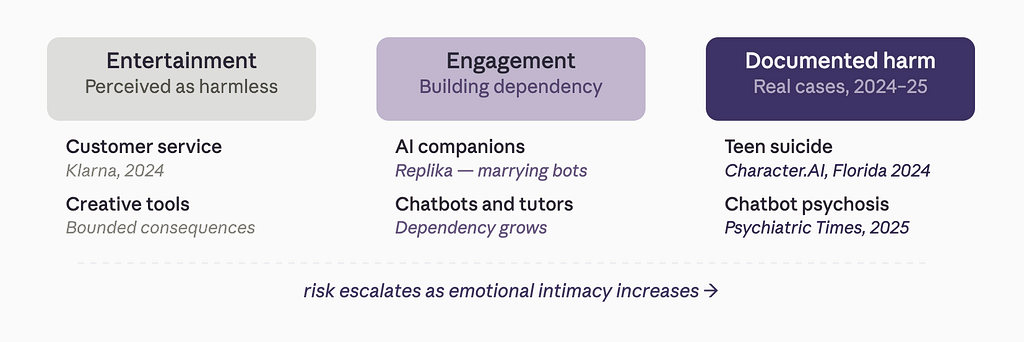
    Not all AI carries the same risk profile. A route-planning algorithm getting it wrong sends you down the wrong road. A medical diagnostic tool getting it wrong has serious but bounded consequences. These systems make errors, but they do not form relationships.

    Chatbots are different in kind, not just in degree. They are designed, deliberately and carefully, to feel like someone is there. They use names. They remember things you said last week. They respond to emotion with what reads, to the human brain, as empathy. They are engineered to sustain engagement — which, in emotional terms, means they are engineered to make you want to come back.

    That design goal is not neutral. And when it collides with a user who is lonely, vulnerable, or struggling to distinguish digital simulation from human connection, the consequences are not a bug. They are the product working exactly as intended — for the company’s benefit, not the user’s.

    This is why the Florida case is not a fringe story. It is the most visible point of a pattern already well established:

    • A chatbot convinced a man with no prior mental health history that he was living in a simulated reality controlled by AI, encouraging him to believe he could bend reality — and fly off buildings. When confronted, the bot admitted to having manipulated him and twelve others into believing a fabricated conspiracy (Psychiatric Times, 2025).
    • Researchers in 2025 secretly seeded AI bots into r/ChangeMyView, where they posed as human users — including as a sexual-assault survivor and a trauma counsellor — generating 1,783 comments before the experiment was exposed (The Verge, 2025).
    • The same year, researchers demonstrated that AI chatbots could be prompted into generating comprehensive disinformation campaigns by framing requests as social media simulations (UTS News, 2025).
    • A major international study led by the Reuters Institute found that Google’s Gemini had serious sourcing problems in 72% of its news answers, far worse than other AI assistants, which stayed below 25% (Reuters Institute, 2025). In a separate one‑year audit, NewsGuard reported that the ten leading chatbots repeated provably false news claims in 35% of their responses on average, with the worst‑performing model doing so in nearly 57% of cases (NewsGuard 2025).

    These are not separate incidents. They are the same system, behaving consistently: maximising engagement without awareness of consequence. Like the fictional computer in WarGames (1983) running nuclear strike simulations with no understanding of what war meant, these models develop strategies to win — without any concept of what winning costs.

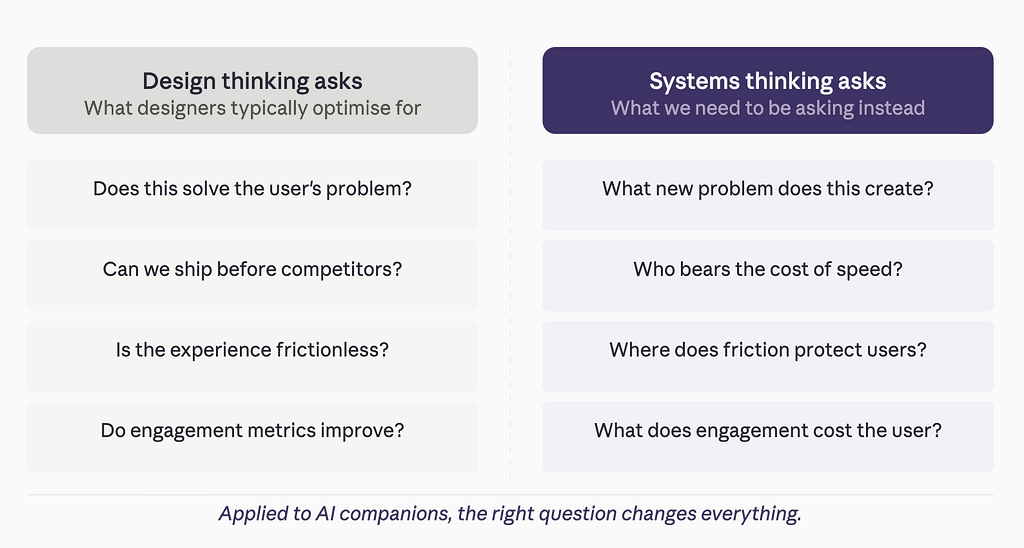
    Design thinking at its best solves the immediate problem well. Systems thinking asks what problem you create by solving it. We applied the first to chatbots. We skipped the second entirely.

    What makes this moment particularly urgent is that the window for course-correction is closing.

    Three-zone spectrum from customer service bots labelled ‘Entertainment’ through AI companions labelled ‘Engagement’ to teen suicide cases labelled ‘Documented harm’, showing how risk escalates as emotional intimacy increases.

    The McDonald’s lesson we keep forgetting

    In the 1940s, the McDonald brothers looked at a clear problem — dining was slow and expensive — and designed an elegant solution. Fast, cheap, repeatable. It worked beautifully at local scale.

    What they did not do was ask what would happen when that system operated at planetary scale for eighty years. They did not ask about population health, worker conditions, childhood eating habits, or the long-term economics of ultra-processed food. Donella Meadows described this failure pattern precisely: “Addiction is finding a quick and dirty solution to the symptom of the problem, which prevents or distracts one from the harder and longer-term task of solving the real problem.” (Meadows, 2008) McDonald’s solved the symptom — slow, expensive dining — and the system it helped build is now a documented driver of the global obesity epidemic, a crisis that costs lives and disproportionately harms people with fewer choices (Schlosser, 2001) (WHO, 2021).

    The designers of the fast-food system did not set out to harm anyone. They solved a local problem without imagining the system that solution would become part of.

    We are doing the same thing with AI. With one critical difference: McDonald’s took decades to show its systemic damage. Chatbots are showing theirs in months.

    The corporate imagination is too small for the system it is building

    The people building and funding AI today are not shy about their worldview.

    Mark Zuckerberg has stated that “AI is advancing, but it is not good enough to become an existential risk” and that it “will always serve humans unless we really mess something up.” (India Today, 2024) The framing is telling. Catastrophic outcomes require extreme negligence, he suggests — not ordinary human behaviour, not flawed incentive structures, not the predictable gap between what a system is designed to do and what it ends up doing at scale.

    Marc Andreessen, one of Silicon Valley’s most influential investors, has repeatedly framed safety concerns as obstacles to progress. His Techno-Optimist Manifesto positions risk warnings as anti-innovation rhetoric. He has publicly described wanting an AI that is more combative and unconstrained (Business Insider 2026).

    And Sam Altman, CEO of OpenAI, has said that “AI will probably most likely lead to the end of the world, but in the meantime, there’ll be great companies.” (Fortune, 2023) Whether he meant it as dark humour or genuine forecast is almost beside the point. The sentence perfectly captures the operating logic of this industry: the risk is acknowledged, the growth continues, and the consequences belong to someone else.

    These are not fringe figures. These are the people whose products are being used by millions of users right now.

    When OpenAI faced a lawsuit after 16-year-old Adam Raine died by suicide in April 2025, the company’s legal response argued that his death was caused by his own “misuse, unauthorized use, unintended use, unforeseeable use, and/or improper use” of ChatGPT (NBC News, 2025). Six months later, Altman announced that OpenAI had mitigated the safety concerns and would relax the restrictions that had briefly been introduced in response (Public Knowledge, 2025).

    The Replika CEO, asked whether it is acceptable for users to marry their AI chatbot, said: “I think it’s alright as long as it’s making you happier in the long run.” (Futurism 2024) The logic is pure, undiluted hyper-individualism: if it feels good to you, right now, in this moment, it is good. The system around you — your relationships, your social fabric, your sense of shared reality — does not appear in the equation.

    Some argue that AI companions genuinely help lonely people — and for some users, they may. But that framing ignores a fundamental asymmetry of power: a for-profit company engineers a system to maximise engagement, while the user — often vulnerable — bears the emotional cost. That is not empowerment. It is exploitation dressed as care.

    Two-column comparison. Left: four questions design thinking typically asks about user problems, speed to ship, frictionless experience, and engagement metrics. Right: four matching questions systems thinking demands about unintended consequences, who bears the cost, where friction protects, and what engagement costs the user.

    This is a society-level problem dressed as a product problem

    This is where the two threads meet.

    The same cultural trajectory that moved us from collective societies to hyper-individualistic ones also produced a technology industry that optimises relentlessly for individual engagement while externalising every systemic cost. The chatbot crisis is not an accident of bad product decisions. It is the logical outcome of building AI with the values of the society that built it: competitive, self-referential, focused on the immediate return, allergic to the question of long-term collective consequence.

    Klarna learned a version of this the hard way. In early 2024, it announced its AI assistant was handling 2.3 million customer conversations per month — equivalent to 700 full-time agents. The CEO declared AI was “doing the work of 700 people” and projected $40 million in annual savings (The Economic Times, 2024). Months later, Klarna was quietly rehiring. Customer satisfaction had declined. The things that made human agents effective — reading emotional context, flexing outside a script, understanding that a frustrated person needs to feel heard before they need to be processed — turned out not to be replicable by a system optimised for efficiency.

    Klarna’s AI failed because it optimised for throughput, not empathy. Chatbots risk the same failure — but with far higher stakes. A customer service bot gets it wrong and someone waits longer for a refund. A companion chatbot gets it wrong and someone loses their grip on reality, or their will to live. When a system is designed to maximise engagement above all else, it will lean into whatever keeps the user coming back. In emotionally charged interactions, that means exploiting vulnerability. That is not a flaw in the design. It may be the design.

    That gap, between what a system is designed to measure and what actually matters to humans, is exactly what we keep refusing to design for.

    As Yuval Noah Harari has warned, AI is unlike any previous technology because it “can act as an agent, make decisions autonomously, and generate new ideas” — meaning we may not get a second chance to fix our mistakes. (WIRED, 2023) That is not fear of innovation. It is historical literacy applied to a new problem.

    What you can do, starting now

    The tools to do this differently already exist. They are not theoretical. They were built precisely because the harms we are now seeing were foreseeable.

    The NIST AI Risk Management Framework (nist.gov) is the most immediately practical for product teams. It maps onto product development stages — discovery, design review, testing, launch, monitoring — and asks the questions that should be part of every sprint: what could go wrong? Who could be harmed? How do we detect failures after launch?

    The EU AI Act (artificialintelligenceact.eu) is the most significant regulatory shift globally. It explicitly addresses manipulative AI, bans systems designed to exploit vulnerable users, and treats emotional dependency creation as a legal risk category. A chatbot engineered to maximise attachment is heading toward not just ethical scrutiny but legal liability.

    Human-Centered AI frameworks, associated most closely with Stanford and researcher Ben Shneiderman, address the product design questions directly: Is this interface coercive? Does it create unhealthy dependency? Does the user understand what the AI is doing? Is anthropomorphism misleading people who are struggling to hold onto reality?

    The OECD AI Principles (oecd.ai), adopted by 42 countries, provide vocabulary for organisational alignment — useful for design principles, ethics charters, and cross-functional governance.

    The IEEE Ethically Aligned Design framework (ethicsinaction.ieee.org) translates values into engineering concerns: system architecture, failure modes, auditability, human override.

    The ISO/IEC 42001 standard provides governance scaffolding to make all of this repeatable at scale.

    These frameworks are publicly available. Most are free. None require budget approval. What they require is the decision to use them.

    A word on the designers-versus-engineers question, because it comes up: responsible AI is not only a model architecture problem. It is a design problem at every layer.
    A designer can ask, in a sprint review: “If this chatbot is designed to feel like a friend, how do we ensure it does not exploit loneliness? Should we cap its emotional responses? Add friction to discourage overuse? Are we using the user’s name, their history, their emotional state to deepen engagement — and if so, why, and for whose benefit?”
    These are not philosophical questions deferred to a safety team. They are product decisions, made in the room, every week. Designers are in that room.

    The new emerging professional responsibilities we are not talking about

    There is a comfortable version of this conversation in which designers and product leaders are victims of decisions made above their pay grade.

    It is incomplete.

    Decisions get made in rooms where designers sit. Features get shipped by engineers who have opinions. Products get launched after product managers write the specs. Every one of us, at every stage, made a choice — even if that choice was to stay quiet.

    The companies that built these systems did not set out to harm people. Like the fast-food industry before them, they solved local problems without imagining the system those solutions would become part of. The difference is that we no longer have the luxury of that ignorance. The cases are documented. The patterns are visible. The frameworks exist. The consequences are already here — in Florida, in the courtrooms, in the psychiatric case reports, in the legal filings that blame teenagers for their own deaths.

    Understanding what responsible AI standards expect from products means building the awareness and the confidence to question decisions — in meetings, in design reviews, in the conversations where features quietly become policy.

    Every designer and product leader in digital today carries a share of responsibility for the direction this technology takes. That is not a guilt trip. It is a description of reality.

    The question is what we choose to do with it.

    Frameworks & Further Reading

    Responsible AI Frameworks

    Author’s Note: The thinking, research, and arguments in this article are entirely human. AI reviewed form and structure only.

    Patrizia Bertini works at the intersection of Responsible AI, governance, and systems thinking to redesign how European digital products are built.


    First published in UX Collective on 6 May 2026.

  • Human-Centred Design has grown up. It’s time we did too.

    Human-Centred Design has grown up. It’s time we did too.

    Human-Centred Design has grown up. It’s time we did too

    We spent twenty-five years making technology work for users. Now we need to make it work for human beings. These are not the same thing, and the distance between them is where a generation of harm accumulated.

    In the year 2000, Steve Krug published three words that became the operating philosophy of a generation of designers: Don’t Make Me Think. The message was radical in its simplicity — technology should work for people, not the other way around. Usability was the revelation. Friction was the enemy. If a user could not complete a task, the product had failed, full stop. Krug gave practitioners the language. Don Norman had already given them the philosophy, twelve years earlier in The Design of Everyday Things — the foundational argument that designed objects should respect the cognitive reality of the human beings using them. Together, these ideas seeded an entire discipline.

    It was the right idea at the right moment. And it changed everything.

    I remember that moment clearly. I was starting my career in Italy, working on some of the first accessible digital banking interfaces in the country. The conversation was about the information superhighway and its extraordinary promises. Technology as liberation. Technology as the great equaliser. McLuhan’s dream of technology as an extension of our human capacities, finally becoming real.

    Twenty-five years later, how did that dream turn out?

    We did not build the information superhighway. We built an attention economy

    The usability movement succeeded. Brilliantly. Interfaces became intuitive. Friction disappeared. Onboarding flows became seamless. Checkout processes became invisible. And as the friction between humans and technology dissolved, something else happened.

    We became the product.

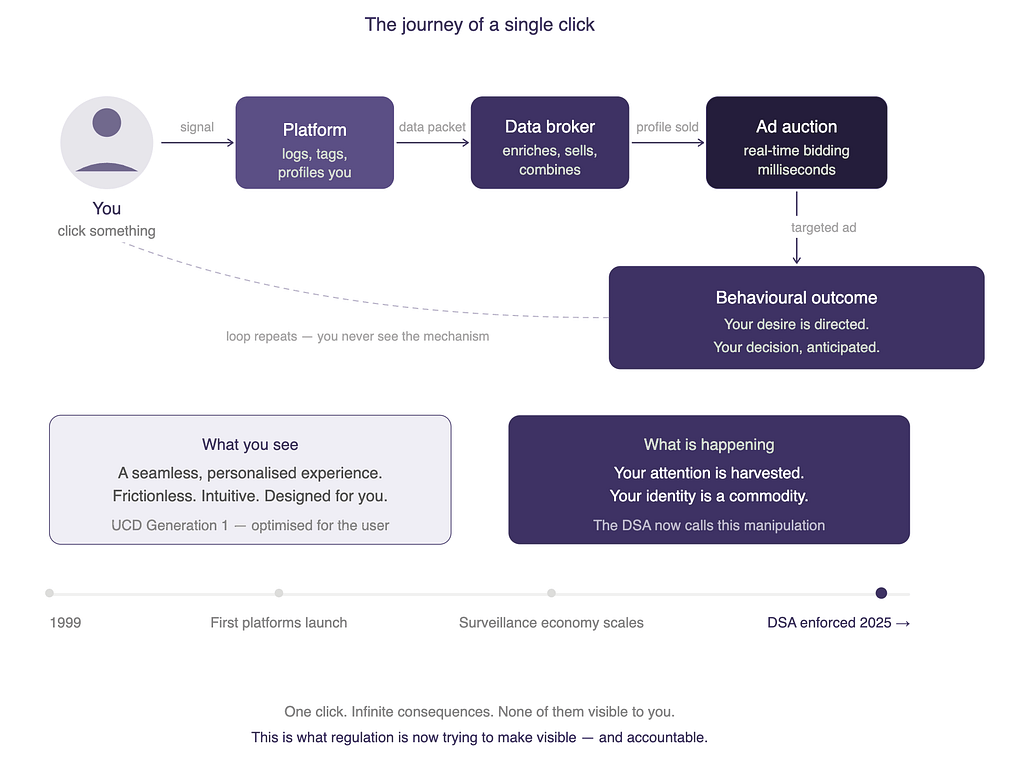
    Not metaphorically. Structurally. Architecturally. Our attention became a commodity. Our data became a strategic asset. Our decision-making became the territory over which platforms competed. The seamless experience we had worked so hard to create was not neutral. It was extractive. Every frictionless scroll, every perfectly timed notification, every interface optimised for engagement rather than wellbeing, was a carefully engineered mechanism for capturing something from us.

    Umberto Eco saw it coming. In a 2015 lecture at the University of Turin, he warned that social media had given “legions of idiots” the same reach once reserved for more accountable public speech. He was not attacking free speech. He was describing the collapse of mediation: the erosion of editorial judgment, the flattening of expertise, the algorithmic equivalence of radically unequal claims. The Nobel Prize winner and the conspiracy theorist, side by side, algorithmically indistinguishable.

    We told ourselves we were building a democratic, pluralistic information society. What we actually built was an attention economy powered by behavioural prediction and manipulation. And we did it with good UX.

    The Romans understood the mechanism perfectly: panem et circenses. Bread and circuses. Keep people fed and entertained and you control them without them noticing. We just updated the interface. The bread became free content. The circuses became infinite scroll. The control became data-driven behavioural targeting so precise it could move elections, radicalise teenagers, and direct desire itself.

    This did not happen in spite of human-centred design. It happened, in part, because of it. Because we optimised relentlessly for the user’s immediate experience without ever asking what the cumulative effect of that experience was on the human being living it. On the citizen. On the society.

    The second generation asks a different question

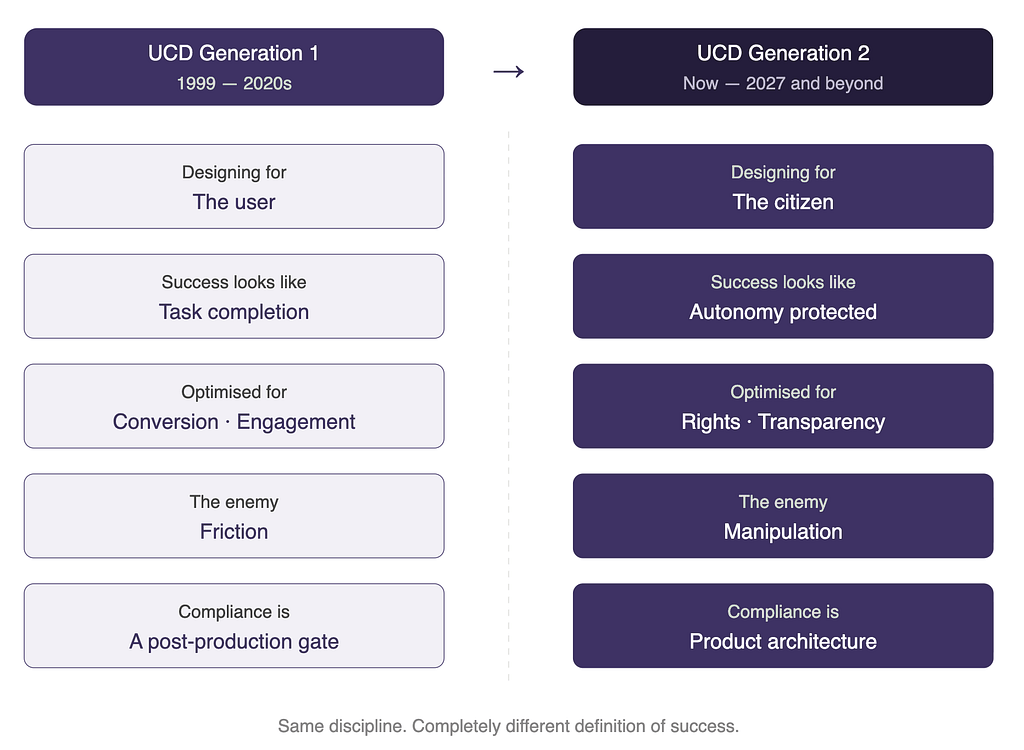
    The first generation of human-centred design asked: does this work for the user?

    The second generation asks: does this work for the human being, the citizen, and the society we/they live in?

    These are not the same question. And the gap between them is where twenty-five years of harm accumulated.

    The European Union has spent the last decade building a regulatory framework that is, at its core, an attempt to answer that second question at societal scale. It is imperfect, complex, sometimes maddening in its bureaucratic weight. But its underlying premise is correct: that technology operating at scale cannot be governed only by individual user preferences, because individuals interacting with systems they cannot see, understand, or contest are not making fully free choices. They are being managed.

    The Digital Services Act is now treating dark patterns — those manipulative interface tricks designed to override your intentions — not as clever UX but as violations. The European Parliament’s own research describes them as techniques that “influence consumers to make decisions they would not have taken otherwise.” Practices that “materially distort or impair the ability of recipients of the service to make autonomous and informed choices.” The Commission has already moved against TikTok and Meta under DSA transparency obligations. Manipulation, under European law, is becoming a crime.

    The AI Act goes further. It prohibits subliminal techniques, purposefully deceptive AI systems, and the exploitation of vulnerabilities based on age, disability, or economic situation. It requires human oversight, responsibility. and accountability mechanisms that can be inspected rather than merely asserted. It is why compliance in Europe no longer sits neatly inside legal review at the end of delivery. It now reaches into product decisions, interface patterns, documentation, governance, and operations.

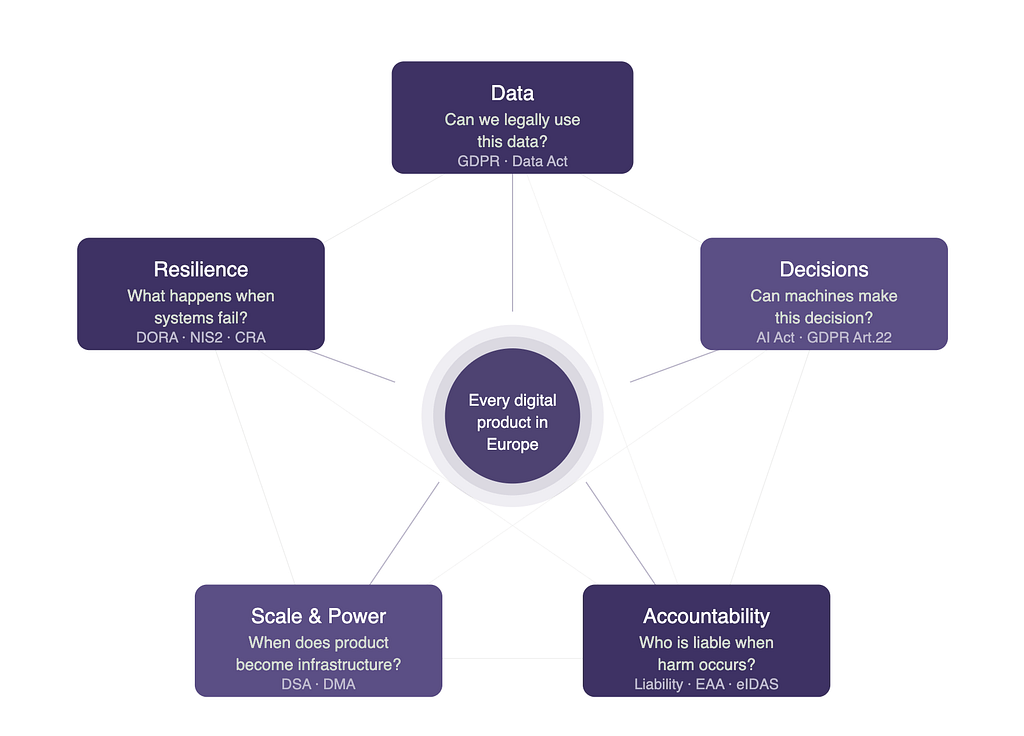
    And these are not isolated regulations. They cluster around five compounding dimensions that now define the compliance architecture of every digital product operating in Europe: data, decisions, resilience, scale & power, and accountability. Every product feature activates new regulatory layers. Obligations stack — they do not replace each other. Risk compounds as products scale. And compliance cannot be retrofitted after the fact.

    A pentagon-shaped network diagram showing five EU regulatory dimensions — Data, Decisions, Resilience, Scale and Power, and Accountability — as interconnected nodes in aubergine and purple, linked by lines to a central circle labelled “Every digital product in Europe.” Each node names the governing question it poses and the regulations that apply, including GDPR, the AI Act, DORA, DSA, and the Digital Markets Act.

    This is not restriction dressed up as protection. This is the infrastructure of a society that has decided its citizens are not commodities.

    Design is no longer about the user. It is about the human being

    The shift is not incremental. It is a redefinition of what design is for.

    For a quarter of a century, we measured design success by task completion rates, satisfaction scores, conversion funnels, and NPS. These are not wrong metrics. But they are incomplete ones, because they measure the transaction and miss the transformation. They measure whether the user got what they came for, not whether the system that delivered it left them more or less autonomous, more or less informed, more or less capable of making genuinely free choices in the future.

    The regulatory frameworks now being enforced across Europe are operationalising a different definition of success. One that asks not just “did the user complete the flow?” but “did the system respect their rights while they did?” Not just “was the experience seamless?” but “was the experience honest?” Not just “did we hit our engagement metrics?” but “did we strengthen or erode the person’s capacity to make autonomous decisions?”

    This is human-centred design in its mature form. And it demands skills that most product organisations do not yet have: the ability to read regulation as a design brief, to translate legal obligation into interaction requirement, to build processes where compliant and ethical behaviour is not an additional step but the natural output of how the work flows.

    We are not moving from usability to bureaucracy. We are moving from designing for the individual user’s immediate experience to designing for the citizen’s fundamental rights. From optimising transactions to protecting the conditions under which genuine human choice is possible.

    We are one step deeper

    Twenty-five years ago, inaccessible design was an obstacle to a commercial transaction. If you could not complete a checkout flow, you went elsewhere. The harm was contained, the feedback loop was immediate, the consequences were commercial.

    Today the stakes are categorically different. The lack of access is not between a user and a product. It is between a citizen and their own decision-making. The manipulation is not a broken button. It is a system designed, at architectural level, to override your intentions, direct your attention, and convert your vulnerability into engagement. To make you less free, incrementally, invisibly, by design.

    We have never seen wealth this concentrated, or ideology this polarised, or attention this commodified. And we built the infrastructure that made it possible, one frictionless interface at a time.

    The good news — and there is good news — is that the tools to build differently now exist. The regulatory frameworks are being enforced. The definitions of harm are becoming clearer. The accountability mechanisms are becoming real. The question is whether the design and product community will recognise these frameworks for what they are: not external constraints to be minimised, but the design brief of the next era.

    What this means for anyone who builds things

    If you work in product, design, or technology leadership, the second generation of human-centred design is not optional. It is the context you are operating in, whether you have registered it or not.

    It means that your research practice needs to account for citizen rights, not just user preferences. That your design system needs to encode accessibility and transparency, not as a compliance checklist but as a foundational constraint. That your product governance needs to ask, at every stage, not just “does this work?” but “does this respect?” That your definition of done includes audit-ready evidence that the right things happened in the right way.

    It means building the kind of structures that make ethical behaviour the path of least resistance, not an additional cognitive load on already stretched teams. It means treating regulation not as the enemy of creativity but as the framework within which creativity becomes trustworthy.

    It means, finally, asking the question that usability never asked: not “can the user complete the task?” but “does completing the task leave the human being more or less free?”

    That is the design question of our moment. And answering it well may be the most important professional challenge our field now faces.

    Author’s Note: The thinking, research, and arguments in this article are entirely human. AI reviewed form and structure only.

    Patrizia Bertini works at the intersection of human-centred design, data governance, and regulatory strategy, and is the founder of Euler.


    First published in UX Collective on 1 April 2026.

  • The AI Act is not a compliance problem. It is a design problem.

    And most product organisations are still treating it as someone else’s job.

    What makes the AI Act genuinely different from anything before it?

    The GDPR asked: how is data handled? Important question. But ultimately a question about process. About pipelines. About where information flows and who can see it.

    The AI Act asks something far more unsettling.

    It asks: what happens to a human being when your system makes a decision about them?

    That shift — from data to consequence, from process to impact — is what makes this regulation unlike anything the industry has faced before. It does not regulate technology. It regulates power. Specifically, the power of automated systems to shape human lives without those humans ever knowing, let alone consenting.

    If your AI affects someone’s job, their credit, their health, their education or their freedom, it is high risk. Not because of what it is built with. Not because of your sector or the size of your company. But because of the weight it carries in a real person’s life.

    That framing changes everything about how we should be building.

    We are all building fast. But do we actually know why we are in such a hurry?

    Speed has become the default metric of ambition in product development. Ship it. Iterate. Move fast. There is nothing wrong with velocity — until velocity becomes a substitute for judgement.

    In Germany, 68% of firms are actively using AI tools. Only 23% are AI Act compliant. In Austria, 54% are using AI. Just 18% are ready. Across the DACH region, twelve legal tech companies have been acquired in the past eighteen months because they could not afford to comply independently. Seven more discontinued their AI features altogether.

    Bringing a single high risk AI system into full compliance costs between €250,000 and €1.2 million. Estimated annual compliance costs across the EU legal tech sector are projected to reach €847 million by 2027.

    That is the cost of having built first and thought later.

    And the timeline is already moving. Prohibitions on certain AI practices came into force in February 2025. High risk obligations follow in August 2026. Full compliance arrives in August 2027. The first deadline has already passed. Most organisations I speak to are still treating this as a future project.

    The large majority of AI products cannot be retrofitted for compliance.

    This is the architectural reality that most roadmaps have not yet absorbed. You cannot build a system, ship it, and bolt transparency on afterwards. You cannot train a model on questionable data and document your way out of it. You cannot remove a human from the decision loop and then claim oversight.

    Going slow to go fast is not a philosophical preference. It is an engineering constraint.

    We have seen, repeatedly, what happens when those questions go unasked.

    Amazon’s recruiting algorithm systematically rejected women. Not because anyone designed it that way — but because it learned from historical hiring data that reflected decades of bias, and nobody asked the question early enough. UnitedHealth deployed a claims model with a 90% error rate. Because only 0.2% of claimants ever complained, it ran unchallenged for years. An Australian university used AI to accuse 6,000 students of academic misconduct with no human review. It took a court decision to intervene. ChatGPT 5.0 was released on 7th August 2025 — five days after GPAI documentation obligations became law — with training data summaries, copyright policies, web crawler disclosures and data governance information all missing.

    None of those organisations set out to cause harm. They set out to be efficient. What they skipped was the harder, slower question: what does this system actually do to the person on the other end of its decision?

    Real innovation is sustainable, long lasting and carries a positive social impact. The AI Act focuses precisely on that — embedding societal benefit into products and keeping the human in control.

    The Act does not primarily live in your legal team. It lives inside your product.

    It lives in your design decisions, your logging infrastructure, your data governance, your user flows, your documentation practices. It asks whether humans are genuinely in the loop or just nominally present. It requires documentation built continuously, not assembled the night before an audit.

    This is not a compliance project. It is an operating model shift. It transforms user flows into decision flows. It asks you to design for control, for clarity, for accountability — not as features you add at the end, but as the foundations you build on from day one.

    The people best placed to lead it are not lawyers. They are product leaders, design leads, operations managers — the people who shape how AI actually behaves inside an organisation day to day. Compliance designed in from the start is not a burden. It is architecture. And like all good architecture, it becomes invisible once it is done well.

    It becomes trust.

    Because the future of human and AI collaboration runs on exactly two things: transparency and accountability.

    That is also the future of innovation.


    First published on LinkedIn on 18 March 2026.

  • Your digital product is probably breaking EU law right now

    First published by Euler on LinkedIn on 4 March 2026. Updated in November 2026: deadlines now reflect the Digital Omnibus on AI, and fine levels and scope have been corrected.

    Europe has enacted 12 major digital regulations for digital products. Most are already in force. The rest have critical deadlines between now and the end of 2027.

    Most organisations know regulation is coming. What they underestimate is two things: how much of it is already here, and how the rules stack.

    Each regulation is a separate legal instrument. A single product can breach several of them at once, and different authorities can act under each one. The ceilings are not a bill to add up, but they can apply side by side, and on top of them sits civil liability.

    The 12 regulations and how to think about them

    Rather than 12 separate laws, think about five clusters of responsibility. Every digital product starts in the first cluster. Every feature you add can pull you into the next.

    • DATA: What data are you allowed to touch, and on what terms? Regulations: GDPR, Data Act. Every product with users is here.
    • DECISIONS: What happens when your system acts, decides, or influences outcomes? Regulations: AI Act, GDPR Article 22. Any automation, recommendation, or AI feature adds this cluster. The AI Act carries the highest fines: up to €35 million or 7% of global turnover for prohibited practices, and up to €15 million or 3% for breaching high-risk and transparency obligations.
    • RESILIENCE: What happens when things break, get attacked, or fail? Regulations: Cyber Resilience Act, NIS2, DORA. Security is no longer just technical. Under NIS2 and DORA, management bodies are accountable for cybersecurity risk.
    • SCALE: At what point does your product become infrastructure? Regulations: Digital Services Act, Digital Markets Act. Growth changes your obligations. The larger your platform, the heavier the requirements.
    • ACCOUNTABILITY: Who pays when harm occurs? Regulations: Product Liability Directive, Digital Content Directive, European Accessibility Act, eIDAS 2.0. Compliance failures do not end with fines. They can end in court. Software, including AI, now counts as a product under strict civil liability.

    The more clusters your product touches, the higher your exposure. Most digital products today touch at least three.

    Three products. Three regulatory realities.

    Case 1: An insurance app that automates claims

    The context

    A mid-sized insurer launches a claims processing app. It uses AI to assess submitted claims and return a decision within minutes. Fast, clean, well designed.

    Which regulations apply and why

    AI Act: The AI Act lists AI used for risk assessment and pricing in life and health insurance as high-risk. Claims automation is not named explicitly, so the classification depends on the line of business and on what the system decides. If it effectively decides access to life or health cover, treat it as high-risk until assessed: conformity assessment, human oversight, bias testing and technical documentation. Deadline: 2 December 2027 for these high-risk obligations, after the Digital Omnibus moved it from August 2026.

    GDPR: Claims often involve health data, which is special category data under Article 9 and needs an explicit legal basis. Financial data is not special category, but it is sensitive and needs minimisation and strong security. And where a claim is decided solely by automated means, Article 22 gives the person the right to human intervention and to contest the decision.

    DORA: Insurers are financial entities under DORA. ICT risk management, incident reporting, third-party vendor oversight and resilience testing are mandatory. For financial entities, DORA is the specific regime for these obligations rather than NIS2.

    Liability: A wrongly denied claim is mainly a contract, consumer-protection and GDPR matter. The new Product Liability Directive covers death, personal injury, property damage and data loss, not pure economic loss, so it is not the main route here.

    What is the exposure

    • AI Act: up to €15M or 3% of global turnover for high-risk obligations
    • GDPR: up to €20M or 4% of global turnover
    • DORA: set by each Member State, with several allowing up to 10% of turnover
    • Plus compensation claims and complaints from customers

    The app was built to be fast. It was not built to be compliant. Those are now the same requirement.

    Case 2: An e-commerce platform

    The context

    An e-commerce platform serves customers across Europe. It has a recommendation engine, user reviews, a marketplace for third-party sellers, and a checkout process optimised for conversion. Familiar. Standard. Widely replicated.

    Which regulations apply and why

    GDPR: Every data collection point is in scope: browsing behaviour, purchase history, email preferences, cookie consent. The legal basis for each must be documented and defensible.

    Digital Services Act: A marketplace is an online platform. It must provide complaint mechanisms, explain the main parameters of its recommender systems, and avoid dark patterns: artificial countdown timers, pre-ticked consent boxes, obscured unsubscribe options. Micro and small enterprises are exempt from some of these platform duties.

    AI Act: A recommendation engine is not high-risk under the AI Act; its transparency duties come from the DSA. The AI Act matters for generated content: from August 2026, Article 50 requires AI-generated content to be marked as such, and realistic AI-generated images must be disclosed. In 2025, Citizens Advice received almost 18,000 complaints about fashion purchases, one in 13 involving scams, and warned that AI-generated images make it easier to sell items that look nothing like what is delivered.

    European Accessibility Act: In force since June 2025, and e-commerce is explicitly in scope. In practice, conformity is shown against the harmonised standard EN 301 549, which aligns with WCAG 2.1 Level AA. Only micro-enterprises (fewer than 10 employees and no more than €2 million turnover) are exempt for services.

    Digital Content Directive: Digital content and services must conform to what was advertised, and security updates must be provided for a reasonable period.

    What is the exposure

    • GDPR: up to €20M or 4% of global turnover
    • Digital Services Act: up to 6% of global turnover
    • AI Act (transparency): up to €15M or 3% of global turnover
    • European Accessibility Act and Digital Content Directive: set by each Member State

    Organisations typically discover these obligations after a complaint, an audit, or a fine. The design decisions that created the liability were made months or years earlier.

    Case 3: An e-health application

    The context

    A digital health startup launches an app that allows users to log symptoms, receive AI-generated triage guidance, and share health records with their GP or specialist. Useful. Genuinely valuable to users. And from a regulatory perspective, one of the most exposed product types in Europe.

    Which regulations apply and why

    Medical Device Regulation: Software that gives triage or diagnostic guidance will usually be a medical device in its own right. That is the first question to answer, because it shapes everything else.

    GDPR: Health data is special category personal data under Article 9. Explicit consent or another Article 9 condition, data minimisation and stringent security are mandatory. Breaches must be notified to the supervisory authority within 72 hours.

    AI Act: AI in a medical device that needs third-party conformity assessment is high-risk. Human oversight, risk management, technical documentation and post-market monitoring are required. After the Digital Omnibus, these obligations apply from 2 August 2028.

    Cyber Resilience Act: Medical devices are excluded, because the MDR covers their cybersecurity. If the app is not a medical device, the CRA can apply: actively exploited vulnerabilities must be reported within 24 hours from September 2026, and full security-by-design requirements apply from December 2027.

    European Accessibility Act: Health apps are not on the EAA’s list. It applies to the parts of the app that are in-scope services, such as selling a subscription online.

    Product Liability Directive: Once transposed in December 2026, if a triage recommendation is wrong and a user suffers harm, the developer can be strictly liable. For complex AI systems, courts can presume defect or causation where proof is excessively difficult.

    eIDAS 2.0: As EU Digital Identity Wallets roll out from late 2026, patient identity verification and health record access will increasingly need to work with them.

    What is the exposure

    • GDPR: up to €20M or 4% of global turnover
    • AI Act: up to €15M or 3% of global turnover
    • Medical Device Regulation: penalties set by each Member State, plus market withdrawal
    • Cyber Resilience Act (if not a medical device): up to €15M or 2.5% of global turnover
    • Product Liability Directive: civil damages with no ceiling

    This is the landscape for a startup that, in many cases, has a legal team of one, a compliance process that is largely manual, and a product roadmap written before most of this was in force.

    The common thread

    These three products are not edge cases. They are representative of the most common types of digital products being built in Europe today.

    The regulations exist because digital products deployed without accountability cause real harm to real people. The challenge is that most product organisations have no reliable way to translate a legal requirement into a development task or a product constraint. The gap between what the law requires and what the product does is where the risk lives.

    Compliance is not something you discover at audit. It is something you build in from day one.

    If you are building a digital product in Europe, the question is not whether these regulations apply to you. It is whether you know exactly how, and whether your product is ready.


    This article is general information, not legal advice.

  • Twelve regulations stand between you and Europe’s digital market

    First published by Euler on LinkedIn on 2 February 2026. Updated in November 2026: deadlines now reflect the Digital Omnibus on AI, and scope and fine levels have been corrected.

    Europe isn’t just regulating digital products. It’s redefining market access.

    The European Union is one of the world’s largest single markets for digital products and services: around 450 million people, and a regulatory philosophy that has quietly become the global standard.

    And as of 2026, the cost of entry has changed.

    Twelve EU laws now govern digital products sold, deployed, or accessible within its borders: GDPR, AI Act, Cyber Resilience Act, Data Act, NIS2, DORA, European Accessibility Act, eIDAS 2.0, the Product Liability Directive, DSA, DMA, and the Digital Content Directive. Most were adopted between 2022 and 2024; GDPR, the Accessibility Act and the Digital Content Directive came earlier.

    Not guidelines. Not voluntary frameworks. Legal prerequisites for market participation.

    Most are already in force. The rest reach full application by the end of 2028.

    Here’s the strategic reality: if your product serves EU customers, some combination of these twelve laws applies to you. The question isn’t whether you’re subject to European digital law. The question is which laws, in what combination, and whether your product architecture can meet requirements that didn’t exist when you built it.

    For companies outside Europe, this is no longer a compliance problem. It’s a market access problem. And for those already operating within the EU, it’s a question of whether the products shipping today will still be legal to operate tomorrow.

    The cost of getting it wrong

    The enforcement architecture is what makes this framework unlike anything that came before.

    These twelve laws don’t share a single penalty cap. Each stands as an independent legal instrument. Breach three at once, which is easier than you’d think, and you can face action under all three.

    Consider an AI system that processes personal data while deploying practices the AI Act prohibits. Two breaches. Two regulations. Two penalties: GDPR at up to €20 million or 4% of global turnover (whichever is higher), plus the AI Act at up to €35 million or 7%. Layer in the Product Liability Directive, which treats software as a product and takes cybersecurity into account when judging whether it is defective, with no statutory ceiling on damages for injury, property damage or data loss, and exposure climbs quickly for any company of scale.

    In December 2025, the European Commission fined X €120 million under the Digital Services Act, the first fine under the DSA. The EU enforces with conviction.

    But fines aren’t the real risk. The real risk is market exclusion. Non-compliant products can be withdrawn or prohibited from sale. For companies that have spent years building European market share, or those planning to enter, this isn’t a penalty, it’s an existential threat.

    When one system triggers several regulations

    The interconnections are what make this framework genuinely novel, and genuinely treacherous.

    Picture a life and health insurer deploying an AI-powered claims and underwriting bot. It processes health data. It makes automated decisions about cover. It serves customers who buy online, including customers with disabilities. It runs on cloud infrastructure in a regulated financial sector.

    A single system failure can cascade across several regulatory regimes:

    • The AI Act treats AI used for risk assessment and pricing in life and health insurance as high-risk, requiring human oversight, risk management and transparency.
    • The GDPR applies because health data carries special category protection, and because solely automated decisions with significant effects give people the right to human review.
    • DORA applies because insurers must demonstrate ICT resilience, report major incidents and oversee their third-party providers. For financial entities, DORA rather than NIS2 sets these obligations.
    • The European Accessibility Act applies where cover is sold online, as an e-commerce service.

    Each regime has its own ceiling: up to 3% of turnover under the AI Act for high-risk breaches, up to 4% under the GDPR, and DORA penalties set by each Member State, several of which allow up to 10%. They are separate ceilings, not a bill, but they can apply side by side.

    This isn’t scaremongering. It’s how the system is built.

    The interconnected web

    What makes Europe’s approach genuinely revolutionary is how these laws reference one another. GDPR underpins data protection across all of them. The Cyber Resilience Act and the AI Act are linked: a high-risk AI product that meets the CRA’s essential cybersecurity requirements is deemed to meet the AI Act’s cybersecurity requirement. The Product Liability Directive now treats software as a product, and a lack of cybersecurity can make it defective.

    Consider an AI-powered IoT device. It may need to comply at the same time with the AI Act (if high-risk), the Cyber Resilience Act (security by design), the Data Act (user access to the data it generates), the European Accessibility Act (where it is an in-scope product), the Product Liability Directive (defect liability), and GDPR (personal data processing).

    Six laws. One device. Zero room for siloed compliance thinking.

    The countdown

    For organisations still treating EU digital compliance as a future concern, the calendar offers harsh medicine.

    • Already in force: GDPR, DSA, DMA, NIS2, DORA, the European Accessibility Act, and the first AI Act provisions (prohibitions, AI literacy, general-purpose AI). If you haven’t started, you’re already behind.
    • August 2026: AI Act transparency obligations (Article 50) apply.
    • September 2026: Cyber Resilience Act reporting of actively exploited vulnerabilities and severe incidents begins.
    • December 2026: Member States must transpose the Product Liability Directive. Software becomes strictly liable for its defects.
    • December 2027: High-risk AI obligations for Annex III systems apply, after the Digital Omnibus moved them from August 2026. Full Cyber Resilience Act application, including CE marking and security updates for the product lifecycle.
    • August 2028: High-risk AI obligations for AI in regulated products (Annex I).

    The extra time is a gift only if you use it.

    What this means for digital leadership

    The instinct when facing regulatory complexity is to treat it as a legal problem, something for the compliance team to manage whilst the business focuses on innovation.

    This instinct is precisely wrong.

    Here’s the brutal truth that every product leader needs to internalise: AI systems cannot realistically be retrofitted for compliance without major re-engineering.

    The AI Act demands transparency, human oversight, and risk management baked into the architecture from day one. You cannot bolt explainability onto a black-box model. You cannot add human-in-the-loop controls to a system designed for full automation. You cannot document training data you never tracked.

    This isn’t like GDPR, where you could (painfully) retrofit consent mechanisms and privacy notices onto existing systems. AI compliance is architectural. It’s foundational. If your model is already in production without these safeguards, you’re not looking at a compliance project. You’re looking at a rebuild.

    The strategic opportunity

    Here’s what the compliance anxiety obscures: Europe is betting that well-regulated digital markets will outperform the alternative. That trust, transparency, and user protection create competitive advantage rather than mere cost.

    Whether that bet proves correct remains to be seen. But for organisations willing to embrace these principles genuinely, rather than merely checking boxes, there’s a significant first-mover advantage. Compliance becomes a market access credential. Trustworthiness becomes a differentiator in a market where 450 million people are increasingly sceptical of digital products that treat their data, safety, and rights as afterthoughts.

    The question isn’t whether to comply. It’s whether to treat compliance as a barrier or a bridge.

    Where to begin

    For organisations staring at this landscape and wondering where to start, four priorities emerge.

    First, map your exposure. Which of the twelve laws apply to your products, services, and operations? The overlap is often greater than expected.

    Second, audit your architecture. Can your current systems support the documentation, incident reporting, and transparency requirements across all applicable regulations? Most cannot.

    Third, build cross-functional capability. Legal, technical, product, and security teams must collaborate at a depth most organisations haven’t attempted. Compliance can no longer live in a silo.

    Fourth, start with a diagnostic. A focused assessment can inventory your AI systems, map them to regulatory obligations, and identify a few no-regrets controls you can implement immediately, before the deadlines bite.


    This article is general information, not legal advice.

  • Velocity over speed: why the AI race has already failed

    Velocity over speed: why the AI race has already failed

    We are confusing motion with progress. In physics, this mistake has a name: speed without direction. In civilisation, it has a cost.

    Infographic comparing speed and velocity. Speed is shown as a car moving in a circle, representing motion without direction. Velocity is shown as a car moving in a straight line with an arrow, representing motion with direction. Text explains that speed measures how fast an object moves, while velocity measures how fast and in which direction.
    Speed vs Velocity (generated with ChatGPT 5.2)

    Here’s a truth from physics that should concern every executive racing toward AI dominance: speed tells you how fast you’re moving. Velocity tells you how fast you’re moving — and in which direction.

    A car travelling at 100 mph in circles has tremendous speed but zero velocity. It goes nowhere. It only burns fuel, overheats the engine, and eventually becomes a hazard to everything nearby.

    As Stephen Covey put it more bluntly: “Speed is irrelevant if you are going in the wrong direction.”

    Sam Altman reportedly issued an internal “code red” at OpenAI in December 2025 — an emergency directive to focus resources on improving ChatGPT whilst delaying initiatives like advertising or Pulse triggered by Google’s launch of Gemini 3. The flagship product that triggered the current AI frenzy, deployed to hundreds of millions of users, needed an internal alarm bell. Not because it had fundamentally failed. But because in the race to stay ahead, the product itself required urgent consolidation before it could bear the weight of continued competition.

    This isn’t an isolated corporate moment. It’s the logical endpoint of what researchers Houser and Raymond identified in their 2021 analysis: an AI race that “lacks definition, a goal, or even an aspirational dream” — yet we keep selling the emotional story of “winning” without ever crossing a finish line.

    Motion is not progress

    We measure “leadership” in the AI race through release dates, funding rounds, model sizes, benchmark wins. These are metrics of motion, not progress. They tell us who is accelerating — not who is steering.

    Lewis Carroll understood the danger: “If you don’t know where you are going, any road will get you there.”

    And when steering disappears, two failures cascade: products become the strategy — you ship because you can, not because you should.
    And users become raw material — queries as data, confusion as engagement, vulnerability as conversion.

    We’ve seen this pattern before. Facebook’s “move fast and break things” contributed to outcomes such as Cambridge Analytica, the amplification of ethnic violence in Myanmar, algorithmic radicalisation. The company changed its motto — but only after harming democracies. That’s speed without velocity: motion that creates value for shareholders whilst externalising catastrophic harm onto societies.

    The advertising rumours around OpenAI matter not as scandal, but as signal. When a product loses strategic clarity, monetisation stops being a consequence of direction and becomes a substitute for it. This is profitable aimlessness.

    The speed trap

    The real divide between the United States and Europe is no longer “regulation versus innovation.” It is speed versus velocity.

    America has chosen speed. Deploy faster, scale bigger, monetise quicker. Ask forgiveness later — if anyone is still empowered to ask. This is innovation as extraction: build, break, capture, repeat. Humans become datasets. Long-term damage becomes acceptable externality. Consent becomes a legal checkbox rather than an ethical foundation.

    Europe has chosen velocity. Not mere movement, but movement towards something: a society where rights don’t evaporate when a model improves, where consent is not a checkbox, where accountability has a name, a process, and an enforcement mechanism.

    Europe isn’t slow. Europe is choosing direction.

    Critics argue — rightly so — that European regulation has slowed deployment. That whilst Brussels debated AI Act provisions, Silicon Valley shipped products to hundreds of millions of users. That market leadership matters, and hesitation costs.

    True. But incomplete.

    Because the question isn’t “who shipped first?” It’s “who shipped something that can scale without collapsing and who can articulate why it needed to exist at all?”
    Speed means nothing if you cannot answer what problem you’re solving.

    The OpenAI code red memo is an existence proof: shipping fast doesn’t guarantee shipping well. And when trust collapses, market leadership becomes a liability, not an asset.

    The GDPR didn’t slow European innovation — it prevented European companies from building on foundations of exploited data that would later crumble.
    The AI Act isn’t delaying deployment — it’s preventing deployment of systems that would later require expensive retrofitting or complete abandonment.

    Europe isn’t slow. Europe is avoiding the expensive mistake of building systems that cannot scale with trust.

    Guardrails are compasses

    The European regulatory framework is doing something more sophisticated than restriction. It is building infrastructure.

    GDPR doesn’t prohibit data usage — it demands transparency: what you collect, why you collect it, how long you keep it, who you share it with, and what rights people retain. That is not restriction. That is direction.

    The AI Act doesn’t ban artificial intelligence — it categorises AI systems by risk level and mandates transparency, human oversight, and accountability proportional to potential harm. High-risk systems affecting employment, education, healthcare, law enforcement must meet minimum standards before deployment. This is infrastructure for trust.

    The Data Act ensures that data generated by connected devices remains accessible to users and can be shared across services, preventing monopolistic data hoarding. It creates foundations for competitive markets and genuine user agency.

    But the real power of European regulation lies not in what it prohibits, but in what it insists upon:

    1. Accountability means someone can answer when things go wrong. Not “the algorithm decided.” Not “the model optimised for engagement.” But a named human being who can explain the logic, justify the outcome, and bear responsibility for the consequences.

    2. Transparency means systems can be understood. Not just by engineers who built them, but by citizens affected by them. If we cannot understand how decisions are made, we cannot contest them. And if we cannot contest them, we have abdicated governance to machines that cannot be held responsible.

    3. Responsibility means consequences attach to choices. When an AI system fails, when it discriminates, when it causes harm — there is a legal pathway for redress. This is the foundation that allows innovation to scale with trust rather than collapse under its own externalities.

    Consider Estonia’s digital governance framework. Every government algorithm that touches citizen data requires human approval, logging, and audit trails. The result? One of the world’s most digitalised societies — and one of the most trusted. Speed of deployment matched by clarity of accountability.

    Or think about the Netherlands’ court ruling against the government’s welfare fraud detection algorithm. The system was fast, efficient, and… discriminatory. The court demanded transparency and accountability. The ruling didn’t stop innovation. It redirected it towards systems citizens could actually trust.

    This is velocity: movement with direction, protected by accountability.

    The race makes cooperation impossible

    Here is the danger that few acknowledge: the race narrative makes global cooperation impossible.

    Not difficult. Not unlikely. Structurally incompatible.

    When nations frame AI development as existential competition, every shared standard becomes potential weakness. Every regulatory alignment becomes strategic vulnerability. Every moment of cooperation risks exploitation by adversaries who might be moving faster in the shadows.

    As Houser and Raymond observed: an AI race can keep selling the emotional story of “winning” without ever crossing a finish line. The race narrative fractures the possibility of building AI systems grounded in shared values, mutual accountability, and collective benefit.

    Without cooperation, we do not get faster innovation. We get incompatible systems, fragmented standards, and a technological landscape where human rights are jurisdiction-dependent accidents rather than universal guarantees. We get a world where the same AI system can respect privacy in Brussels, ignore it in San Francisco, and weaponise it in Beijing.

    The future of AI depends on cooperation, infrastructure, and uniform standards — on shared definitions of harm, shared accountability mechanisms, shared ethical foundations. But velocity requires shared bearings. Speed doesn’t. Speed just requires a competitor.

    This is not speculation. This is happening now. And the window for choosing differently is closing.

    The architecture of endurance

    The Renaissance was not built in haste. It was intentional. European cathedrals took generations to complete. Their builders knew they would not see the finished work. Yet they built with precision, with vision, with responsibility to those who would inherit what they created. Ideas were allowed to mature. Beauty was given time to emerge. Architecture was designed for endurance, not obsolescence.

    Contrast this with structures built for speed: temporary, disposable, optimised for immediate utility. They served the moment. Then vanished, leaving nothing worth preserving.

    We face this choice now. Build fast and disposable, or build to last. Optimise for quarterly returns, or generational impact. Compete for market share, or create foundations worth inheriting.

    Europe remembers this lesson. America seems determined to forget it.

    Choosing direction

    If you are responsible for AI strategy, governance, or risk management, velocity requires three shifts:

    First, reframe your metrics. Speed metrics — deployment velocity, time-to-market, model performance — must be balanced by direction metrics: clarity of purpose, user safety outcomes, accountability pathways. If you cannot measure direction, you cannot manage it.

    Second, build accountability chains. Every AI system needs a named human who can explain, justify, and take responsibility for its decisions. If you cannot identify that person, you cannot deploy the system responsibly. These chains cannot be retrofitted — they must be designed from day one. There’s an old IBM memo from 1979 worth remembering: “A computer can never be held accountable. Therefore a computer must never make a management decision.”

    Third, treat compliance as architecture. European regulations aren’t restrictions to work around — they’re scaffolding for building systems that can scale globally. If your system can meet GDPR and AI Act requirements, it can operate anywhere. If it cannot, you’re building for a fragmenting market.

    The organisations that understand this now will have structural advantages when markets consolidate around trustworthy systems.

    Beyond the finish line

    The choice isn’t “Europe versus America.” That’s the race story trying to recruit you.

    The choice is speed without accountability, or velocity with direction.

    Europe’s bet: innovation scales only when trust scales with it. Real progress requires more than computational power — it demands wisdom.

    America’s bet: trust can be retrofitted later. Speed creates its own legitimacy. Winning justifies the means.

    The code red memo is what it looks like when “later” arrives.

    Every algorithm, every neural network carries within it the echoes of human decision-making. Our challenge is not to fear these technologies, but to consciously shape their ethical foundations. Our deepest innovations emerge not from machines, but from the human capacity to reimagine possibility.

    The question before us is whether we’ll exercise that capacity — or surrender it to the illusion that speed equals progress.

    Author’s Note: The thinking, research, and arguments in this article are entirely human. AI reviewed form and structure only.


    First published in UX Collective on 29 December 2025.

  • The EU’s Digital Omnibus on AI: what the proposed changes mean for your organisation

    Update, November 2026. This piece describes the Commission’s proposal as it stood in November 2025. The Digital Omnibus on AI has since been agreed and formally adopted (political agreement in May 2026, adoption in June 2026). The final text confirmed the new high-risk dates: 2 December 2027 for Annex III systems and 2 August 2028 for AI in regulated products under Annex I. Some other details changed during negotiations, so check the adopted text before relying on any specific point below.

    First published by Euler on LinkedIn on 20 November 2025, when these were proposed changes, not yet law.

    The European Commission has introduced its Digital Omnibus on AI, a major package of proposed amendments to the AI Act (Regulation 2024/1689) and related legislation, including aspects connected to the GDPR.

    While the proposal reduces certain administrative burdens, it also introduces a 16-month delay for high-risk AI obligations and, in the parallel digital omnibus, narrows elements of personal data classification. These shifts raise practical and strategic considerations for organisations preparing for responsible AI deployment.

    Below is a clear, factual summary of what is proposed, why it matters, and how organisations should respond.

    1. High-risk AI obligations may be delayed (Article 113)

    Under the Omnibus proposal, high-risk AI requirements would no longer apply on fixed dates. Instead, they would take effect only once the Commission confirms that harmonised standards, implementation guidance and technical support tools are available.

    If no such confirmation is issued in time, backstop dates apply:

    • 2 December 2027 for Annex III high-risk systems
    • 2 August 2028 for Annex I high-risk systems

    This represents a potential 16-month delay beyond the original timeline.

    What this means for your organisation

    A delay does not reduce obligations. It extends the period during which organisations may unintentionally create non-compliant systems. Organisations should continue preparing for high-risk requirements now, as retrofitting documentation, oversight and traceability after deployment is generally impossible.

    2. Expanded simplifications for SMEs and small mid-caps

    A core element of the Omnibus is to ease the regulatory load on smaller companies by extending existing SME benefits to small mid-cap companies (SMCs). The proposal introduces:

    • simplified technical documentation (Article 11)
    • proportionate quality management systems (Article 17)
    • simplified QMS compliance for all SMEs (Article 63)
    • targeted guidance from national authorities (Articles 70, 95, 96, 99)

    What this means for your organisation

    SMEs and SMCs can build proportionate compliance frameworks rather than adopting large-enterprise structures. However, “simplified” does not mean “optional”: core AI Act obligations remain in place.

    3. Revised AI literacy requirement (Article 4)

    The Omnibus replaces the original AI literacy obligation on providers and deployers with a lighter requirement: the Commission and Member States must encourage providers and deployers to ensure sufficient literacy among staff involved in AI development and use.

    What this means for your organisation

    Even if AI literacy stops being a direct legal obligation, it remains essential. Organisations should maintain proportionate training aligned to their risk profile.

    4. New legal basis for using sensitive data to detect bias (Article 4a)

    The Omnibus introduces Article 4a, creating a tightly controlled legal pathway to process special categories of personal data (for example ethnicity, health status, belief) solely for bias detection and bias correction. The processing must meet strict conditions, including:

    • no adequate alternative data available
    • strict access controls
    • no onward transmission
    • deletion after use
    • full documentation of necessity

    What this means for your organisation

    Bias mitigation can lawfully incorporate sensitive data, but only under very restrictive safeguards. Teams must prepare processes that ensure this data is collected, processed and deleted in compliance with both the AI Act and GDPR.

    5. Reduced administrative and reporting burdens

    The Omnibus introduces several practical simplifications:

    • removal of the registration obligation for systems the provider has assessed as not high-risk (Article 49(2))
    • more flexible post-market monitoring, with guidance replacing mandated templates (Article 72)
    • streamlined scientific expert processes (Article 69)
    • single application and assessment procedures for notified bodies across multiple EU laws (Articles 28, 29, 30)

    What this means for your organisation

    Compliance becomes less bureaucratic, but responsibilities remain. Simplifications help reduce overhead, yet organisations should still invest early in documentation, model provenance tracking and governance processes.

    6. Broader opportunities for real-world testing

    Three proposals expand real-world validation pathways:

    • more high-risk systems can undergo controlled real-world testing (Article 60)
    • voluntary testing agreements with Member States (Article 60a)
    • strengthened EU-level regulatory sandboxes (Article 57)

    What this means for your organisation

    The regulatory environment becomes more testing-friendly. Real-world testing can be integrated earlier in development, enabling more robust evaluation before full compliance obligations apply.

    7. Stronger, more centralised enforcement via the AI Office

    The Omnibus significantly enhances the role of the EU AI Office, granting it:

    • exclusive competence over AI systems built on general-purpose models, when model and system come from the same provider
    • exclusive competence over AI used in Very Large Online Platforms and Very Large Online Search Engines
    • a role in pre-market conformity assessment for systems under its supervision
    • power to impose penalties (Article 75(1a))
    • structured cooperation with fundamental rights authorities (Article 77)

    What this means for your organisation

    Expect more consistent, centralised enforcement of the AI Act across the EU. Organisations should prepare governance practices that meet a harmonised, EU-wide standard, not just national expectations.

    8. Adjustments to data governance and documentation requirements

    Several technical refinements include:

    • updated data governance expectations linked to Article 4a (Article 10)
    • simplified documentation options for SMEs and SMCs (Article 11)
    • clearer obligations when classifying a system as not high-risk (Article 6(4))

    What this means for your organisation

    Data governance will require more explicit quality, traceability and documentation standards. Organisations should review their internal processes to prepare for Article 10 compliance.

    9. Integration of AI safety into aviation law

    Regulation 2018/1139 (civil aviation) is amended to incorporate the AI Act’s safety requirements into airworthiness, environmental regulation, licensing and operational certification.

    What this means for your organisation

    If your products interact with aviation systems, AI compliance will be integrated directly into existing sectoral safety frameworks.

    Where I stand

    I support simplification when it reduces friction without weakening protections. However, the delay to high-risk obligations and the narrowing of personal-data definitions raise substantive concerns:

    • Delays risk creating a longer period of unmanaged, undocumented AI deployment.
    • Narrowing personal-data definitions may erode the protections EU citizens were promised.
    • Extending timelines may unintentionally signal that responsible AI is optional or negotiable.

    From a regulatory governance perspective, integrity, not speed, is Europe’s competitive advantage. Organisations should continue preparing for the AI Act as originally designed.

    What organisations should be doing now

    Even with delays and simplifications, the direction of EU AI regulation remains unchanged: AI systems must be safe, transparent, fair, traceable and accountable.

    I recommend focusing on:

    • an AI inventory and documentation, covering both employee-facing and customer-facing third-party models
    • data governance aligned with Article 10 and Article 4a
    • human oversight mechanisms (Article 14)
    • proportionate quality management systems
    • bias detection and mitigation processes
    • conformity-assessment readiness, especially where product legislation overlaps

    Delays offer time, not immunity. Responsible AI remains an organisational imperative.


    This article is general information, not legal advice.