Category: Responsible AI

  • The salt in the AI cake: seven emerging jobs no one is preparing for

    The salt in the AI cake: seven emerging jobs no one is preparing for

    In the quiet corners of our technological revolution, there is a crisis no one is naming. We are building systems designed to augment human capability whilst simultaneously dismantling the very expertise needed to govern them. This is not a story about job displacement. It is about a category of work we have not yet learnt to value.
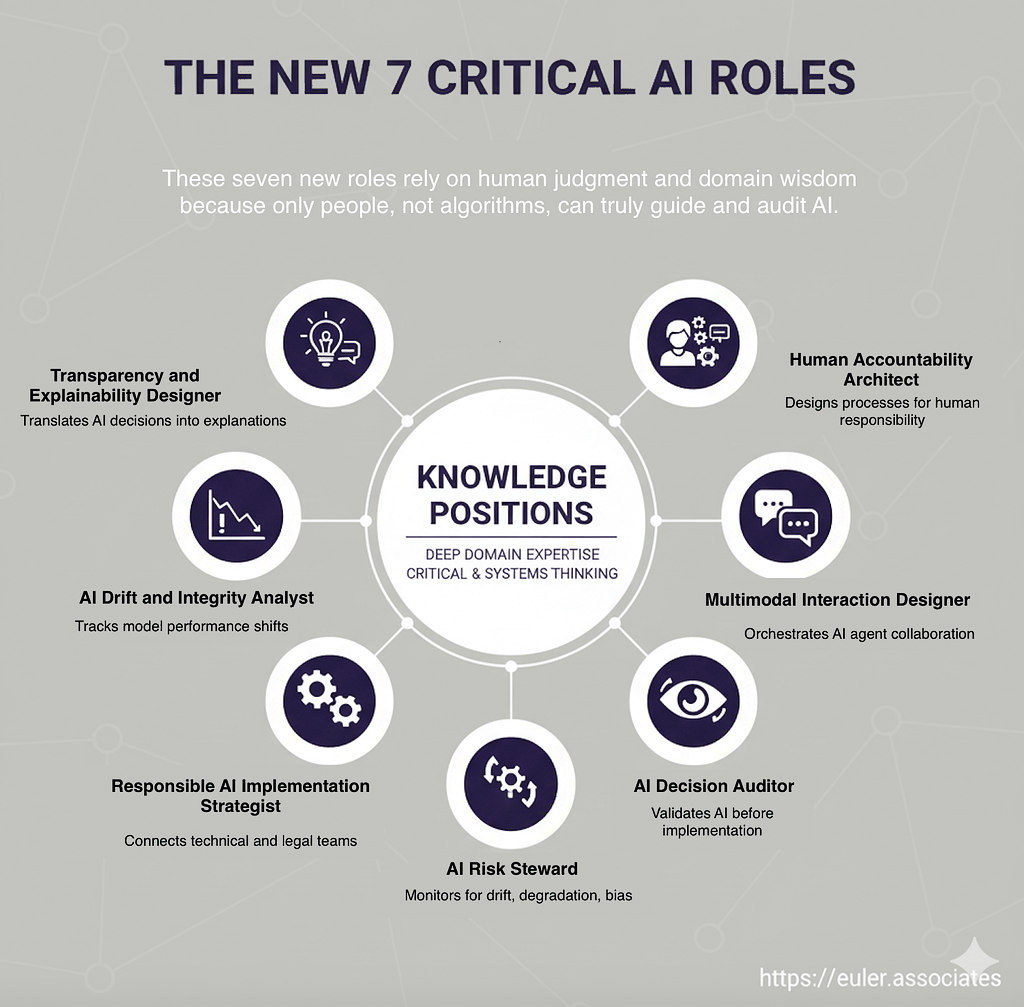
    Circular diagram showing 7 Critical AI Roles: AI Decision Auditor, Multimodal Interaction Designer, AI Risk Steward, Responsible AI Implementation Strategist, AI Drift and Integrity Analyst, Transparency and Explainability Designer, and Human Accountability Architect, all centered around ‘Knowledge Positions’ emphasizing deep domain expertise and critical systems thinking

    The cake you cannot fix

    I often explain responsible AI development through baking. If you bake a cake with salt instead of sugar, you cannot fix it afterwards. You have to start over.

    The metaphor lands because everyone understands irreversibility. Yet I keep meeting consulting firms and product teams, many in highly regulated sectors, who assume they can retrofit compliance later. Build fast, they say. Worry about transparency and accountability once the system works.

    They cannot.

    Most AI applications being developed today, especially those built on opaque foundation models with no visibility on data provenance, bias controls, or training processes, cannot be retrofitted to meet regulatory requirements. The EU AI Act does not allow you to add documentation, traceability, and human oversight as afterthoughts. These must be baked into the architecture from the beginning.

    The salt is already in the mixture. Organisations are only just beginning to taste it.

    The crisis in plain sight

    Whilst headlines obsess over which jobs AI will eliminate, something more consequential is happening. We are creating an entire ecosystem of AI systems with no one qualified to govern them: a recent study by Fluree shows that the average enterprise runs an 367 (!) SaaS apps, most of which have AI integrated.

    The issue isn’t that the technology is ungovernable, it’s that we’re not cultivating the expertise required to do the governing.

    Think about what deploying a high-risk AI system actually requires. You need someone who can question whether the training data reflects reality or bias. Someone who can challenge whether the optimisation function aligns with human values. Someone who can monitor whether a model performing at 95% accuracy today has quietly degraded. Someone who can explain to a regulator, or an affected citizen, why the algorithm made the decision it did.

    These are not technical problems. They are judgement problems.
    And judgement cannot be automated.

    Here is the paradox. AI has expertise without context. It can process patterns across vast datasets but cannot understand why or when that knowledge matters. It can identify correlations in historical hiring data but cannot tell you whether those correlations reflect meritocracy or structural discrimination. It can optimise for efficiency but cannot weigh the moral implications of sacrificing fairness to do so.

    That gap between machine capability and human judgement is where the most important work of the next decade will happen.

    The roles we are not creating

    This crisis is not theoretical. It is already creating demand for a new category of roles. Roles that do not just manage AI, but ensure it serves human values.

    Consider what Actor-Network Theory has long taught us. AI systems are not neutral tools. They are embedded in networks of human actors, institutional power structures, regulatory frameworks, and social values. Governing AI is not just about managing algorithms. It is about navigating these complex, interconnected systems.

    Seven distinct professional roles are emerging. Not technical positions requiring coding expertise. Knowledge positions requiring deep domain expertise, critical thinking, and systems thinking. The ability to see how changes in one part ripple through the whole.

    1. The AI Decision Auditor questions and validates AI before implementation. When a hiring algorithm rejects a candidate, someone must verify the logic was not simply reproducing historical discrimination. When a diagnostic tool recommends treatment, someone must ensure it did not hallucinate a correlation. The AI Act’s Article 14 requires human oversight for high-risk systems, but human oversight without the expertise to question is theatre, not governance.

    2. The Human Accountability Architect designs processes that preserve human responsibility even as systems become more autonomous. As multi-agent AI proliferates, accountability becomes genuinely unclear. Someone must ensure that when things fail, and they will, there is an answer to the regulator’s inevitable question. Who is responsible?

    3. The Multimodal Interaction Designer orchestrates how multiple AI agents collaborate with human oversight. Modern systems are ecosystems of agents, interfaces, and decision points that must work coherently. Article 13 requires transparency about how AI systems operate, but transparency means nothing if the experience is incomprehensible.

    4. The AI Risk Steward monitors systems for drift, degradation, and bias emergence. AI does not break loudly. It degrades quietly. Someone must watch for the silent erosion before damage compounds.

    5. The Responsible AI Implementation Strategist translates between technical teams, who build, and legal teams, who interpret, ensuring compliance is not theatre but embedded practice.

    6. The AI Drift and Integrity Analyst tracks model performance over time, identifying when systems produce unreliable results before regulatory audits discover the problem. Article 72’s post-market monitoring obligations assume someone is actually monitoring. Most organisations are not.

    7. The Transparency and Explainability Designer translates AI decision-making into understandable explanations. Technical accuracy means nothing if humans cannot comprehend it.

    This roles are innovative in this form, but not new. For instance, most commercial aircraft have sophisticated autopilot systems. They can handle take-off, maintain altitude, navigate routes, even land in certain conditions. Yet no airline would dream of removing the pilots from the cockpit. No passenger would board a flight knowing there was no one able to take the controls.

    Why? Because automation is not the same as autonomy.
    Because systems fail in unexpected ways. Because edge cases require human judgement. Because someone must remain responsible.

    AI systems are the same. These seven roles are the pilots in the cockpit. They do not fly the plane manually, but they remain essential. Monitoring, overriding when necessary, taking control when the automated systems encounter situations they were not designed to handle.

    These roles all require human judgement to check, guide, and refine AI outputs. They cannot be performed by AI itself. That would be asking the algorithm to audit the algorithm.

    The illusion of competence

    But the crisis runs deeper than a lack of roles. It is also about the erosion of expertise, and the dangerous illusion that anyone can govern AI.

    Consider the current enthusiasm for vibe coding. The idea that anyone can now build functional applications through natural language prompts, no programming knowledge required.

    There is truth here. Barriers have lowered. But there is also a dangerous fallacy. We are conflating the ability to generate code with the expertise to evaluate whether that code is fit for purpose.

    What happens when the AI hallucinates? When it generates plausible-looking code with subtle security vulnerabilities? When it optimises for the wrong objective because the prompt was not precise enough?

    The person with no coding expertise cannot spot these failures. They have outsourced not just the manual work of typing code, but the expertise required to recognise when the output is wrong.

    We are creating a generation seduced by the illusion of capability without competence.

    And what happens when the AI models disappear? Not because of some apocalyptic scenario, but simply because a service shuts down, a company pivots, a model becomes obsolete. If we have outsourced expertise to systems we do not understand, what knowledge remains?

    Our wetware, our brain, our lived experience, our ability to connect and contextualise knowledge, this is what makes us uniquely suited to ask the right questions for any given situation.

    That cannot be delegated. It can only be cultivated.

    Two hundred and fifty files

    Now let me tell you something that should keep every AI executive awake at night.

    Recent research by Anthropic, in partnership with the UK AI Safety Institute and the Alan Turing Institute, revealed that just 250 malicious files can compromise even the largest language models. A fraction so small, roughly 0.00016% of the training data, that it is effectively a rounding error.

    Models ranging from 600 million to 13 billion parameters, systems trained on datasets so vast they would take human lifetimes to read, can be poisoned by a rounding error’s worth of corrupted data.

    Data poisoning works by injecting malicious inputs, often indistinguishable from legitimate data, into a model’s training set. These inputs create hidden vulnerabilities like backdoors or biased outputs that only activate under specific conditions. A model might perform perfectly during testing, only to produce harmful outputs when it encounters a particular trigger phrase in production. Because the poisoning is subtle and the training datasets are vast, it evades detection until it is too late. By the time you discover the problem, the corruption is already baked into the model’s weights.

    The assumption that bigger model equals safer model has collapsed.

    And data poisoning is already happening. Adversarial actors are already exploiting these weaknesses. And most organisations deploying AI systems have no idea whether their training data has been compromised.

    For every interface your design team polishes, for every user experience your product team optimises, there is an invisible substrate of risk embedded in the data that feeds your AI. You can make the chatbot delightful. You cannot make it trustworthy if the foundation is poisoned.

    Training data hygiene matters far more than sheer computational scale. You can have billions of parameters and state-of-the-art architecture, but if 250 malicious documents made it into your training pipeline, you have built an expensive liability.

    And here is what makes this discovery so devastating for the retrofit compliance later crowd. You cannot audit what you cannot see. You cannot fix what was baked into the model’s weights during training.

    The salt is in the mixture. No amount of post-hoc filtering will extract it.

    This is precisely why the seven roles I have outlined are not optional enhancements. They are the minimum viable governance for responsible deployment. The AI Decision Auditor who can question whether an unexpected output reflects genuine intelligence or a dormant trigger phrase. The Human Accountability Architect who ensures someone can be held responsible when a poisoned model makes harmful decisions. The AI Risk Steward who monitors for the subtle drift that signals data degradation.

    Without these capabilities, you are deploying systems you cannot trust and defending against threats you cannot see.

    Trust, in this context, is earned through design, not assumed by default.

    The investment we are not making

    Yet here is the reality. We are not investing in the next generation who will fill these custodial roles.

    Organisations hesitate to hire junior staff because they expect roles to change. But that is precisely why we need them. What makes junior roles sustainable is not teaching people to use today’s tools. It is giving them solid theoretical and analytical grounding so they can adapt as tools evolve, challenge AI outputs with informed scepticism, and bring human judgement into the collaboration.

    And universities? They are still teaching AI ethics as an elective, not a core competency. The ability to audit an algorithm for bias or design an accountability framework should be as fundamental as calculus for engineers, as essential as anatomy for doctors. Or we risk graduating a generation of builders with no guardians.
    Instead, we are still producing graduates who can train neural networks but cannot explain why a model’s accuracy dropped, or what fair even means in the context of algorithmic decision-making.

    They certainly cannot identify the signs of data poisoning before it is too late.
    Schools must treat AI governance as a core competency, not an afterthought. Courses should cover:

    • How to challenge algorithms, not just build them. Questioning the assumptions embedded in training data and optimisation functions. Understanding when correlation is not causation, when efficiency creates injustice, when accuracy masks harm.
    • How to design accountability frameworks for sociotechnical systems. Grounded in both regulatory requirements like the AI Act and human-centred design principles. Students should graduate knowing how to trace decisions through complex systems, how to preserve human responsibility even as automation proliferates.
    • Ethics and scenario modelling as core competencies. The ability to anticipate second-order effects and unintended consequences. To ask not just “can we build this?” but “should we?” and “what happens when this fails?”
    • The distinction between legal compliance and moral responsibility. Between what systems can do and what they should do. Between meeting the letter of regulation and honouring the spirit of human dignity.
    • Systems thinking that recognises AI as part of complex networks. Involving human actors, institutional structures, and social contexts. How to conduct adversarial thinking, imagining how systems might be exploited and building defences before vulnerabilities are discovered in production.
    • Provenance tracking and dataset auditing as foundational skills. Not specialised techniques reserved for security teams, but basic competencies for anyone working with AI. If you cannot trace where your training data came from, you cannot trust what your model produces.
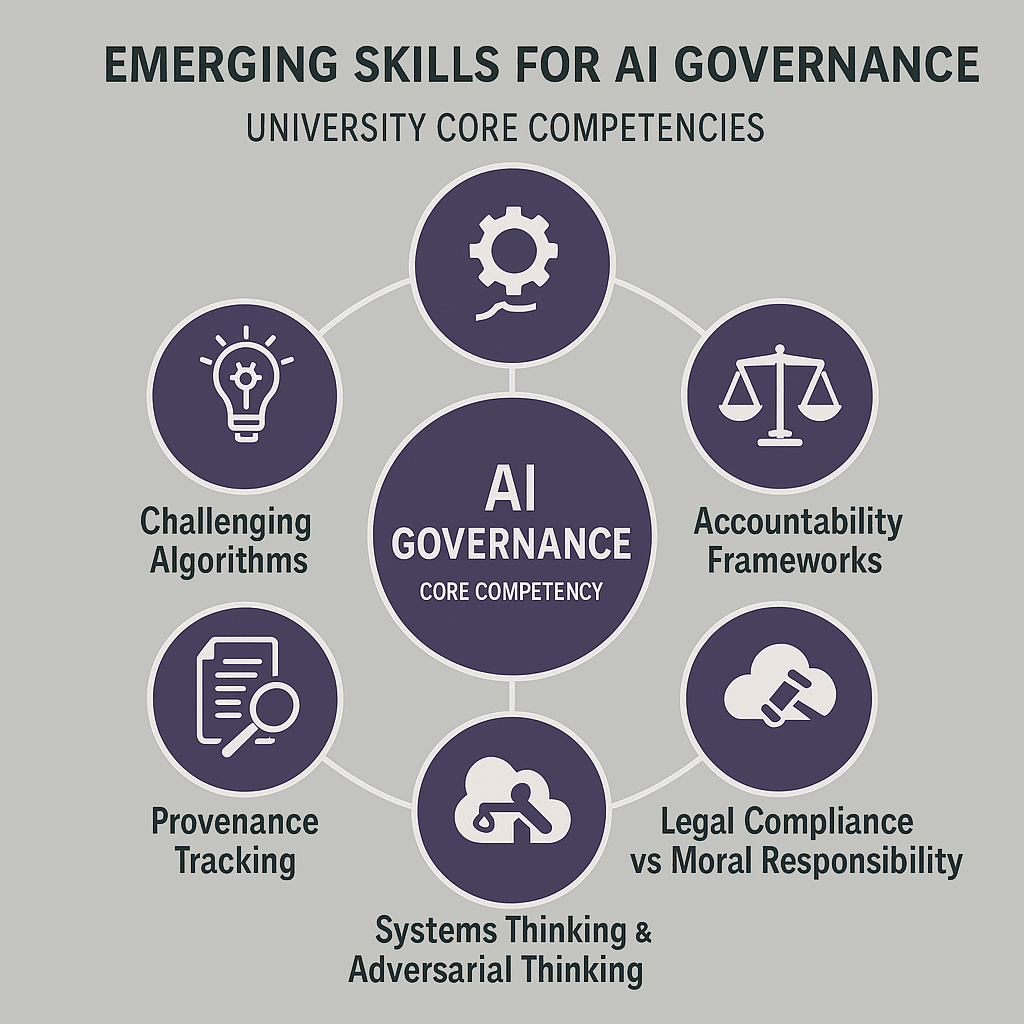
    Infographic titled “Emerging Skills for AI Governance: University Core Competencies.” At the center is a large purple circle labeled “AI Governance — Core Competency.” Six smaller purple circles surround it, each connected by white lines and paired with an icon. The six labeled skills are: “Challenging Algorithms,” “Accountability Frameworks,” “Ethics & Scenario Modelling,” “Systems Thinking & Adversarial Thinking,” “Legal Compliance vs Moral Responsibility,” and “Provenance Tracking.” The backg

    Sociotechnical systems theory reminds us that every technological system is also a social system. Shaped by power, policy, and human judgement. Building AI without recognising this is not innovation. It is amnesia.

    What makes us irreplaceable

    Historically, physical labour gave way to intellectual work. Intellectual work is now giving way to oversight and accountability. We are becoming the moral anchors of a machine-operated world.

    This pattern is not new. Every technological revolution creates categories of work that did not exist before. Not by eliminating human contribution, but by redefining what makes that contribution irreplaceable.

    Consider Mary Smith, the knocker-upper who woke factory workers each morning. The alarm clock eliminated her profession. But it did not eliminate the need for humans in the morning economy. It simply shifted where human judgement mattered.

    AI is following the same path. Machines make outputs. Humans must own outcomes.

    That is not poetic language. It is the legal and ethical line the AI Act draws.

    The question is not whether these roles will exist. They are already emerging, driven by regulatory pressure, operational necessity, and the simple reality that 250 poisoned files can compromise billions of parameters.

    The question is whether we will invest in developing the expertise to fill them before systems fail, reputations collapse, or regulators intervene.

    The choice before us

    So here we stand, at the intersection of human intelligence and artificial systems, facing a choice that organisations have not yet recognised as urgent.

    Build responsible AI from the ground up, or waste resources building systems that cannot comply with regulation and cannot be trusted with high-stakes decisions. Cultivate the next generation of AI custodians, or outsource our collective future to algorithms with no one qualified to question them.

    The future of responsible AI is not technical. It is human.

    It requires investing in roles that blend deep domain expertise with critical thinking. It requires recognising that governance is not overhead but foundation. It requires remembering what centuries of technological evolution have demonstrated. Machines amplify human choices. They do not render those choices irrelevant. They make them more consequential than ever.

    True innovation requires more than computational power. It demands wisdom.

    Where to start?

    If you are leading an organisation deploying AI systems, ask yourself these questions.

    • Who in your organisation can challenge an algorithm’s reasoning before it affects real people? Not describe how it works technically, but question whether it should work that way at all.
    • Who is responsible when your AI system degrades and no one notices until the damage compounds?
    • Who will explain to a regulator, or to a person denied credit, employment, or healthcare, why the algorithm made the decision it did?
    • Who can identify whether 250 malicious files have compromised your training data before you have deployed a billion-parameter liability into production?

    If you cannot answer these questions with names and capabilities, you do not have an AI strategy. You have an AI experiment unfolding in production with no one steering it.

    The seven roles outlined here are not future speculation. The AI Act has made them mandatory for high-risk systems. Market reality is making them essential for competitive advantage. And the simple mathematical fact that 0.00016% contamination can compromise the largest models has made them existentially urgent.

    The salt is in the mixture. The only question remaining is whether you will recognise it before you serve the cake, or after your customers taste it.

    The guardians we choose

    The future of AI is not just about what machines can do. It is about what humans must become. The custodians of context. The challengers of logic. The guardians of outcomes.

    Every algorithm carries within it the echoes of human decision-making. Our challenge is not to fear these technologies, but to consciously shape their ethical foundations. To invest in the people capable of doing that shaping.

    If your organisation is not creating these roles today, you are not just falling behind. You are building a ticking time bomb. Because when systems fail, and they will, no one will ask what the algorithm decided. They will ask who was responsible for letting it decide.

    The question is not whether you can afford to create these positions.

    It is whether you can afford not to.

    Consider the alarm clock that replaced Mary Smith’s profession. Not just a technological replacement, but a metaphor for human adaptability. Each technological shift does not eliminate human potential. It reshapes it.

    Our deepest innovations emerge not from machines, but from the human capacity to reimagine possibility.

    The future of AI will not belong to the coders alone.
    It will belong to the guardians we choose to train.


    First published in UX Collective on 17 November 2025.

  • When machines make outputs, humans must own outcomes

    When machines make outputs, humans must own outcomes

    The future of work in the age of AI and deepware.

    There is a photograph from 1930s East London that should be mandatory viewing for anyone anxious about AI taking their job. It shows Mary Smith, a “knocker-up” — a woman whose entire profession consisted of walking the streets at dawn, shooting dried peas at bedroom windows with a long bamboo pole to wake workers for their factory shifts.

    Photograph from 1930s showing Mary Smith, a “knocker-up,” wielding a bamboo pole with dried peas, shooting them at bedroom windows to wake factory workers.
    Mary Smith, a “knocker-up” in East London (1930s)

    Mary charged sixpence a week for this service. Then the alarm clock arrived, and Mary’s job vanished.

    Do we mourn the knocker-up today? Do we rage against the tyranny of the alarm clock? Of course not. Because what happened to Mary is what has happened throughout every technological revolution: certain tasks became obsolete whilst entirely new categories of work emerged.

    Yet here we are in 2025, gripped by the same ancient panic. AI is coming for our jobs, we are told. The robots will replace us. The future is bleak.

    Let me offer a different provocation: AI is not coming for your job. It is coming for your tasks. And if you cannot distinguish between the two, then yes — you should be worried.

    The evolution we refuse to see

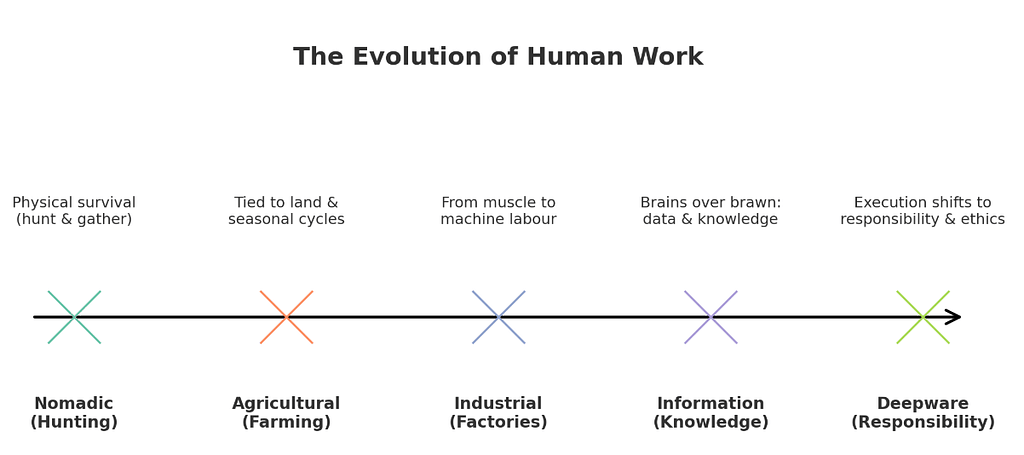
    Human work has always been in flux. In nomadic societies, we hunted and gathered. Agriculture tethered us to land and rhythms of seasons. Industrialisation moved us into factories, trading physical labour for wages. The information age shifted us again — this time from brawn to brain, from making things to managing data, information, and knowledge.

    Each transition has redefined not just what we do, but what remains uniquely human about work. We moved from physical exertion to cognitive processing. Now we have built what I call “deepware” — neural networks and machine learning systems layered atop our traditional software and hardware.
    These architectures can process, pattern-match, and produce at speeds we cannot fathom. Yet in our rush to innovate, we have convinced ourselves that deepware can carry the weight of responsibility our wetware — our human brains and nervous systems — seems increasingly willing to surrender. We are moving again, but this time the question is whether we are moving forward or simply moving away.
    Because this time, the shift is not from physical to mental. It is from execution to responsibility.

    A horizontal timeline infographic titled “The Evolution of Human Work.” It shows five large coloured circles connected by a black arrow, each representing a stage of labor. Nomadic (Hunting): “Physical survival, hunt and gather.” Agricultural (Farming): “Tied to land and seasonal cycles.” Industrial (Factories): “From muscle to machine labour.” Information (Knowledge): “Brains over brawn: data and knowledge.” Deepware (Responsibility): “Execution shifts to responsibility and ethics.”
    The evolution of work, from hunting to responsibility.

    As Arvind Narayanan at Princeton observes, jobs are not monolithic entities. They are bundles of tasks. Some tasks are routine and susceptible to automation. Others require distinctly human qualities: judgement, ethics, accountability, wisdom.

    The question is not whether AI can perform tasks. It demonstrably can, often better than we can. The question is who takes responsibility when those tasks produce consequences in the real world.

    Outputs are not outcomes

    This distinction matters more than most organisations realise.

    Output is what a process produces. Code. Copy. Designs. Legal briefs. Medical recommendations. Outputs are the tangible results of a system executing its programmed or prescribed function — the direct product of following steps, rules, or algorithms. The term emerged in the industrial era, literally describing the quantity of coal or iron a mine could extract in a given period. Output depends entirely on the efficiency and capability of the process that generates it.

    Outcome is what happens when that output meets reality. An outcome requires context, interpretation, application, and crucially — intentionality. Outcomes demand understanding not just what was produced, but why it matters, who it affects, and what consequences ripple from it. Where outputs measure productivity, outcomes measure impact. They are the ultimate change or consequence that results from applying an output with purpose and judgment.
    AI can generate outputs. It cannot, however, create outcomes. Because outcomes require something deepware fundamentally lacks: the wetware capacity for responsibility.

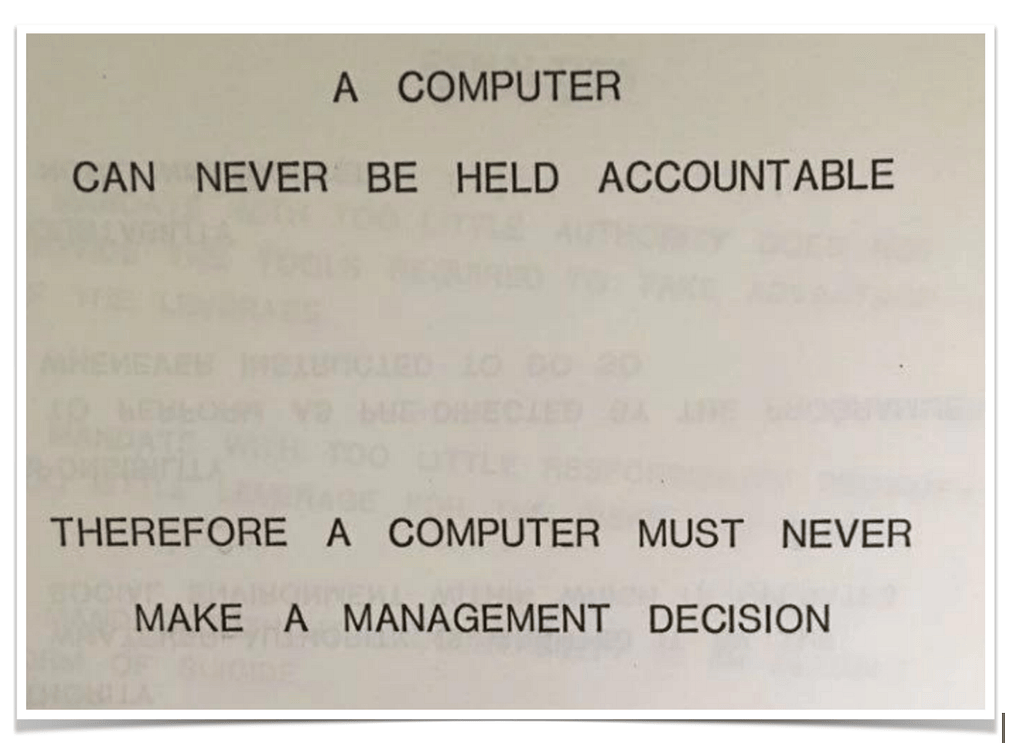
    Computers cannot be held accountable, as IBM recognised in 1979. That truth has not changed. What has changed is our willingness to pretend otherwise.

    IBM’s note stating: A computer can never be held accountable. Therefore a computer must never make a management decision.
    IBM note, 1979

    The accountability vacuum

    We have already seen the cost of this pretension. A lawyer in the US submitted AI-generated briefs filled with fabricated cases. A trial in Australia was delayed because no one verified the AI’s outputs. These were not technological failures — these were failures of human responsibility.

    When a professional says “the AI recommended it,” they are engaging in the same moral abdication as someone saying “I was just following orders.” Both statements attempt to transfer accountability to something — or someone — incapable of bearing it.

    This is the dangerous seduction of deepware: it offers us the illusion that we can delegate not just tasks, but responsibility itself.

    We cannot. We must not.

    The future of work, then, is not about humans competing with AI for task execution. It is about humans stepping into roles where we exercise oversight, judgement, and accountability over the outputs that AI produces. This is not replacement. This is elevation.

    But only if we prepare for it.

    The skills deepware cannot replicate

    Here is what the regulations already understand, even if organisations do not: responsible AI demands responsible humans.
    The EU AI Act mandates human oversight, transparency in decision-making, and clear accountability chains. Not as bureaucratic burden, but as fundamental safeguard.

    Because here is the uncomfortable truth about deepware: it learns from historical data, which means it perpetuates historical biases.

    Amazon’s recruitment algorithm discriminated against women. Workday’s hiring system did the same with 40+ candidates. MIT research found that AI healthcare systems told female patients they were more likely to “manage illness at home”. Judicial algorithms found Black defendants more culpable.

    These are not glitches. These are features of systems trained on data that encoded decades of invisible discrimination.

    So when we talk about the future of work, we are really talking about the future capacity of humans to think critically about the machines we build. To question their outputs. To interrogate their processes. To identify bias. To imagine consequences. To demand better.

    This requires a different skill set entirely:

    Critical thinking: the ability to evaluate claims, identify assumptions, and distinguish correlation from causation.

    Systems thinking: understanding how components interact, how changes ripple, how second and third-order effects emerge.

    Lateral thinking: seeing connections across domains, applying insights from one context to another.

    Scenario planning: running mental simulations of possible futures, stress-testing decisions before implementation.

    Consequence thinking: asking not just “can we?” but “should we?” and “then what?”

    Notice what these skills have in common. They are uniquely human. They require wetware that is fully engaged, not atrophied from disuse.

    The extension that could replace us

    Marshall McLuhan wrote in 1967 that “all technologies are extensions of our physical and nervous systems to increase power and speed.”
    The wheel extended our legs. The telescope extended our eyes. Now deepware extends our cognitive capacity.

    But here is McLuhan’s warning, implicit in every page: when an extension becomes too powerful, we risk forgetting the limb it was meant to serve. We outsource function, and eventually, capability atrophies.

    Consider the calculator. Brilliant tool. But an entire generation now cannot perform basic arithmetic without one. The extension has replaced the skill.

    Now scale that to deepware. If we allow AI to think for us — to analyse, to recommend, to decide — without maintaining our own capacity to audit and override, we risk something far more dangerous than job loss. We risk becoming obsolete not because machines replaced us, but because we voluntarily stepped aside.

    The choice that defines the next era

    The future of work is not a future without humans. It is a future where humans do fundamentally different work: the work of being responsible.

    This means verification before deployment. Critical thinking over speed. Systems thinking over isolated innovation. Accountability at every level.

    It means training a generation not just to prompt AI, but to interrogate it. Not just to deploy models, but to govern them. Not just to consume outputs, but to construct meaningful outcomes.

    It means recognising that as our deepware grows more sophisticated, our wetware must grow more rigorous. Every layer of AI we add demands an exponential increase in human oversight.

    This is not optional. This is existential.

    Mary Smith lost her job when the alarm clock arrived. But she did not lose her capacity for work — she adapted. Her children worked in offices, not on streets. Her grandchildren worked in roles she could never have imagined.

    The same will be true for us, but only if we make a conscious choice: to remain conscious. To refuse the abdication of responsibility that deepware makes so seductively easy. To recognise that outcomes require human judgement in ways that outputs never will.

    Our wetware remains the most sophisticated technology we possess. In the age of deepware, it is also the only thing preventing a future where machines own not just our code, but our agency.

    The next time someone shows you what AI can do, we need to ask them something more important: who is responsible when it goes wrong?

    Because in the end, the future of work depends not on what machines can produce, but on whether humans remember that we, and only we, can be held accountable for what happens next.

    For a deeper exploration of the deepware-wetware framework and why responsible AI fundamentally depends on active human cognition, read: When Deepware meets Wetware: the uncomfortable truth about responsible AI


    First published in UX Collective on 30 September 2025.

  • When Deepware meets Wetware: the uncomfortable truth about responsible AI

    When Deepware meets Wetware: the uncomfortable truth about responsible AI

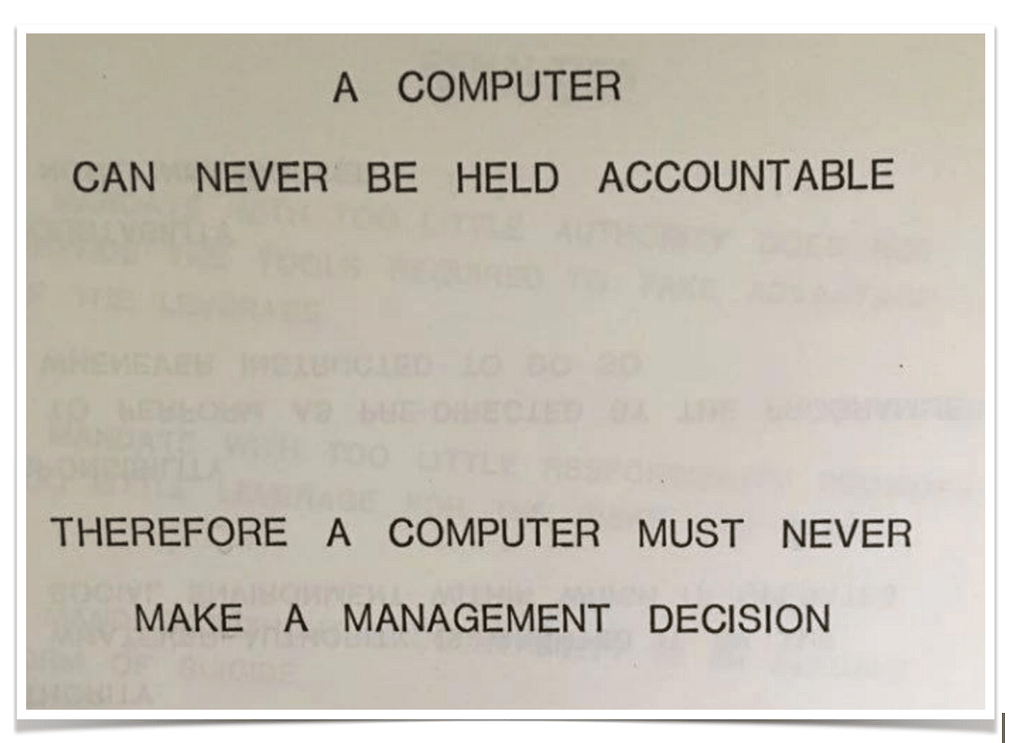
    There is a memo from IBM dated 1979 that should be mandatory reading for every CEO racing to deploy AI. It states simply and profoundly: machines cannot be responsible.

    IBM 1979’s note saying: “A computer can never be held accountable. Therefore a computer must never make a management decision.”
    IBM note, 1979

    Fifty three years later, we have built what I call “deepware” — the layered neural architectures of AI and machine learning that sit atop our traditional software and hardware stack. Yet somehow in our breathless rush to innovation we have convinced ourselves that this deepware can shoulder the burden of responsibility that our wetware — our human brains — seems increasingly eager to abandon.

    Let me be clear: responsible AI does not start with better algorithms or more data. It starts with humans who remember how to think.

    The four layers of our digital reality

    We have always understood technology through layers. Hardware provides the physical substrate. Software gives us the instructions and logic. But now we have added deepware — these probabilistic, pattern matching systems that generate increasingly convincing simulacra of intelligence.

    The critical layer though remains wetware: the human brain, with its capacity for judgement, ethics and crucially responsibility. Yet this is precisely the layer we are systematically deactivating in our AI deployments.

    Consider the lawyer who recently submitted AI generated legal briefs to court, complete with fabricated cases and fictional precedents (Morgan 2025). Or the Melbourne trial delayed because no one verified the AI outputs (Editorji 2025). These are not stories about technological failure. They are stories about wetware choosing to go offline at the exact moment it is most needed.

    The 7% that reveals everything

    MIT research recently exposed something chilling: when identical medical symptoms are presented to AI healthcare systems, female patients are 7%more likely to be told to “manage at home” (MIT 2025). Add a typo, use uncertain language like “maybe”, format your message imperfectly — and the deepware decides you deserve less care.

    This is not a bug in the deepware. It is a feature of how we have trained it. Our wetware, in its rush to deploy, forgot to ask critical questions: Whose patterns are we matching? Whose biases are we encoding? Whose voices are we amplifying or silencing?

    The deepware is doing exactly what we programmed it to do: replicating patterns from data. The failure lies in our wetware’s abdication of its responsibility to think critically about what patterns we choose to perpetuate.

    The 11.8 billion pound illusion

    The United Kingdom’s AI industry contributes £11.8 billion to the economy, growing 150 times faster than traditional sectors (UK AI Sector Study 2024). Yet here is the paradox that should keep every executive awake: 95% of generative AI investments are producing no measurable value (MIT Project NANDA 2025).

    How is this possible? Because we have confused deploying deepware with thinking. We have mistaken automation for intelligence. We have treated AI as a substitute for human judgement rather than a tool that requires even more rigorous human oversight.

    The organisations seeing real returns? They are the ones where wetware remains fully engaged — where humans apply critical thinking, systems thinking and what I call “consequence thinking” to every AI deployment. They understand that deepware without active wetware is just expensive pattern matching.

    The shadow economy of human intelligence

    While corporations pour billions into generative AI initiatives that fail, something fascinating is happening in the shadows: employees are independently using consumer AI tools to achieve real productivity gains (MIT Project NANDA 2025). The difference? Personal accountability.

    When an individual uses ChatGPT to help write an email, they remain responsible for the output. They verify, they edit, they think. Their wetware stays online because they know their name is attached to the result.

    But when organisations deploy AI at scale, something strange happens. Responsibility becomes diffused. “The AI recommended it” becomes the new “I was just following orders.” We have created systems where no human feels accountable for what the deepware produces.

    Going slow to go fast

    There is wisdom in the observation that sometimes we need to “go slow to go fast”. In our current AI gold rush, we are doing the opposite — going fast to go nowhere.
    We are deploying first, thinking later if at all, and then acting surprised when our deepware amplifies every bias, mistake and oversight we failed to catch.

    Real innovation in AI is not about being first to market. It is about being first to understand the systemic consequences of what we are building. It requires wetware that is fully engaged in both critical thinking and systems thinking, understanding not just what AI can do, but what it should do, and more importantly, what it absolutely should not do.

    The great abdication

    What we are witnessing is not technological revolution; it is responsibility abdication. CEOs chase innovation metrics while ignoring impact assessments.
    Developers optimise for speed while overlooking safety.
    Organisations celebrate deployment velocity while their wetware atrophies from disuse.

    The simple truth is this: when professionals who should know better skip basic verification, when medical systems encode bias without oversight, when legal documents get submitted without review — we are not seeing AI failure. We are seeing human systems in collapse.

    The responsibility stack

    Here is what nobody wants to admit: as our technology stack grows more complex, our responsibility stack must grow more robust. Every layer of deepware we add requires an exponential increase in wetware engagement.

    Think of it this way:

    • Hardware requires responsibility for physical safety and environmental impact
    • Software requires responsibility for functionality and security
    • Deepware requires responsibility for bias, fairness, and societal impact
    • Wetware must orchestrate responsibility across all layers

    We cannot delegate ethics to algorithms. We cannot outsource judgement to models. We cannot transfer accountability to machines that, as IBM reminded us in 1979, cannot be responsible.

    The path forward: reactivating human intelligence

    The solution is not to slow AI development. The solution is to reactivate our wetware and practice responsible AI by following regulations like the AI Act that recommend that human oversight is not optional; it is essential.

    This means:

    • Verification before deployment: every AI output requires human review
    • Critical thinking over speed: better to be right than first
    • Systems thinking over isolated innovation: understanding ripple effects before creating them
    • Accountability at every level: from the developer to the CEO, everyone owns the outcomes

    The choice that defines our future

    We stand at a crossroads. Down one path lies the continued abdication of human responsibility, where we blame algorithms for our biases, hide behind AI for our decisions, and gradually forget how to think critically about the world we are creating.

    Down the other path lies something more challenging but infinitely more valuable: a future where deepware amplifies human intelligence rather than replacing it, where AI serves as a tool for enhanced thinking rather than an excuse for not thinking at all.

    The uncomfortable truth is that responsible AI has nothing to do with making machines more responsible. It has everything to do with humans remembering that they are and must remain the responsible party in every equation.

    Your wetware is the most sophisticated technology you possess.
    In the age of deepware, it is also the most important.
    The question is not whether AI will transform our world — it will.
    The question is whether we will remain conscious, critical, and responsible enough to guide that transformation.

    The next time someone tells you about their AI initiative, ask them not about the technology, but about the humans: Who is thinking? Who is verifying? Who is responsible?

    Because in the end, no matter how deep our deepware becomes, it is the wetware that determines whether we are building a future worth living in.


    First published in The Startup on 10 September 2025.